


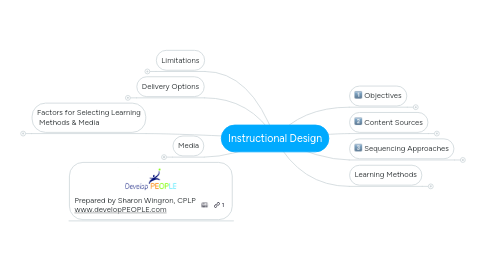
1. Media
1.1. PowerPoint
1.2. Video
1.3. Music
1.4. Flipcharts
1.5. Participant Guides
1.6. Handouts/Worksheets
1.7. Pictures
1.8. Technology Options
1.8.1. Webinar
1.8.2. Conference Calls
1.8.3. Tweeting/Twitter
1.8.4. Online Chat
1.8.5. Who Knows What's Next?!?
2. Factors for Selecting Learning Methods & Media
2.1. Audience
2.2. Intended Outcome
2.3. Type of Content
2.4. Time of Day
2.5. Time Available
2.6. Room Size & Shape
2.7. Number of Participants
2.8. Equipment Available
2.9. Space Available
2.10. Activity Sequence
2.11. Trainer Comfort & Knowledge
3. Delivery Options
3.1. On-the-job Training
3.2. One-on-One Instruction
3.3. Classroom
3.4. Synchronous online
3.5. Asynchronous online
3.6. Blended Learning
3.7. Informal Learning
4. Limitations
4.1. Learning Objectives
4.2. Money
4.3. Time to Prepare
4.4. Time to Deliver
4.5. Expertise
4.6. Physical Space AVailable
5. Prepared by Sharon Wingron, CPLP www.developPEOPLE.com
6. Objectives
6.1. What
6.1.1. Knowledge
6.1.2. Skills
6.1.3. Attitudes
6.2. What Level
6.2.1. Knowledge
6.2.2. Comprehension
6.2.3. Application
6.2.4. Analysis
6.2.5. Synthesis
6.2.6. Evaluation
7. Content Sources
7.1. Subject Matter Experts (SMEs)
7.2. Books
7.3. Policies
7.4. Regulations
7.5. Company Procedures
7.6. Product Descriptions
7.7. Equipment Manufacturers
7.8. IT Systems Providers
7.9. Off-the-Shelf programs
7.10. Trainer's Own Experience
8. Sequencing Approaches
8.1. Step-by-Step
8.2. Priority
8.3. Logical Timing
8.4. Broad to Specific
8.5. Experiential to Lecture
8.6. Easy to Difficult
8.7. Safe to More Risky
8.8. Foundational to Advanced
8.9. Concept to Application
9. Learning Methods
9.1. Presentations
9.1.1. Panels
9.1.2. Lecturettes
9.1.3. Debates
9.1.4. Guided Note-Taking
9.1.5. Storytelling
9.1.6. Tours
9.2. Polling
9.2.1. Stand Up, Sit Down
9.2.2. Show of Hands
9.2.3. Online Poll
9.2.4. PollEverywhere
9.3. Art
9.3.1. Draw on Tote Bag
9.3.2. T-Shirt Slogan
9.3.3. Posters
9.3.4. Portraits
9.3.5. Cartoons
9.3.6. Day in the Life
9.3.7. Draw a Logo
9.3.8. Skits
9.4. Demonstrations
9.4.1. Instructor Role-Play
9.4.2. Field Trips
9.4.3. videos
9.4.4. DVDs
9.4.5. clips from movies
9.4.6. Magic Tricks
9.4.7. Coaching
9.4.8. Props
9.4.9. Fishbowl
9.4.10. Improvisation
9.4.11. How I'd Handle It
9.5. Discussions
9.5.1. Large Group
9.5.2. Table Group
9.5.3. Small Group
9.5.4. Partner
9.5.5. Triad
9.5.6. Interviews
9.5.7. Expert Panels
9.5.8. Q&A with Executives
9.5.9. Leaders Teaching Leaders
9.5.10. Buzz Groups
9.5.11. Neighbor Discussion
9.5.12. Round Robins
9.5.13. Brainstorming
9.5.14. Develop a theory
9.6. Games
9.6.1. Word Search
9.6.2. Bingo
9.6.3. Scavenger Hunt
9.6.4. Jeopardy
9.6.5. Crossword Puzzles
9.6.6. Relay Race
9.6.7. Card Games
9.6.8. Computer Games
9.6.9. Simulations
9.6.10. Board Games
9.6.11. Game Show Adaptations
9.6.12. Icebreakers
9.7. Reading
9.7.1. Pre-work Reading
9.7.2. InfoLines
9.7.3. Letters
9.7.4. Story Starters
9.7.5. Internet Research
9.7.6. Handouts
9.7.7. Job Aids
9.7.8. Names & Notions to Know
9.8. Case Studies
9.8.1. Job Case Studies
9.8.2. Challenging Situations
9.8.3. In-Baskets
9.8.4. Critical Incidents
9.8.5. Problem-Solving Clinic
9.8.6. Role Plays
9.9. Experiential
9.9.1. Jigsaw
9.9.2. Skill Centers
9.9.3. Teaching Teams
9.9.4. Self-Analysis & Reflection
9.9.5. Research
9.9.6. Skill Practice
9.9.7. On the Job Activities
9.9.8. Shadowing