

1. Sanguine (red-heart)
2. Incongruence can lead to maladjustment
3. Melancholic (black-liver)
4. Historical Perspective
4.1. Franz Gall
4.1.1. Proposed that: distance betweenbumpson the skull reveal personal traits
4.1.1.1. Phrenology
4.2. Hippocrates
4.2.1. Human behaviors are based on4temperaments
4.2.1.1. Choleric (yellow-liver)
5. We experience incongruence when thereisadiscrepancy between our ideal andattitude
6. Rationalization
7. Regression
8. PsychodynamicPerspectiveFreud
8.1. Stages of Psychosexual Development
8.1.1. Oral 0-1
8.1.2. Anal 1-3
8.1.3. Phallic (genitals) 3-6
8.1.4. Latency (None) 6-12
8.1.5. Genital 12+
8.2. Unconscious
8.2.1. EGO
8.2.1.1. Id & Superego
8.3. Defense Mechanisms
8.3.1. Denial
8.3.2. Displacement
8.3.2.1. Low: uncooperative
8.3.3. Projection
8.3.4. Reaction Formation
8.3.5. Repression
8.3.6. Sublimation
9. Individual Psychology
10. Neo-Freudians
10.1. Adler
10.1.1. Social tasks
10.1.1.1. Occupational tasks
10.1.1.2. Societal tasks
10.1.1.3. Love tasks
10.1.2. Inferiority complex
10.1.3. Superiority complex
10.2. Erikson
10.2.1. Interpersonal relationships are more important tnat sexual energy
10.2.2. Personality is developed throught your life
10.2.3. Stages of Psychosocial crisis
10.2.3.1. autonomy vs. shame (will) 1-3
10.2.3.2. initiative vs. guilt (purpose) 3-5
10.2.3.2.1. industry vs. inferiority (competency) 5-12
10.2.3.2.2. identity vs. role confusion (fidelity) 12-18
10.2.3.3. intimacy vs. isolation (love) 18-40
10.2.3.4. generativity vs. stagnation (care) 40-65
10.2.3.5. Ego integrity vs. despair (wisdom) 65+
10.3. Jung
10.3.1. The collective unconscious is a universal version of the unconscious.
10.3.1.1. Mental patterns or memory traces
10.3.1.1.1. These acestral memories are called archetypes
10.3.2. 2 attitudes or approaches towards life
10.3.2.1. extroversion
10.3.2.2. introversion
10.3.2.3. The focus of analytical pshycology is on working to balance opposing forces of conscius and unconscious thought and experience within one´s personality.
10.4. Horney
10.4.1. Copying styles
10.4.1.1. Moving towards people
10.4.1.1.1. Afiliation and dependence
10.4.1.2. Moving against people
10.4.1.2.1. Agression and manipulation
10.4.1.3. Moving away from people
10.4.1.3.1. Detachment and isolation
10.4.2. Each individual has the potential forself-realization.
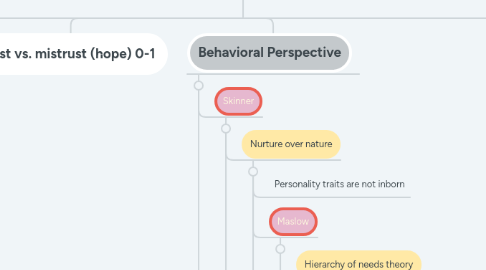
11. trust vs. mistrust (hope) 0-1
12. Behavioral Perspective
12.1. Skinner
12.1.1. Nurture over nature
12.1.1.1. Personality traits are not inborn
12.1.1.2. Maslow
12.1.1.2.1. Hierarchy of needs theory
12.1.1.3. Behave on prior learning
12.1.2. Behave in a certain way
12.1.2.1. Theory of birth order
12.1.2.1.1. The middle ones will help both get along.
12.1.2.1.2. The youngest will be spoiled.
12.1.2.2. Personality develops over our entire life not only the first few years
12.1.2.3. Increasing the ones that lead to positive results
12.2. Bandura (social-cognitive)
12.2.1. Reciprocal Determinism
12.2.2. Observational Learning
12.2.2.1. Personality is shaped by actions
12.2.3. Learning new behavior patterns when we see others performing them.
12.2.4. Decrease the ones that don´t
12.2.5. Self-Efficacy
13. Our level of confidence in our abilities to approach challenges and reach goals.
14. HIgh congruence leads to greater sense of healthy andproductive life
15. Humanistic Approaches
15.1. Carl Rogers
15.1.1. Divided the self
15.1.1.1. Ideal: the person you would like to be
15.1.1.2. Real: the person you actually are
15.1.2. We experience congruence when our thoughts about our real and ideal self are similar
16. Twins even when they are separated they have pretty similar personalities.
17. Biological Approaches
17.1. Minessota
17.2. Somatoypes
17.2.1. Endomorph
17.2.1.1. Average-size bones, solid torso, low levels of fat, very sociable and fun
17.2.2. Mesomorph
17.2.2.1. Equilibrates body of muscles and bones, athletic. Very energetic and like sports
17.2.3. Ectomorph
17.2.3.1. Tall, thin. Very emotional, suffer social problems
18. Traits Approach
18.1. The Five Factor Model (OCEAN)
18.1.1. Oppennes
18.1.1.1. High: curious, independent.
18.1.1.2. Low: practical, conventional
18.1.2. Conscientiousness:
18.1.2.1. High: hardworking, organized
18.1.2.2. Low: impulsive, careless
18.1.3. Extroversions
18.1.3.1. High: outgoing, warm
18.1.3.2. Low: quite, reserved
18.1.4. Agreebleness
18.1.4.1. High: helpful, empathetic
18.1.5. Neuroticism
18.1.5.1. High: anxious, unhappy
18.1.5.2. Low: calm, secure
19. Cultural Understanding
19.1. Universal
19.1.1. Some personality traits dont depend on culture.
19.2. Culture-specific
19.2.1. Asian: collectivism
19.2.2. Central & South American: openness
19.2.3. European: neuroticism
19.3. Study Approaches
19.3.1. Cultural-comparative
19.3.2. Combines