
Getting Writer’s Block? Here Are 21 Ways To Find Inspiration For Your Next Story


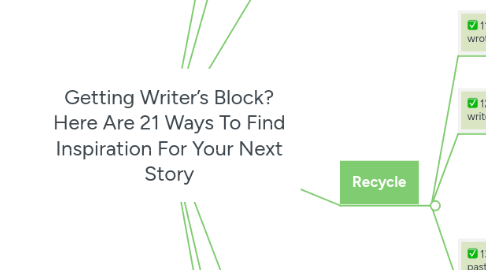
1. Answer a Question
1.1. 1. Any answer you give to someone verbally
1.1.1. If it is insightful and useful to the other person, chances are it probably is interesting for your audience too.
1.2. 2. Write about a great answer someone gave you
1.2.1. If you receive great advice from someone, pass it along to your readers!
1.3. 3. Answer a question from your audience
1.4. 4. Browse Quora for questions to answer
1.4.1. If your answer is in long format, consider moving it over as a Medium story.
2. Be Aware
2.1. 5. Pay attention to your conversations
2.1.1. Be a good listener
2.1.2. Try to genuinely get what the other person is saying and take mental notes on the key points of a conversation.
2.1.3. Even in regular conversations, a good topic comes up that’s worth writing about.
2.2. 6. Listen to other people’s conversations
2.2.1. Sometimes you overhear people talking and you make up your own opinion on the subject in your head.
2.2.2. Articles with multiple points of views make for interesting stories
2.3. 7. Just pause and look around you
2.3.1. There’s something inspiring about watching other people do things, or gazing at nature.
3. Consume Quality Content
3.1. 8. Read books on the topics you write about
3.1.1. Chances are, almost everything you highlight in a book is a good topic for a Medium story.
3.2. 9. Listen to podcasts on the topics you write about
3.2.1. Follow Tim Ferriss
3.2.2. Follow Aleesha Lauray and MR. Molly Maguire and their podcast for the On The Rise publication
3.3. 10. Start with a quote
3.3.1. Whenever you read a story that has a quote that inspires you, write in down in my quotes collection.
3.3.2. They are good starting points for a story.
4. Recycle
4.1. 11. Re-write an older story you previously wrote
4.1.1. Try to come up with a different perspective and with new ideas on the subject
4.1.2. Get the story packaged in a different, and more interesting way.
4.2. 12. Write on a topic you read from another writer
4.2.1. Read and get inspired by stories of others
4.3. 13. Talk about a relatable story from your past
4.3.1. Did you grow up in a weird/different family context?
4.3.2. How was high school?
4.3.3. How was going to college?
4.3.4. How was your first date?
4.3.5. Your first kiss?
4.3.6. Your first job?
5. Do Things
5.1. 14. Attend events
5.1.1. Find events on:
5.1.1.1. meetup.com
5.1.1.2. Couchsurfing
5.1.2. When you attend events, both the topic and the people you meet will inspire you to write.
5.2. 15. Practice physical activities
5.2.1. Physical activity is a hot topic and many people are looking for new things to try all the time.
5.3. 16. Travel
5.3.1. Your travel stories could resonate with a lot of other travellers.
5.3.2. By the nature of it, traveling tends to be quite eventful.
6. Educate
6.1. 17. Give your top tips on things you’re good at
6.1.1. These stories tend to do really good.
6.2. 18. Talk about things that worked and things that didn’t work for you
6.2.1. It’s personal, emotional and shows your vulnerable side. Readers love that.
6.3. 19. Talk about your hard skills
6.3.1. You don’t have to be the best in the world at it
6.3.2. Be honest, and give your best advice, with no pretence that your tips are the best in the world.
7. Cheating
7.1. 20. Listicles just work
7.1.1. Listicles tend to do much better than the rest because they tend to be bite-sized and easy to read.
7.2. 21. Quotes are powerful
7.2.1. Assemble a series of related quotes and write a story around them.
7.2.2. People smarter than us have written smarter things than us, take advantage of this.