


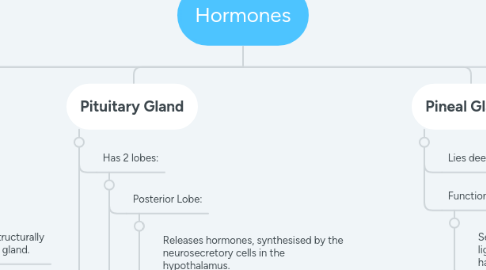
1. Features
1.1. They are Intercellular communication molecules secreted by endocrine cells.
1.2. They are distributed by blood.
1.3. Hormone receptor=>Protein that transducer de hormonal signal, cells with those receptors are the target's cells.
1.4. There are 2 types: Amino-Acids and Cholesterol.
1.5. Some hormones can't be released, so they entered to a Second Messenger.
2. Hypothalamus
2.1. Function:
2.1.1. Control de internal environment.
2.1.2. Is in the forebrain and connects structurally and functionally with the pituitary gland.
2.1.3. Produces inhibiting hormones, that discourage their target cells from secreting a hormone.
3. Pituitary Gland
3.1. Has 2 lobes:
3.1.1. Posterior Lobe:
3.1.1.1. Releases hormones, synthesised by the neurosecretory cells in the hypothalamus.
3.1.1.2. Function:
3.1.1.2.1. Synthesizes peptide hormones that are transported along the axons to the posterior pituitary lobe.
3.1.1.2.2. An action potential triggers the axons to release the hormones into the blood.
3.1.1.3. Hormones that produces:
3.1.1.3.1. Oxytocin: Targets cells of Smooth muscle and cause uterine contractions.
3.1.1.3.2. Antydrunetic Hormone: Reduces urine output and targets Kidney cells.
3.1.2. Anterior Lobe:
3.1.2.1. Synthesizes its own hormones but releases them in response to hormones produced in the hypothalamus
3.1.2.2. Function:
3.1.2.2.1. Makes peptide hormones and secretes them in response to hormones by the hypothalamus.
3.1.2.3. Produces 6 hormones:
3.1.2.3.1. Adrenocorticotropic hormone
3.1.2.3.2. Thyroid-stimulating hormone
3.1.2.3.3. Follicle-stimulating hormone
3.1.2.3.4. Luteinizing Hormone
3.1.2.3.5. Prolactin=>Breast development at puberty
3.1.2.3.6. Growth Hormone=>Affects targets cells throughout the body, some disorders can be caused for a tumor in the pituitary gland.
3.2. Neurosecretory cells:
3.2.1. Are neurons that responds to an action, by releasing hormones in the blood.
4. Pineal Gland
4.1. Lies deep inside the brain.
4.2. Function:
4.2.1. Secretes the hormone melatonin, needs low light and dark contractions, if this no happened, the production will be slow.
4.2.2. Melatonin: Helps regulate human sleep-wake cycles and increases drowsiness and a drop in body temperature.
5. Thyroid and ParaThyroid glands
5.1. The Thyroid is in the base of the neck.
5.2. Secretes 2 iodine-containing molecules.
5.2.1. Trilodothyrone
5.2.2. Thyroxine