

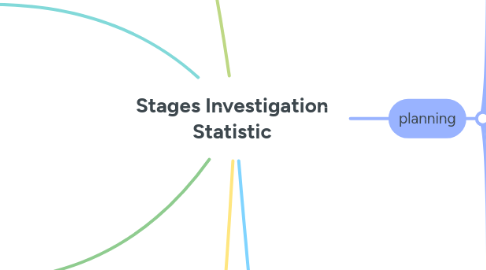
1. planning
1.1. Purpose or Object of the researching
1.1.1. Fact or phenomenon that we are going to observe and record numerically
1.1.1.1. Define the object or purpose of the researching
1.1.1.2. Determine its nature quantitative and qualitative
1.1.1.3. Determine the possibility of their researching
1.1.1.4. Limiting the object of investigation
1.1.1.4.1. Limiting the field of the researching
1.1.1.4.2. Limiting the object to be investigated
1.2. source of information
1.2.1. Direct (primary)
1.2.1.1. It is there where the fact economic occurs
1.2.2. Indirect (secondary)
1.2.2.1. It is where the fact is manifested indirectly, where it is reflecteda
1.3. procedures
1.3.1. They should show clarity and advertising, simplicity and utility
1.3.2. Continued research
1.3.2.1. The statistical moment is all
1.3.3. Researching Periodic or isolated
1.3.3.1. Occur at large intervals or small. Time series or time
1.3.4. Researching Occasional
1.3.4.1. The data collection is given when it eventually occurs a problem
1.4. material
1.4.1. printed material
1.4.1.1. form or questionnaire
1.4.1.1.1. collective or individual
1.4.1.1.2. They contain: Heading Corps Open questions Closed Questions remarks Instructions Shipping date Research Firm
1.4.2. Material Instrumentall
1.4.2.1. -Equipment, Computers -Depending on the type of research is used a special instrument
1.5. The cost and its financing
1.5.1. They appropriate budget for:
1.5.1.1. organization
1.5.1.1.1. -Preliminary Studies -Geographic Works -Propaganda -Personnel Training -Consultancies -Formulation of the Plan -Printing of the form -Contracting of services auxiliary -Materials and Equipment
1.5.1.2. -Field Work (Collection) -Systematization -Publication
2. Criticism and Codification
2.1. Set of operations of revision and correction of the information collected
2.1.1. To group and process it
2.1.1.1. Facilitates the production of tables, graphs and analysis for publication
2.2. Allows to classify the material primary research
2.2.1. good material
2.2.2. Incorrect but correctable material
2.2.3. Incorrigible or disposable material
2.3. The answers must be translated into codes (1, 2, 3, etc)
3. collection
3.1. Stages of the collecting understands these aspects:
3.1.1. Distribution of material or collection instrument
3.1.2. collection
3.1.3. Control of the number of forms collected
3.1.4. Control of the quality of information collected
4. publishing
4.1. Make known the final result of the investigation
4.1.1. The report shall contain the following
4.1.1.1. problem statement
4.1.1.2. objective of the research
4.1.1.3. Hypothesis that you want to try
4.1.1.4. Brief presentation of the adopted methodology, design, sample size, etc
4.1.1.5. May be included in the report
4.1.1.5.1. Copy of the form used in the collection, justifying in form His questions more than important research
4.1.1.6. Description of the results (tables, graphs, analyses and comparisons according to data)
4.1.1.7. conclusions and recommendations
4.1.1.8. Appendix
5. processing
5.1. The processing depends on:
5.1.1. The number of forms will use
5.1.2. Of the number of questions that have the form
5.1.3. Of time and resources (Financial- Equipment available)
5.2. We obtain lists or bases of data
5.2.1. para poder elaborar cuadros
5.2.1.1. Para facilitar el cruce y analisis de información, elaboración de graficas, conclusiones y recomendaciones
6. Analysis and Interpretation (number and graph)
6.1. It analyzes the data they have to do with the objective of investigation
6.2. Distributions or tables are made of frequencies obtained through of the systematization of the information
6.2.1. Summary and implementation of measures statistics
6.2.1.1. Dispersion or averages, percentages and proportions
6.2.1.1.1. Resulting figures