

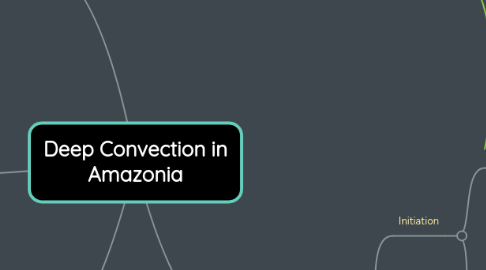
1. Effects
1.1. Radiation
1.1.1. Budget
1.1.1.1. Albedo [SW]
1.1.1.2. Greenhouse gas [LW]
1.2. Climate
1.2.1. Energy balance
1.2.1.1. Latent heat
1.2.2. Water cycle
2. Variability
2.1. Diurnal
2.2. Monthly
2.3. Annual
3. "How do microphysics affect dynamical processes in clouds?"
4. Ingredients
4.1. Temperature
4.2. Humidity
4.3. Wind profile
4.4. Heat and moisture fluxes
4.5. Aerosol
5. “How do we differentiate the aerosols' total net effect from their impact on each stage in the cloud or cloud system lifecycle?”
6. Depends on Core vs Margin processes
6.1. Core dominates in large volume/area ratio
6.2. Margin tends to dominate in small volume/area ratio
7. Deepens convective clouds
7.1. Lin et al. (2006) [Amazon dry season]: increased cloud cover and higher cloud tops
7.2. Li et al. (2011) [Southern Great Plains]: used ground measurements
8. Lifecycle
8.1. Initiation
8.1.1. Aerosol Effect
8.1.1.1. More aerosol provides more CCN, forming more cloud droplets
8.1.1.1.1. Narrower droplet size distribution (more but smaller)
8.1.1.2. Aerosol in excess "kill the cloud"
8.1.1.2.1. Absorption/scattering warms and dries the atmospheric layer, cools the surface
8.1.1.3. Turning point between them
8.1.2. Initiation of rain is influenced by...
8.1.2.1. Condensation/Evaporation
8.1.2.2. Drag-forces
8.1.2.3. Latent heat fluxes
8.1.2.4. Droplet terminal velocities, collection and entrainment
8.2. Maturation
8.2.1. Aerosol Effect
8.2.1.1. More smaller ice particles near cloud-top in polluted environments
8.2.1.2. Meskhidze et al. (2009) [Amazon, DRY season]: stronger conversion of water to ice clouds from morning to afternoon
8.2.1.3. Andreae et al. (2004) [Amazon, smoky conditions]: more intense thunderstorms
8.2.1.4. Mixed results when compared to rain rates
8.3. Decay
9. Cloud Invigoration Hypothesis
9.1. Ideal case
9.1.1. Deep convection
9.1.2. Highly unstable
9.1.2.1. High RH
9.1.3. Core processes
9.1.4. Weak wind shear