


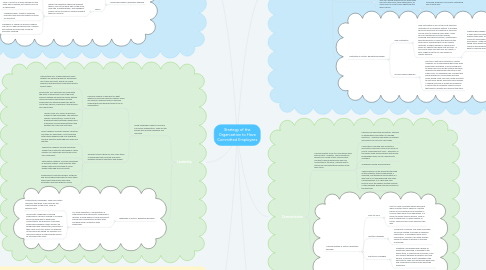
1. Groups and Teams
1.1. Groups: a collection of people who actions affect others - have a general desire to get along and contribute
1.1.1. Needs cohesion! It is the "social glue" that makes a group functional. More cohesiveness typically translates to more productivity; however, a group can be TOO cohesive and create a hive mind that hurts an organization.
1.1.1.1. Cohesion is affected by stability, similarity, size, support, and satisfaction,
1.1.2. Groups can range from a small collection of people to whole branches, departments, and sections of an organization.
1.1.3. Focused more on the work of an individual rather that working on a collective task.
1.2. Teams: a cohesive collection of people whose purpose is to accomplish and specific task or goal. Typically smaller an temporary in nature. People are require to pool their effort to achieve their goals. There are three main types of teams.
1.2.1. Production Teams: focused on making actual product.
1.2.2. Idea-generating Teams: creative braimstormers - creates new product ideas, marketing ideas, etc.
1.2.3. Problem Solving Teams: creates plans of action and heavily involved in decision making.
1.3. Groups and Teams: Bookstore Example
1.3.1. Groups
1.3.1.1. In a small bookstore the whole store (cafe included) is a group. There are store goals and focuses that all employees adhere to, such as excellent customer service.
1.3.2. Teams
1.3.2.1. Within the bookstore there are different teams, such as the book side of the store, cafe side, marketing team, and managers. People can be involved in several different teams or just one.
1.3.2.1.1. The Book Side: Handles most customers. Deals with phone calls, customer special orders, book suggestions, gift wrapping, cashiering, and restock receiving.
1.3.2.1.2. The Cafe Side: Makes coffee and food to order. Can act as a spare checker for the book side if needed, but mainly focus on all things cafe.
1.3.2.1.3. Marketing Team: Creates, organizes, promotes and executes events or brand for the store.
1.3.2.1.4. Managers: In charge of decision making. The "go-to" when problems arise. Handles accounting and financials as well as inventory ordering.
2. Leadership
2.1. Good leadership is key to running a successful organization. They are the people who provide guidance and direction.
2.1.1. Decision making: a large part of what leaders do involves decision making. There are different methods used in decision making that have different affects on an organization.
2.1.1.1. Authoritarian DM: making decision alone without any outside guidance. Employees don't have any input, which can cause problems with decisions made that directly effects them.
2.1.1.2. Democratic DM: decisions are made with the input of employees. This is the most popular method because the leader gathers more information beforehand and the employees are satisfied when they get to voice their opinion, especially if the decision will effect them.
2.1.1.3. Laissez-Faire DM: leaves all decision making to the employees. This method causes complications, conflicts and disappointments between leaders and employees involving expectations and whether the outcome met them.
2.1.2. Different Styles: there are four main styles of leadership that fluctuate efficiency between different situations and people.
2.1.2.1. Direct Leaders: provides specific direction and tasks for employees. Most effective with people experiencing role ambiguity, and less effective with high skill levels and abilities.
2.1.2.2. Supportive Leaders: provide emotional support and connects with people. These leaders can make jobs less stressful and less unpleasant.
2.1.2.3. Participative Leaders: Involves employees in decision making. Most effective with people with personal stake at risk or people with high levels of ability.
2.1.2.4. Achievement-oriented Leaders: set goals and encourages employees to reach them. Works best with people who seek motivation and have high skill levels.
2.2. Leadership in Action: Bookstore Example
2.2.1. In a small bookstore, a combination of authoritarian and democratic leadership is needed. A good leader in this environment should also be supportive of their team and have good connection with employees.
2.2.1.1. Authoritarian Leadership: There are certain decisions that have to be made by the own/manager of the store, such as expense cuts.
2.2.1.2. Democratic Leadership: involving employees in decision making in a smaller store is a good way to keep them committed to the business. It will keep employees engaged if their opinion are being heard and represented, especially if their input is put into action. An example of this would be asking for opinions on a new store display or which books should be stocked in the store.
3. Conflict Management
3.1. Within an organization, conflict will always exist to some degree. The ability to manage conflict is crucial to creating an environment where people enjoy working. Even though conflict is usually thought of as negative, it is needed, in some degree, to spark ideas and good decision making within an organization.
3.1.1. Types of Conflict
3.1.1.1. Interpersonal: internal conflict typically caused by micromanagement, role ambiguity, and role conflict
3.1.1.2. Interpersonal: among coworkers, employees/managers, CEOs and their staff
3.1.1.3. Intergroup: conflict among different groups of people, such as different divisions or competitors
3.1.2. Six Main Causes: organizational structure, limited resources, task interdependence, incompatible goals, personality difference, and communication problems.
3.1.2.1. Changing the structure of the organization, moving members in conflict, voting, and goal orientation are all ways conflict can be resolved. If there is conflict - change the way things are to better the environment.
3.1.3. Five Styles of Handling Conflict: avoidance, accommodation, compromise, competition, and collaboration.
3.1.3.1. Collaboration is the best method to resolving conflicts, followed by compromise and accommodation.
3.1.4. Negotiation: two or more parties working towards a mutually beneficial agreement.
3.1.4.1. Negotiation is a give and take collaboration between two different people. This is the most effective way to resolve problems and create a result that more ideal that the current one.
3.2. Conflict in Action: Bookstore Example
3.2.1. One of the biggest cause of conflict in a bookstore involves miscommunication. When communication is not clear, if can be confusing and cause problems with expectations that were not met or disappointed customers. Making sure messages are thorough, direct, and detailed can help diffuse confusion.
3.2.1.1. Another conflict in a bookstore can be between the cafe and the book side. The cafe employees may not be as dedicated to the wellness of the store as the booksellers are. This causes angst and tension among the store.
3.2.1.1.1. Negotiation and collaboration methods can be used to diffuse tension in the store. Both parties involved must work together to create an environment that is comfortable and benefits all.
4. Motivation: the desire to achieve goals. There are several different theories of motivating a work force.
4.1. Needs-based Theories - four different types.
4.1.1. Maslow's Hierarchy of Needs: There are five different basic human needs, physiological, safety, social, esteem, and self-actualization.
4.1.1.1. These needs act as motivators. Ranked in order of importance. As one need is met, it no longer becomes the main focus. Only one trait can motivate at a time.
4.1.2. ERG Theory: Similar to Maslow's Theory - focuses on existence, relatedness, and growth.
4.1.2.1. Recognizes that more than trait can be needed at once. These traits are not ranked in a particular order and can change depending on the situation.
4.1.3. Two-factor Theory: focuses on hygiene and motivating factors.
4.1.3.1. Hygiene Factors: conditions where the job is performed - policies, supervision, work conditions, salary, safety, security.
4.1.3.2. Motivators: make a job worthy - achievement, recognition, responsibility, achievement, growth opportunities.
4.1.4. McCelland's Acquired Needs Theory: three needs - achievement, affiliation, and power.
4.1.4.1. Affiliation: need to be liked. Good at human interactions. Bad at management.
4.1.4.2. Achievement: motivated to be successful and improve - very goal focused.
4.1.4.3. Power: wants to influence and control environment. Can be self-destructive. Makes the best leaders.
4.2. Process-based Theories - three main types
4.2.1. Equity Theory: fairness within interactions are important. Compares one's self to a referent and the result they get.
4.2.2. Expectancy Theory: motivated by interest of outcomes for their efforts. Has high valence and performs instrumentally.
4.2.3. Reinforcement Theory: behavior is the result of outcomes. Reward the behavior that is ideal. "Punish" the behavior that is unfavorable.
4.3. There are other factors that motivate employees - such as the job itself.
4.3.1. Smart Goals: used to energize, give direction, make you think, and provide challenges
4.3.2. The Job: should require one to utilize their skills at a high level, have significance, an some level of control over what/how the work is done
4.3.2.1. Providing feedback is crucial to motivating one to work well.
4.4. Motivation in Action: Bookstore Example
4.4.1. Goal Motivation
4.4.1.1. Goal motivation is one of the most effective motivators in a bookstore setting. It provides short and long-term occupation of time and can be used to maximize work ethic. Goals such as maintaining a certain display, receiving and shelving restock, creating and executing events or ideas that promote the store are all examples that can be used to motivate. Another example is selling more books for charity than were sold last year - if 500 books were sold last year for charity, a goal might be set to sell 750 books for charity this year.
4.4.1.1.1. Creating goals keeps employees engaged in their work and satisfies them when they achieve their goals. Providing feed back is crucial to employees when given a task to accomplish - either positive feedback telling them about how great they did or constructive feedback they can use as a base to improve upon.
4.4.2. Process-based Theories
4.4.2.1. This ties in with goal motivation. Having "rewards" for accomplishing goals can keep employees motivated. Such as being able to leave early once all the restock has been received and shelved and the store is not super busy. If a bookseller has a review that was published on a book they read and loved, giving a gift card can create incentive to read more books and write more reviews. A reward could be as simple as bringing in a certain title a bookseller read and loved that wasn't currently be carried at the store.
5. Communication
5.1. Communication is key to a successful work environment. However, communications barriers can create a toxic environment. The key to having employees who are committed to the work, is being able to overcome communication barriers in the work force.
5.1.1. Filtering and Selective Perception: filtering is withholding information to manage reactions - selective perception is filtering information to suit your own needs
5.1.2. Information Overload and Semantics: information overload is too much stuff for one to comprehend at once - semantics is the jargon used among people with similar knowledge bases, can be confusing to outsiders.
5.1.3. Grapevine: gossip among people
5.1.4. These barriers can be prevented through active listening, being forward with a message, and delivering information in a way that is not overwhelming and easily comprehended. It is a give and take process from the sender and the receiver of the message. Being clear and concise is the best way.
5.2. Communication in Action: Bookstore Example
5.2.1. Face-to-face
5.2.1.1. Face-to-face communications work best when a certain task is asked of a certain person or an individual has a question or concern that needs to be addressed. It is easier to explain tasks in person, such as how to subsection a certain groups of books. Training is also more effective this way.
5.2.2. Written Messages
5.2.2.1. To prevent confusion over write messages, forms are created to include all required information. If something needs more clarification, a person can either ask the sender to explain in person or through e-message.
5.2.3. Electronic Messages
5.2.3.1. Adapting a messaging app capable of effectively delivering a message to the whole store, a select group of people, such as a division between bookseller and cafe people, or person direct messages is the best way to make sure employees have read and understood communicate about the workplace.
5.2.4. Communication is important in the workplace because a failure to communicate can result in unhappy customers, a failed event, and conflict over inventory and displays. When communication is good, employees are typically more satisfied and enjoy their work more.
6. Do They Fit?
6.1. One of the most important parts of having committed employees is hiring people who fit the job - ones who are excited and motivated to work. Personality tests and in-person interviews are a great way to test if an employee will fit well with the company.
6.2. Hiring the Right Fit: Bookstore Example
6.2.1. Every employer wants to hire someone who fits well with the organization. If one's interest align with the company, they are more likely to be committed to work well. In a bookstore, hiring someone who has a passion for reading and literature is ideal. Successful booksellers should be able to talk about books and be excited about them. The key to selling books is having a well-read team that has diverse reading tastes so that employees are reading in every section of the store. Hiring someone who doesn't read books wouldn't make any sense.