


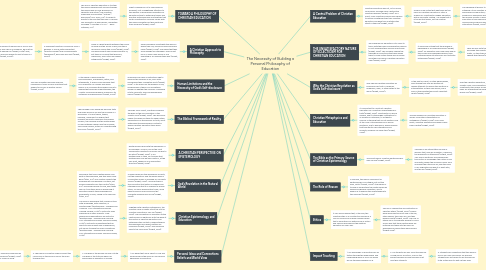
1. TOWARD A PHILOSOPHY OF CHRISTIAN EDUCATION
1.1. What is required is not a "philosophical blueprint," but a heightened attention to the realities of professional obligation as educators strive to establish a theory and practice both personally and together that unites Christianity's universal values with the needs and details of their particular time and place (Knight, 2006).
1.1.1. The aim of Christian education is to steer the human development process towards the human goal of God: godliness of character and action (The Christian Philosophy of Education | Articles | Resources | BJU Press, n.d.). It bends its efforts to the end that the man of Heaven can be great in all good works, completely furnished (2 Timothy 3:17 NIV - - Bible Gateway, n.d.).
2. A Christian Approach to Philosophy
2.1. When individuals investigate the world in which they live, numerous discoveries are made (Knight, 2006). One being that their surroundings are intelligible. They do not live in a "gone mad" world or one operating in an unpredictable way (Knight, 2006).
2.1.1. There is a great dispute between the forces of good and the forces of bad, and this is mirrored in every step of life (Knight, 2006). The environment may be welcoming to us, but there is no doubt that harmony, orderliness, and culture are always antagonistic (Knight, 2006).
2.1.1.1. A significant question is posed by such a paradox: If God is both omnipotent (infinite in power) and compassionate (benevolent), how does evil exist (Knight, 2006)?
2.1.1.1.1. He would wish to abolish evil if God is fully loving; and if he is all-powerful, he must be able to abolish evil (Knight, 2006). Why, then, does evil appear to exist if there is a God (Knight, 2006)?
3. Human Limitations and the Necessity of God’s Self-disclosure
3.1. Individuals also have a motivating urge to discover the purpose of life, even after recognizing their conceptual limits (Knight, 2006). In its search for the essence of life, mankind asks if there is an acceptable answer or whether the universe 's response is total, absolute, and incomprehensible silence (Knight 2006).
3.1.1. In the sense of environmental purposefulness, friendliness, nature, and intelligibility, it seems more plausible that by a realization of Himself and divine reason in a communicative fashion and at a degree that would be understandable, the Creator-God would break by mankind in its finiteness and helplessness (Knight, 2006).
3.1.1.1. This self-revelation has been used by individuals in terms of holy scriptures that appear to be from a spiritual source (Knight, 2006).
4. The Biblical Framework of Reality
4.1. Through Jesus Christ, Christians embrace the Bible as the self-revelation of the Creator-God (Knight, 2006). This discovery makes it possible for them to make further assumptions on the essence of truth, and it establishes the philosophical context in which Christian education takes place (Knight, 2006).
4.1.1. The paradigm from which we perceive truth and make sense of life and the universe is a worldview. "It is any theory, theory, ideology, movement or religion that presents an holistic approach to knowing Heaven, the universe and the relationships of man between Heaven and the universe," says David Noebel, author of Understanding the Times (Tackett, 2006) .
5. A CHRISTIAN PERSPECTIVE ON EPISTEMOLOGY
5.1. Epistemology deals with the awareness of an individual. As such, one of the most fundamental questions of human life has to do with it (Knight, 2006). If our epistemology is false, so it follows that anything else may be inaccurate or, at the very least, skewed in our information structure (Knight, 2006).
6. God’s Revelation in the Natural World
6.1. Human beings are the discoverers of facts, not the originators; and the whole edifice of scientific inquiry is founded on concepts a priori (Knight, 2006). "Among others is the conviction that nature is ordered and intelligible and that it is available to human study, a curious presumption today, since beyond science men announce the complete insignificance of life (Knight, 2006)."
6.1.1. We believe that God created heaven and earth in the beginning, and they were really good (Staff, n.d.). Any creation reflects the sovereign will and purpose of Nature, but remains separate from the Creator (Staff, n.d.). The world belongs to God, who takes care of it and takes pride in preserving it. Formation asserts the knowledge and sovereignty of God, calling us to obey him (Staff, n.d.).
7. Christian Epistemology and Education
7.1. Together with Christian metaphysics, the Christian view of reality sits at the root of Christian education's very life (Knight, 2006). The recognition of revelation as the central basis of legitimacy puts the Bible at the centre of Christian education and establishes the context of understanding through which all subject matters are measured (Knight, 2006). This especially affects the curriculum (Knight, 2006).
7.1.1. The field of philosophy that concerns itself with knowledge, with cognition, is epistemology (Epistemology · Teaching and Learning · DNS International Teacher Training College, 2018). A instructor uses experience in many respects. New awareness is generated by an instructor (Epistemology · Teaching and Learning · DNS International Teacher Training College, 2018). A instructor understands that he wants to have a great deal of experience, but he has to grasp the finer foundations (Epistemology · Teaching and Learning · DNS International Teacher Training College, 2018).
8. Personal Ideas and Connections Beliefs and World View
8.1. 1. My Belief that Jesus Christ is Lord and King should be the drive for my personal philosophy of education.
8.1.1. 2. The Bible is the primary source of truth. The Bible is the truth by which my philosophy of education is formed.
8.1.1.1. 3. The beliefs of christian schools effect the curriculum as the word of God is the main teaching tool.
8.1.1.1.1. 4. Philosophical views are influenced by educational experiences (Knight, 2006). My philosophy is a way of living.
9. A Central Problem of Christian Education
9.1. Christian education was not, all too much, consciously founded upon a distinctive Christian ideology (Knight, 2006). As a result, many Christian schools have chosen to deliver something other than Christian education and have thus frustrated the intent of their life (Knight, 2006).
9.1.1. Gordon Clark noted that what goes by the name of Christian education is often a scheme of" Christianity's pagan education with a chocolate coating. He added that it is the pill that works, not the coating (Knight, 2006).
9.1.1.1. The challenge at hand is to strive to establish a truly Christian approach to philosophy and education, rather than to preserve an ambiguous partnership with the broader society in which Christian educators in their search for Christian values pick and choose among secular alternatives (Knight, 2006).
10. THE UNSATISFACTORY NATURE OF ECLECTICISM FOR CHRISTIAN EDUCATION
10.1. The challenge for educators is to come to terms with the basic presuppositions which in fact undergird their surface eclecticism (Knight, 2006). This includes making the theological convictions that have driven them to mark certain things as successful and others as bad for Christian educators clear (Knight, 2006).
10.1.1. It should be noticed that the building of philosophy is an ongoing process (Knight, 2006). As educators learn new ideas and as their scope of knowledge expands, their methodological structure will be constantly established (Knight, 2006).
10.1.1.1. They will also note that their philosophy will guide their practice and that their reality, on the other hand, will appear to change their theory(Knight, 2006).
10.1.1.1.1. Educational experts should think about educational theory on a regular basis as what they "do," rather than as what they merely learned in a course with those terms in the title (Knight, 2006).
11. Why the Christian Revelation as God’s Self-disclosure?
11.1. Why should Christian revelation be preferred over that of Hinduism , Buddhism, Islam, or other faiths of the world (Knight, 2006)?
11.1.1. In the light of Christ, all other philosophies, even though they may be worthy yet flawed attempts to resolve the question of interpretation on their own words, are in error in their greatest and most important facets (Knight, 2006).
11.1.1.1. Why the Christian Revelation, as the Creator-God 's self-revelation? Since Christianity itself offers an appropriate basis for interpreting the predicament of human life (Knight, 2006).
11.1.1.1.1. The Christian Revelation expresses itself not as a truth, but as the truth (Knight, 2006).
12. Christian Metaphysics and Education
12.1. It is important to construct Christian education on a Christian understanding of truth (Knight, 2006). Christianity is a divine religion, and it is thoroughly antithetical to all modes of naturalism, to all theistic schools of thinking that do not position God at the core of the experience of human existence, and to humanism, which believes that through its own intelligence and morality, mankind can save itself (Knight, 2006).
12.1.1. The groundwork for Christian education is laid by a Christian interpretation of metaphysics (Knight, 2006). Since God exists, Christian educational programs have been created (Knight, 2006).
13. The Bible as the Primary Source of Christian Epistemology
13.1. The scriptures as Christian epistemology's main source (Knight, 2006).
13.1.1. The Bible is an authoritative source of wisdom that, even by revelation, is beyond the possibility of attainment (Knight, 2006). The "major questions" are answered by this center of knowledge: the nature of life and death, where the universe comes from and what the future will be, how the issue of sin originated and how it is dealt with, and the like (Knight,2006).
14. The Role of Reason
14.1. In learning, the logical component of epistemology is an integral, but not the main, factor (Knight, 2006). Its purpose is to help us understand the reality gained by unique and general revelation, and to enable us to expand the understanding to the unknown (Knight, 2006).
15. Ethics
15.1. It can also be known that, in the end, the Christian ethic is a constructive influence. A love for God and our fellow human beings that is reflected in an external life of action and service goes beyond the death of adoration for one's self.
15.1.1. The role is redemptive and restorative in Christian ethics (Knight, 2006). People were disconnected from God in the fall, other people, their own self, and their physical world (Knight, 2006). The role of ethical life is to empower people to live in such a way that these relationships are restored and taken into the place of wholeness for which they were formed (Knight 2006).
16. Impact Teaching
16.1. 1. My philosophy of Education will be tested through the dependable and unchanging word of God. My lesson will go through Philippians 4:8.
16.1.1. 3. My students will see Jesus through me. Loving God is an action. Jesus is the perfect example of how teachers must love their students.
16.1.1.1. 3. Students will understand that the word of God is our main curriculum for learning. Students will be trained to use the word of truth as the lamp to light up their way!