


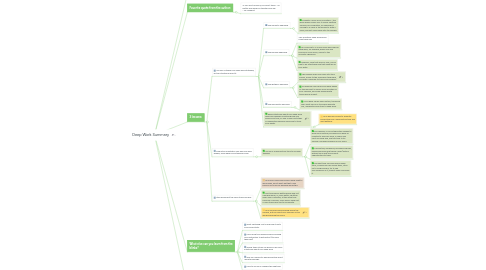
1. 1-Sentence-Summary:
1.1. Deep Work proposes that we have lost our ability to focus deeply and immerse ourselves in a complex task, showing you how to cultivate this skill again and focus more than ever before with four simple rules.
2. Favorite quote from the author:
2.1. "If you don't produce, you won't thrive - no matter how skilled or talented you are." - Cal Newport
3. 3 lessons:
3.1. Use one of these four deep work strategies, but be intentional about it.
3.1.1. The monastic approach.
3.1.1.1. Monastic comes from monastery – the place where monks live. It means shutting yourself off completely, for example by moving to a cabin in the woods to write a novel, and not come back until it’s finished.
3.1.2. The bimodal approach.
3.1.2.1. This prioritizes deep work above everything else.
3.1.2.2. You could set a 4-6 hour block each day for deep work, for example, where you lock yourself in your office, similar to the monastic approach.
3.1.2.3. However, once that block is over, you’re free to do everything else that might be on your plate.
3.1.3. The rhythmic approach.
3.1.3.1. This chunks down your work into time blocks, similar to the Pomodoro technique, and uses a calendar to track your progress.
3.1.3.2. For example you’d plan your week ahead of time and put 10 blocks of 90 minutes on your calendar, and make working with timed blocks a habit.
3.1.4. The journalistic approach.
3.1.4.1. If you have a busy daily routine, this works well. What you do is to simply dedicate any, unexpected free time to deep work.
3.1.5. Being intentional about your deep work approach requires monitoring how you spend your time, so one of your first steps in making this decision should be to track your habits.
3.1.5.1. You’ll quickly be able to separate productive from unproductive time and spot patterns.
3.2. Productive meditation can help you work deeper, even while you’re taking a break.
3.2.1. Use your “unproductive” time to do deep thinking.
3.2.1.1. For example, if you’re taking the subway to work each morning, and know you have 30 minutes to and from work, in which you can’t do much else, use this time to try solving a complex problem in your mind.
3.2.1.2. Commuting, showering, household chores, buying groceries and taking a walk (with or without your dog) are all great opportunities to think.
3.2.1.3. The next time you have some “down time”, in which you do menial tasks, latch on to a big problem, try to see sub-problems of it, break it down and solve it.
3.3. Stop working at the same time each day.
3.3.1. Your brain needs some space each night to wind down, and it won’t get that if you have an as-much-as-possible work ethic.
3.3.2. Limit yourself by quitting work and not checking email, or, even better, shutting down your computer, at the same time each day. This way, you’ll have a fixed slot of free time every day to recuperate.
3.3.3. Your mind will keep working below the surface, but you won’t burn yourself out by working around the clock.