


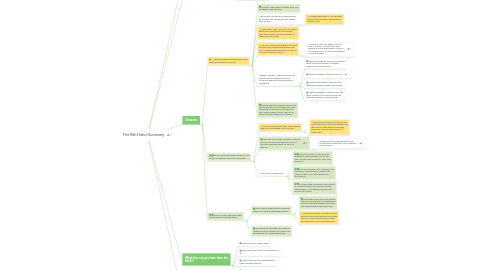
1. 1-Sentence-Summary:
1.1. The 8th Habit is about finding your voice and helping others discover their own, in order to thrive at work in the Information Age, where interdependence is more important than independence.
2. Favorite quote from the author:
2.1. "People simply feel better about themselves when they're good at something." - Stephen R. Covey
3. 3 lessons:
3.1. There’s no bigger gift you’ve been born with than the ability to choose.
3.1.1. In order to help others find their voice, you first have to find your own
3.1.2. How fast you’ll be able to do that depends on how well you use the gifts you’ve been given at birth.
3.1.2.1. And the biggest gift is: You are free to choose how you react to any and every situation in life.
3.1.3. Unlike plants, who can’t move, or animals, whose life is just a series of instinctual, knee-jerk reactions, we as humans get to choose our next action.
3.1.4. We can’t control what happens to us. But we sure as hell can decide how we’ll react to it. So whether that next step is a step up or down is entirely up to you.
3.1.4.1. If someone treats you badly, be it your boss or a friend, if people try to peer pressure you into doing things, it is up to you to give in to it, to do something about it, or to walk away.
3.1.5. However, freedom of choice isn’t the only enabling factor in finding your voice. Covey also talks about the four kinds of intelligence:
3.1.5.1. Physical intelligence, which is your body’s ability to function mostly on autopilot, without conscious direction.
3.1.5.2. Mental intelligence, what you’d call IQ.
3.1.5.3. Emotional intelligence, which is about empathy and what’s sometimes called EQ.
3.1.5.4. Spiritual intelligence, which is your own moral compass, your true north star, the thing that drives your life’s meaning.
3.1.6. Recognizing these powers you have and playing with how you use them is the first step towards finding and capitalizing on your unique powers at work. Then, it’s all about communicating them to others.
3.2. Be nice, apologize when you have to and deliver on what you promise to build trust.
3.2.1. Communicating with others comes easiest when your relationship is built on trust.
3.2.1.1. The more you trust in one another, the more things you’ll feel comfortable saying, the more you think about each other’s words and the more likely you are to accept them.
3.2.2. Think about this in the concept of business, and you can easily see why trust is one of the most important things for CEOs to work on.
3.2.2.1. It determines the speed with which you can execute and therefore, your company’s success overall.
3.2.3. Trust is built in three ways:
3.2.3.1. Stick to your word. If you promise something, follow through. 100% of the time. Not sure if you’ll make it? Then don’t promise it.
3.2.3.2. Be nice. So simple, yet so powerful. Just be friendly. Say “thank you,” “please,” and “how can I help you?” Avoid gossip and stay positive.
3.2.3.3. Say sorry when you have to. We all screw up. The best thing, by far, you can do when that happens, is to instantly acknowledge it and just say “Sorry!”
3.3. Give up control and hand others responsibility to empower them.
3.3.1. One of the strongest ways to empower others is to just hand the power to them
3.3.1.1. That doesn’t mean you should let the intern run the business, but always keep extending the responsibility and control your employees have over their work.
3.3.1.2. Having the freedom to make important decisions about their work will make them feel a lot more motivated and of course help them trust in your future decisions.
3.3.2. This applies to friendships too! Ask your friends for help, trust them to do their part and see how your relationship grows.