


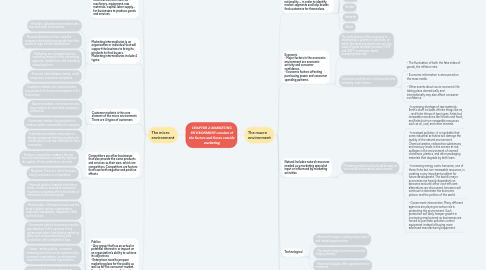
1. The micro environment
1.1. Company: marketing managers need to work closely with groups with diferent functions in the company such as
1.1.1. Top management
1.1.2. Finance
1.1.3. R&D
1.1.4. Purchsing
1.1.5. Operations
1.1.6. Accounting
1.2. Suppliers: suppliers provide essential elements such as machinery, equipment, raw materials, capital, labor supply… for businesses to produce goods and services.
1.3. Marketing intermediaries is an organization or individual that will support the business to bring its products to final buyers. Marketing intermediaries include 4 types:
1.3.1. - Resellers: whosalers and retailers who buy and resell merchandise.
1.3.2. - Physical distribution firms: help the company stock and move goods from their points of orgin to their destinations
1.3.3. - Marketing services agencies: the marketing research firms, advertising agencies, media firms, and marketing consulting firms
1.3.4. - Financial intermediaries: banks, credit companies, insurance companies.
1.4. Customer markets is the core element of the micro environment. There are 4 types of customers
1.4.1. - Customer markets: are customers who buy products for home consumption or for themselves
1.4.2. - Business markets: are customers who buy products to serve their company's production
1.4.3. - Goverment markets: buy products to produce public consumables for everyone
1.4.4. - International markets: are people or foreign companies that buy products for consumption or as raw materials for their companies
1.5. Competitors are other businesses that also provide the same products and services as their own, which are competitors. Competitors are factors that have both negative and positive effects
1.5.1. - Positive: competition creates a driving force for businesses to constantly improve the quality of their products or services
1.5.2. - Negative: There is a risk of business losing customers to competitors
1.6. Publics - Any group that has an actual or potential interest in or impact on an organization’s ability to achieve its objectives -Enterprises need to prepare marketing plans for the public as well as for the consumer market. Every business typically has the following publics:
1.6.1. - Financial publics: financial institutions, banks, investors, securities companies, insurance companies affect the ability of enterprises to borrow capital.
1.6.2. - Media publics: Enterprises must sow the trust of public opinion organizations, especially newspapers, magazines, radio and television.
1.6.3. - Goverment publics: businesses need to pay attention to the opinions of the government when formulating marketing plans such as true advertising, safe production, anti-competition laws.
1.6.4. - Citizen - action publics: corporate marketing activities can be questioned by consumer organizations, environmental organizations and other organizations.
1.6.5. - Local publics: every business must communicate with local communities like local organizations, neighbors.
1.6.6. - General publics: businesses need to be mindful of the public's attitudes toward their activities and products. Although the public does not influence the business as an organized force, the public's impression of the business affects its customers.
1.6.7. - Internal publics: includes the number of employees and intellectuals, managers and boards of directors. When employees feel comfortable with their business, this positive attitude spreads to the outside of the business.
2. The macro environment
2.1. Demographic: the study of human populations in term of size, density, location, age, gender, race, occupation, and other statistics. Data that helps to divide the characteristics of a group of people such as age, income, race, gender, nationality ... in order to identify market segments and help brands find customers for themselves.
2.1.1. Occupation
2.1.2. Hobbies
2.1.3. Age
2.1.4. Income
2.1.5. Location
2.1.6. Gender
2.1.7. Interests
2.1.8. Values
2.2. Economic - Major factors in the economic environment are economic activity and consumer confidence. - Economic factors affecting purchasing power and consumer spending patterns
2.2.1. The performance of the economy is assessed by a system of indicators, of which the most important ones are: the value of gross domestic product (GNP and GDP); income per capita; unemployment rate
2.2.2. Consumer confidence is influenced by the following major factors:
2.2.2.1. - The fluctuation of both the fake index of goods, the inflation rate
2.2.2.2. - Economic information is announced on the mass media.
2.2.2.3. - Other events about socio-economic life taking place domestically and internationally may also affect consumer confidence.
2.3. Natural:Includes natural resources needed as a marketing specialist input or influenced by marketing activities.
2.3.1. Marketing professionals should be wary of four trends in the natural environment:
2.3.1.1. - Increasing shortage of raw materials: Earth's stuff includes infinite things like air, ... and finite things of two types: finite but renewable resources like forests and food; and finite but non-renewable resources such as oil, coal, and other minerals.
2.3.1.2. - Increased pollution: it is inevitable that some industrial activities will damage the quality of the natural environment. Chemical wastes, radioactive substances, and mercury levels in the sea are at risk, spillages in the environment of canned containers, plastics, and other packaging materials that degrade by birth learn.
2.3.1.3. - Increasing energy costs: kerosene, one of those finite but non-renewable resources, is creating a very important problem for future development. The world's major economies are heavily dependent on kerosene and until other cost-efficient alternatives are discovered, kerosene will continue to dominate the economic picture. and the politics of the world.
2.3.1.4. - Government intervention: Many different agencies are playing an active role in protecting the environment. Such protection will likely hamper growth in increasing employment as businesses are forced to purchase pollution control equipment instead of buying more advanced manufacturing equipment.
2.4. Technological
2.4.1. - New technologies creating new product and market opportunities
2.4.2. - The teachnological enviromentis now shaping destiny
2.4.3. - New technologies offer opportunities for marketers
2.5. Political -> Influence, limit various organizations or individuals in given society
2.5.1. - Law
2.5.2. - Government agencies
2.5.3. - Pressure groups
2.6. Cultural
2.6.1. Institutions+other forces affect society’s basic values, perceptions, preferences and behaviors