

1. Vision :
1.1. Through international cooperation and the coordination of research efforts in ocean sciences, develop strong scientific understanding as well as systematic observations of the ocean system to develop sustainable development and global governance approaches to ocean management
1.1.1. Keywords :
1.1.1.1. International cooperation
1.1.1.2. Coordination of research programmes
1.1.1.3. Strong scientific understanding of ocean issues
1.1.1.4. Systematic approach to data collection and ocean observation
1.1.1.5. Bridge science and policy
1.1.1.6. Enable policies based on ecosystem-approaches for sustainability
2. High level objectives :
2.1. I. Healthy ecosystems and sustained ecosystem services
2.2. II. Effective early warning systems and preparedness for tsunamis and other ocean-related hazards
2.3. III. Development of scientifically-founded strategies of adaptation and mitigation for increased resiliency to climate change and enhanced safety, effectiveness and efficiency of ocean-based activities
2.4. IV. Enhanced knowledge of emerging ocean issues
2.5. Keywords :
2.5.1. Ecosystem health and services
2.5.2. Ocean hazards resilience
2.5.3. Climate change resilience
2.5.4. Knowledge on emerging issues
3. On the High Seas
3.1. BBNJ
3.1.1. Preparatory commission on implementing an agreement incorporated to UNCLOS
3.1.1.1. 4th work session end of August 2021
3.1.2. 4 issues :
3.1.2.1. Establishment of Marine Protected Areas (MPAs)
3.1.2.2. Access to benefit sharing concerning genetic resources
3.1.2.3. Environmental impact assessment
3.1.2.4. Transfers of technology
3.1.3. There is no legal definition of MPA just yet
3.1.4. The UNESCO World Heritage convention does not assess BBNJ
3.2. Principles needed for management
3.2.1. Rules :
3.2.1.1. Shared responsibility
3.2.1.2. Conditional access
3.2.1.3. Effective enforcement
3.3. On the Deep Sea
3.3.1. Creation of a regime based on assessment and prevention at the UN
3.3.1.1. Instigated by the Deep Sea Conservation Coalition
3.3.1.2. 2006-2009
3.4. Sylvia Earle's Hope Spots / Wish
3.4.1. Protect 20% of the High Sea
3.4.2. Get everyone involved in science and aim for appropriation of the issue by society
4. Intern Tasks and How I Fit
4.1. Compétences et expériences requises
4.1.1. Bonne connaissance des enjeux océanographiques
4.1.1.1. Acidification de l'océan
4.1.1.2. Désoxygénation de l'océan
4.1.1.3. Eutrophisation de l'océan
4.1.1.4. Pollution par le plastique
4.1.1.5. Écosystèmes carbone bleu
4.1.1.6. Éclosions d'algues toxiques
4.1.1.7. Nexus Climat-Océan
4.1.1.8. Protection de la biodiversité en zones internationales
4.1.2. Atout / Expérience SIG (ArcGIS/QGIS) et gestion de données de l'information
4.1.2.1. STeDe
4.1.2.1.1. 1 cours sur ArcGIS (Padova)
4.1.2.1.2. 1 cours sur QGIS (Paris)
4.1.2.1.3. 1 cours en analyse de données (Paris)
4.1.2.2. Cégep de Sherbrooke
4.1.2.2.1. 1 cours d'optimisation (Sherbrooke)
4.1.3. Capacité d'analyse, de synthèse et de rédaction
4.1.3.1. Auxilia
4.1.3.1.1. Réalisation de plusieurs communiqués, rendus et études à finalité d'acteurs diversifiés et sous formats diversifiés
4.1.3.2. ACOGUATE
4.1.3.2.1. Rédaction d'articles visant à vulgariser et à communiquer des enjeux complexes de droits humains au public général
4.1.3.3. SONU-UNESCO
4.1.3.3.1. Création de contenus vulgarisés sur la plateforme web
4.1.3.4. Expérience soutenue dans le milieu universitaire, dans différentes cultures académiques
4.1.3.4.1. Canada : Sherbrooke, Montréal
4.1.3.4.2. Italie : Padova
4.1.3.4.3. Belgique : Leuven
4.1.3.4.4. France : Paris
4.1.3.5. Mémoire de maîtrise
4.1.4. Maîtrise des langues parlées et écrites
4.1.5. Habiletés en communication web
4.1.6. Aptitudes de communication et grand sens des relations publiques
4.1.7. Autonomie et initiative
4.1.8. Bonne résistance à la pression
4.1.9. Atout / Expérience en organisation d'événements
4.1.10. Être capable de travailler dans un environnement multinational et multiculturel dans le respect des valeurs des Nations Unies
5. BBNJ ILBI
5.1. The IOC provides essential services to the negotiations to take place
5.1.1. The agreement will need to be built on the best available science and knowledge on the ocean. The IOC is coordinating its development :
5.1.1.1. Capacity Building
5.1.1.2. Research coordination
5.1.1.3. Technology and skills transfers
5.1.1.4. Area-based management
5.1.2. The IOC is developing a Clearing House Mechanism
6. Structure :
6.1. General Conference
6.1.1. 150 Member States
6.1.2. Meeting every two years
6.1.2.1. Reviews the work of the Commission and Member States
6.1.2.2. Defines orientations for the upcoming two years
6.1.2.3. Elects the Executive Council
6.1.2.4. Elects the Chairperson and the 5 vice-chairpersons
6.1.2.5. Elect the Executive Secretary when necessary
6.2. Executive Council
6.2.1. 40 members from 5 geographic groups
6.2.2. Meeting every year
6.2.2.1. Reviews the work done by the secretariat over the year and according to the 2 years plan
6.2.2.2. Prepares the General Assembly
6.2.2.3. Operationalizes the decisions taken in General Assembly to set a plan of actions for the secretariat
6.3. Office
6.3.1. 1 Chairperson and 5 Vice-Chairpersons
6.3.1.1. With the Executive Secretary, coordinate the activities of the IOC
6.3.1.2. Elected every two years. Each VP must represent a different voting group
6.3.1.3. Terms are for 2 years, can be renewed once
6.3.2. Daily work
6.3.2.1. Manage the IOC activities for a duration of 2 years
7. Ocean Decade 2021-2030
7.1. Main focus : Cooperation
7.1.1. Co-design of ocean science
7.1.2. Co-production of knowledge
7.1.3. Co-delivery of solutions
7.2. Ocean Objectives
7.2.1. I. Identify required knowledge for sustainable development
7.2.1.1. Provide the scientific basis necessary to regularly assess the state of the ocean and identify gaps in knowledge
7.2.1.2. Promote technology development and enhance access to technology necessary to create data, information and knowledge
7.2.1.3. Enhance GOOS to deliver standardized information on ocean variables (socioeconomic, geological, physical, chemical, biological, ecological, etc.)
7.2.1.4. Develop mechanisms that support community-led science initiatives and promote local and indigenous knowledge
7.2.1.5. Regularly assess the ocean science capacity to identify and overcome barriers (geographic, generational, economic, gender, diversity, etc.)
7.2.2. II. Generate comprehensive knowledge and understanding of the ocean
7.2.2.1. Map and understand roles and functions of ocean components, including nexus between the ocean and : humans, the atmosphere, the cryosphere, land
7.2.2.2. Understand thresholds and tipping points
7.2.2.3. Expand the use of historical ocean knowledge to support sustainable development
7.2.2.4. Improve and develop new ocean models to better understand the ocean's past, present and future states
7.2.2.5. Improve prediction services regarding ocean hazards and extreme weather and climate related events
7.2.2.6. Expand cooperation in ocean-related education, training and capacity development as well as in technology transfer
7.2.2.7. Build the knowledge base of ocean stressors to implement ecosystem-based management
7.2.3. III. Increase the use of ocean knowledge
7.2.3.1. Communicate about ocean science and promote its role for diverse stakeholder groups
7.2.3.2. Enhance ocean literacy both formally and informally for diverse stakeholders across societies
7.2.3.3. Involve stakeholders in the co-design of ocean science and the co-delivery of ocean solutions including policy, decision-making, ocean management frameworks, etc.
7.2.3.4. Expand and enhance spatial planning processes to contribute to sustainable development across regions and scales
7.2.3.5. Expand inclusive and integrated management frameworks to promote nature-based solutions
7.2.3.6. Expand and enhance tools to mobilize the ocean data, information and knowledge
7.2.4. Keywords :
7.2.4.1. Develop a good basis (inclusivity, knowledge, infrastructure, capacities, tech, skills) for the enhanced development of ocean science
7.2.4.2. Use this good basis to generate pragmatic science that touches urging issues and is relevant to the most stakeholders
7.2.4.3. Put this knowledge to use in society by enhancing stakeholder involvement and capitalizing on education and communication
7.3. Ocean Challenges
7.3.1. Knowledge and Solutions
7.3.1.1. I. Understand and beat marine pollution
7.3.1.1.1. Understand and map land and sea based sources of pollutants and contaminent
7.3.1.1.2. Understand pollutants' impacts on human health and ocean ecosystems
7.3.1.1.3. Develop solutions to mitigate them
7.3.1.2. II. Protect and restore marine ecosystems and biodiversity
7.3.1.2.1. Understand the effects of stressors on ocean ecosystems
7.3.1.2.2. Develop solutions to monitor, protect, manage and restore ecosystems and biodiversity
7.3.1.3. III. Sustainably feed the global population
7.3.1.3.1. Generate knowledge and support innovations
7.3.1.3.2. Optimize the role of the ocean in sustainably feeding the global population
7.3.1.4. IV. Develop a sustainable and equitable blue economy
7.3.1.4.1. Generate knowledge and support innovations
7.3.1.5. V. Unlock ocean-based climate solutions
7.3.1.5.1. Enhance understanding of the ocean-climate nexus
7.3.1.5.2. Generate knowledge and solutions to mitigate, adapt and build resilience to the effects of climate change across geographies
7.3.1.5.3. Improve services regarding ocean, climate and weather prediction
7.3.2. Essential Infrastructure
7.3.2.1. VI. Increase community resilience to ocean hazards
7.3.2.1.1. Enhance multi-hazard warning systems
7.3.2.1.2. Mainstream community preparedness and resilience to ocean hazards
7.3.2.2. VII. Expand the GOOS to all ocean basins
7.3.2.2.1. Cover all geographical zones
7.3.2.2.2. Deliver accessible, timely and actionable data for all users
7.3.2.3. VIII. Create a digital representation of the ocean
7.3.2.3.1. Foster multi-stakeholder cooperation to develop a digital representation of the ocean
7.3.2.3.2. Include a dynamic ocean map and provide free and open access
7.3.2.3.3. Enable it to display past, present and future ocean conditions in a way that is relevant for diverse stakeholders
7.3.3. Foundational
7.3.3.1. IX. Skills, knowledge and technology for all
7.3.3.1.1. Ensure capacity development and equitable access to data, information, knowledge and technology across all aspects of ocean science and for all stakeholder
7.3.3.2. X. Change humanity's relationship with the ocean
7.3.3.2.1. Promote the multiple values and services of the ocean for human well-being, culture and sustainable development
7.3.3.2.2. Ensure benefits can be widely understood by diverse stakeholders
7.3.3.2.3. Identify and overcome barriers to behaviour change
7.3.4. Keywords :
7.3.4.1. The challenges act on three aspects of ocean science management :
7.3.4.1.1. Setting the foundation : evolving the mentality, sharing the skills and capacities
7.3.4.1.2. Build the infrastructure to support research and enhance monitoring
7.3.4.1.3. Develop research on key issues to enable policy-making based on science
7.4. Decade Outcomes
7.4.1. I. A clean ocean
7.4.2. II. A healthy and resilient ocean
7.4.3. III. A productive ocean
7.4.4. IV. A predicted ocean
7.4.5. V. A safe ocean
7.4.6. VI. An accessible ocean
7.4.7. VII. An inspiring and engaging ocean
7.5. Types of actions
7.5.1. Programmes
7.5.1.1. Contributes to the achievement of one or more ocean decade challenge
7.5.1.2. Long term (multi-year)
7.5.1.3. Regional or global
7.5.1.4. Interdisciplinary
7.5.2. Projects
7.5.2.1. Contributes to an identified programme
7.5.2.2. Discrete and focused undertaking
7.5.2.3. Regional, national or sub-national
7.5.3. Activities
7.5.3.1. Can be part of a programme or a project
7.5.3.2. Standalone initiative (event, workshop, training opportunity, etc.)
7.5.4. Contributions
7.5.4.1. Provision of resources (funding, in-kind contribution)
8. Bridge between scientific findings and policy-making by contributing to scientific assessments and policy-making processes
9. Office Organization :
9.1. Executive Secretary : Mr. Vladimir Ryabinin (Russia)
9.2. 4 sections
9.2.1. Capacity Building
9.2.2. Tsunamis
9.2.3. Ocean Observation and Information
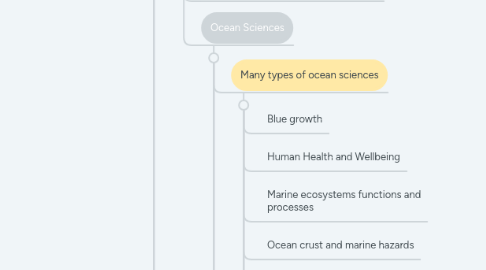
9.2.4. Ocean Sciences
9.2.4.1. Many types of ocean sciences
9.2.4.1.1. Blue growth
9.2.4.1.2. Human Health and Wellbeing
9.2.4.1.3. Marine ecosystems functions and processes
9.2.4.1.4. Ocean crust and marine hazards
9.2.4.1.5. Ocean and climate
9.2.4.1.6. Ocean heallth
9.2.4.1.7. Ocean observation and marine data
9.2.4.1.8. Ocean technology
9.2.4.2. Head of section : M. Salvatore Arico (Italy)
9.2.4.3. Missions :
9.2.4.3.1. Fostering knowledge generation in IOC Member States through the design and pursuit of common research agendas
9.2.4.3.2. Identify protocols to support systematic observation of ocean's features
9.2.4.3.3. Elucidate ocean questions related to ocean hazards other than tsunamis (e.g. HABs)
9.2.4.3.4. Keywords :
9.2.4.4. Actions :
9.2.4.4.1. Build capacities in ocean science in terms of scientific, legal and institutional structure.
9.2.4.4.2. Keywords :
9.2.4.5. Main topics :
9.2.4.5.1. Blue Carbon
9.2.4.5.2. Climate Change and the Ocean
9.2.4.5.3. Ocean Acidification
9.2.4.5.4. Ocean Deoxygenation and Eutrophication
9.2.4.5.5. Ocean Science Capacity
9.2.4.5.6. Harmful Algal Blooms and Health
9.2.4.5.7. Marine Plastics
9.3. 4 High Level Objectives
9.3.1. Ecosystem health
9.3.1.1. Healthy ecosystems and sustained services
9.3.2. Ocean Hazards
9.3.2.1. Enhanced early warning and preparedness
9.3.3. Climate Change
9.3.3.1. Increased resilience of ocean-based activities to climate change
9.3.4. Enhanced Scientific Knowledge
9.3.4.1. Better understanding of emerging issues
9.3.5. Keywords :
9.3.5.1. Just look above, it's quite pragmatic already. I just wanted to greenlight it and show you you need to come back to this in final revision
9.4. IOC Regional Sub-Commissions
9.4.1. Adapts IOC's agenda to specific geopolitical considerations
9.4.1.1. Africa and Adjacent Island States
9.4.1.2. Caribbean and Adjacent Regions
9.4.1.3. Western Pacific
9.4.1.4. Central Indian Ocean
9.4.1.5. Keyword :
9.4.1.5.1. 4 regional sub-commissions
9.5. Project Offices
9.5.1. Offices spread out across the world focusing on precise IOC projects
9.5.1.1. Bridgetown, Barbados
9.5.1.2. Brest, France
9.5.1.3. Copenhagen, Denmark
9.5.1.4. Ostend, Belgium
9.5.1.5. Jakarta, Indonesia
9.5.1.6. Nairobi, Kenya
9.5.1.7. Muscat, Oman
9.5.1.8. Port-au-Prince, Haïti
9.5.1.9. Keywords :
9.5.1.9.1. 8 project offices around the world
10. Global Ocean Science Report
10.1. Findings
10.1.1. States tend to follow ocean science conclusions in their sustainable development policies
10.1.1.1. Highlighted benefits to society contribute to this dynamic
10.1.1.2. On the other hand, they remain underexploited
10.1.2. Financing to ocean sciences is way bellow the ambition it requires to properly scale up
10.1.2.1. An average of 1,7% of R&D budgets are dedicated to ocean science
10.1.2.2. When compared to the GDP, countries such as Guinea, Mauritania, Mozambique and Benin invest more than Canada, Australia and other developed countries
10.1.3. Women are underrepresented in ocean sciences
10.1.3.1. 37% of researchers are women
10.1.3.2. Some countries have as few as 7% women in the field
10.1.4. Young oceanographers are not well recognized and don't benefit from enough opportunities
10.1.4.1. Developing countries tend to have younger researchers
10.1.4.2. In developed countries such as Canada, more than 50% of researchers are older than 45
10.1.5. Huge inequalities in technical capacities remain across regions
10.1.5.1. Short-term financing dynamics enhance this phenomenon
10.1.6. Publications on ocean research are on the rise, especially in East and South-East Asia
10.1.6.1. 10% increase in Asia
10.1.6.2. Internationally signed articles went from 52% (2000) to 61% (2020)
10.1.6.3. Only 5% of research is carried at the international scale, 11% at global scale
10.1.7. Many countries don't have the means to properly manage ocean data
10.1.7.1. Has a direct impact on data sharing
10.1.7.2. Only 57 countries have national institutions for data management
10.1.7.3. Less than 50% of Latin America and the Caribbean has a national data sharing policy
10.1.7.4. 60% of countries continue to restrict the access to certain types of data
10.1.7.5. Most of the infrastructure is in the hand of few States : the US owns 33% of the global fleet
10.1.7.6. 23 countries own the entire fleet
10.1.8. The Ocean State Reports helps systematically monitor SDG 14.A. We need similar initiatives on all the SDG's subgoals.
10.2. How to foster international cooperation in ocean research?
10.2.1. Finance international research administration councils
10.2.2. Finance exchange programs
10.2.3. Finance advisory positions in national and regional institutions
10.2.4. Finance invited researcher positions in the academic world
10.3. Recommendations
10.3.1. I. Augment financing of ocean science
10.3.1.1. Diversify sources of financing
10.3.1.2. Invite financing mechanisms to make of ocean science a priority
10.3.2. II. Uniformly and continuously collect data at the global scale on investment being done in ocean science to underline positive benefits
10.3.3. III. Facilitate cooperation around ocean science by involving diverse stakeholders in co-designing research and co-developing solutions
10.3.3.1. Operationalize research
10.3.3.2. Encourage stakeholder appropriation of issues
10.3.4. IV. Develop multi-stakeholders partnerships in ocean solutions
10.3.4.1. Knowledge, skills and tech transfers
10.3.4.2. Capacity building
10.3.4.3. Diverse partnerships : public-private, north-south, south-south
10.3.5. V. Foster equality of access to research
10.3.5.1. Gender equality
10.3.5.2. Generational equality
10.3.5.3. Foster diversity
10.3.5.4. Valuing indigenous and local knowledge
10.3.6. VI. Identify needs in order to tackle obstacles to equality in research
10.3.7. VII. Identify and assess obstacles in access to data and technology around the globe
10.3.8. VIII. Develop ocean-related education and communication both in the formal and informal sector to make ocean science more central for diverse stakeholders
11. SDG 14 - Life below water
11.1. i. Reduce marine pollution
11.2. ii. Protect and restore marine ecosystems
11.3. iii. Reduce ocean acidification
11.4. iv. Build sustainable fisheries
11.5. v. Protect and restore coastal areas and ecosystems
11.6. vi. End subsidies contributing to overfishing
11.7. vii. Increase social and economic benefits linked to a sustainable use of marine resources
11.8. a. Enhance skills, knowledge, capacities and technologies for ocean health
11.9. b. Support small fishers and provide them access to the market
11.10. c. Strengthen ocean governance and enforce international law of the sea
12. Ocean Sciences Issues revision
12.1. Ocean Acidification
12.1.1. The ocean absorbs around 30% of all CO2 emissions
12.1.2. Observations of the last 20-30 years show a clear decrease in ocean pH caused by an increase in CO2 disolved in the water
12.1.3. Modifies the ecosystemic conditions and threatens many species that cannot thrive in these conditions
12.1.4. Competes with clams and other shell animals for carbonates
12.1.5. Bleach coral reefs which host 25% of all marine life
12.2. Ocean Deoxygenation
12.2.1. Eutrophication
12.2.1.1. Nutrients (nitrogen, phosphorus) run off from on-land activities and feed invasive species that proliferate in uncontrollable quantities
12.2.1.2. Invasive species block sunlight and are often toxic for the ecosystem, hence causing the death of specimens that decompose
12.2.1.3. By decomposing, algae and fish create CO2 and reduce the ecosystem's capacity to create O2. The concentrations decrease sharply and dead zones get created
12.2.2. Ocean warming
12.2.2.1. By increasing temperature, the ocean can't contain nearly as much oxygen as it did before, worsening the impacts caused by eutrophication
12.2.2.2. CO2 dissolves in the water and compete with oxygen too, which accentuates the phenomenon
12.3. Climate Change
12.4. Plastic Pollution
12.5. Harmful Algal Blooms
12.6. Blue Carbon
13. Part of the UNESCO
13.1. About
13.1.1. Created in 1946
13.1.2. 193 Member States
13.1.3. Mission : Build peace through international cooperation in the fields of education, science and culture
13.1.4. Devise : Since wars begin in the minds of men and women, it is in the minds of men and women that the defences of peace must be constructed
13.2. Structure
13.2.1. General Director : Mme Audrey Azoulay (France)
13.2.2. General Conference
13.2.2.1. 193 Member States
13.2.2.2. Meeting every two years
13.2.2.2.1. Review the work of the UNESCO and Member States
13.2.2.2.2. Define orientations for the upcoming two years
13.2.2.2.3. Elect the Executive Council
13.2.3. Executive Board
13.2.3.1. 58 Elected States from the 5 geographical groups
13.2.3.1.1. 2 years terms
13.2.3.2. Meeting twice a year
13.2.3.2.1. Prepare the General Conference
13.2.3.2.2. Review the work done by the secretariat according the the 2 years plan
13.2.3.2.3. Operationalizes the decisions taken in General Conference to set a plan of actions for the secretariat
13.2.4. Secretariat
13.2.4.1. More than 700 employees
13.2.4.2. 53 offices around the wold
13.2.4.3. Carry UNESCO's programmes
13.2.4.4. 5 sections
13.2.4.4.1. Education
13.2.4.4.2. Culture
13.2.4.4.3. Natural Sciences
13.2.4.4.4. Human and Social Sciences
13.2.4.4.5. Communication and Information
14. Ocean-Climate Platform
15. Blue Carbon Report 2021
16. ECO - Ocean Decade Edition
17. Ocean Statistics
17.1. 80% of marine pollution comes from land-based sources
17.2. 96% of global trade uses the sea
17.3. The yearly economic worth of the ocean is of 3T$
17.4. 40% of humankind lives at less than 100km from the coast
17.5. 13 out of 20 megacities are coastal
17.6. 500M people directly rely on ocean resources for their livelihood
17.7. The ocean directly feeds 50% of the world's population
17.8. 33% of all fish species are overexploited
17.9. 66% of all fish species are exploited at maximum threshold
17.10. Key species such as tuna and cod have seen their populations decrease by 90% in the last 30 years
17.11. 25% of all marine species live in coral reef ecosystems
17.12. 93% of global warming happens in the ocean
17.13. The ocean generates 50% of the air we breathe
17.14. The ocean acts as a carbon sink for 30% of our CO2 emissions
17.15. Blue carbon ecosystems such as mangroves and marine meadows lock 10 times more carbon than land forests
17.16. 37% only of ocean science researchers are women
17.17. 82% of all ocean sciences comes from only 45 contries
17.18. Only 57 countries have a national ocean science data institute
17.19. Less than 50% of Latin America has a national policy on data sharing
17.20. 69% of students in international cooperation programmes and event in ocean sciences come from Europe and North America
17.21. Ocean science represents an average of 1,7% of R&D expenses from States
17.22. The pH of the ocean is decreasing at a rate never seen in the last 300M years
17.23. By 2040, the ocean pH could be the lowest it's been in the last 20M years
17.24. 61% of ocean research is co-signed by an international committee
17.25. 23 countries own the entire research fleet for the world
17.26. 60% of countries still limit the access to certain types of data in ocean science
17.27. Collapsed reefs can't protect from storms
17.28. Estimated 1 to 8 million undiscovered species in reef ecosystems
18. Quotes
18.1. Sylvia Earle
18.1.1. American marine biologist
18.1.1.1. "The actions we take in the next 10 years will define the state of the ocean for the next 10 000 years."
18.2. Jacques-Yves Cousteau
18.2.1. French marine biologist
18.2.1.1. "On aime ce qui nous émerveille, et l'on protège ce que l'on aime."