

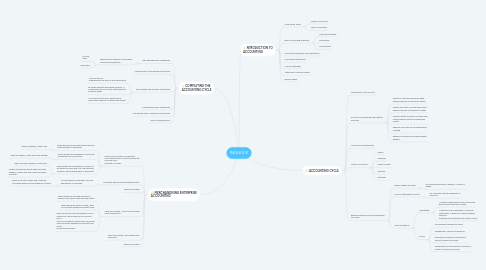
1. COMPLETING THE ACCOUNTING CYCLE
1.1. Matching Revenues & Expenses
1.1.1. There are two methods of recording revenues and expenses
1.1.1.1. Accrual basis
1.1.1.2. Cash basis
1.2. Introduction to the Adjustment Process
1.3. Work Sheets and Financial Statements
1.3.1. The first step of preparing a work sheet is the trial balance
1.3.2. Once the adjusted trial balance proves, if is separated into an income statement and a balance sheet
1.3.3. All columns of the work sheet should have equal balances for debits and credits
1.4. Preparing Financial Statements
1.5. Journalizing & Posting Closing Entries
1.6. The Accounting Cycle
2. MERCHANDISING ENTERPRISE ACCOUNTING
2.1. Entries for Purchases Transactions Accounting Entries Used to Record the Purchase And Payment of Goods
2.1.1. When goods are purchased with cash, the following entry is necessary
2.1.1.1. debit Purchases, credit Cash
2.1.2. When goods are purchased on credit, the following entry is necessary
2.1.2.1. debit Purchases, credit Accounts Payable
2.1.3. When goods are purchased on credit, but are paid back early due to a cash discount incentive, the following entry is necessary
2.1.3.1. debit Accounts Payable, credit Cash
2.1.3.2. credit Purchases Discount debit Accounts Payable, credit Cash, and credit Purchases Discount
2.2. Purchases Returns and Allowances Rules
2.2.1. If merchandise is returned or a price adjustment is necessary
2.2.1.1. debit Accounts Payable and credit the Purchases Returns and Allowances account
2.3. Sales Accounting
2.4. Sales Accounting - Rules for Recording Sales transactions
2.4.1. When goods are sold and payment is made in cash, debit Cash and credit Sales
2.4.2. When goods are sold on credit, debit Accounts Receivable and credit Sales
2.4.3. When goods are sold through the use of a credit card, there often will be a service fee. In such circumstances, debit Cash and Credit Card Collection Expense (for the fee) and credit Accounts Receivable
2.5. Sales Accounting - Recording Sales Discounts.
2.6. Sales Accounting
3. NTRODUCTION TO ACCOUNTING
3.1. Accounting fields
3.1.1. Private accounting
3.1.2. Public accounting
3.2. Basic Accounting principles
3.2.1. Sole Proprietorship
3.2.2. Partnership
3.2.3. Corporations
3.3. Accounting equations and transactions
3.4. Accounting statements
3.5. Income statement
3.6. Statement of owner’s equity
3.7. Balance sheet
4. ACCOUNTING CYCLE
4.1. Introduction to an account
4.2. Rules for Increasing and Decreasing accounts
4.2.1. Asset accounts normally have debit balances and are increased by debits
4.2.2. Liability accounts normally have credit balances and are increased by credits
4.2.3. Owner's equity accounts normally have credit balances and are increased by credits
4.2.4. Revenue accounts are increased when credited
4.2.5. Expense accounts are increased when debited
4.3. Normal Account Balances
4.4. Chart of Accounts
4.4.1. Assets
4.4.2. Liabilities
4.4.3. Owner's equity
4.4.4. Revenue
4.4.5. Expenses
4.5. Balance Sheet and Income Statement Accounts
4.5.1. Balance sheet accounts
4.5.1.1. are classified as assets, liabilities, or owner's equity.
4.5.2. Income statement accounts
4.5.2.1. are classified as either expenses or revenues
4.5.3. The Trial Balance
4.5.3.1. Advantage
4.5.3.1.1. It reveals mathematical errors since total debits must equal total credits
4.5.3.1.2. It assists in the preparation of financial statements. It should be noted, however, that trial balances cannot detect every type of error
4.5.3.2. Errors
4.5.3.2.1. Journalizing a transaction twice
4.5.3.2.2. Forgetting to record a transaction
4.5.3.2.3. Entering an erroneous but identical amount in debit and credit
4.5.3.2.4. Posting part of a transaction as a debit or credit to the wrong account