
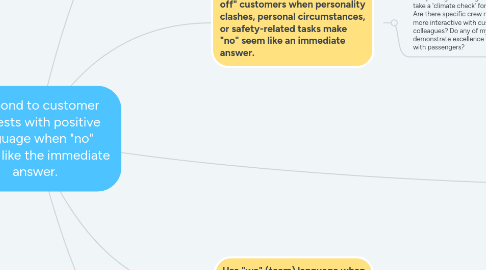
Respond to customer requests with positive language when "no" seems like the immediate answer.
Respond to customer requests using positive language instead of saying "no."

1. Repeat already-stated information when customers ask questions that require the same response. (ex. avoid saying "As I already said...").
2. Share a personal 'story' with the customer to demonstrate empathy and understanding of his/her situation (ex. "I've been there before...") instead of saying "no".
2.1. If the passenger request is not feasible, share that his/her experience is being escalated to the customer experience team and will receive a follow-up response.
2.1.1. If passenger continues request, show understanding again by using I statements (ex. I've been there before...").
2.1.1.1. If time permits, show the passenger that his/her complaint/request has been sent to the customer experience team by briefly showing the written FACTS report on a personal SkyPro.
2.1.1.1.1. Assure the passenger a representative from the customer experience team will be in contact with him/her.
3. Use crew coordination to "pass off" customers when personality clashes, personal circumstances, or safety-related tasks make "no" seem like an immediate answer.
3.1. Use pre-flight briefings and pick-ups to take a 'climate check' for the day. Think: Are there specific crew members that are more interactive with customers and colleagues? Do any of my colleagues demonstrate excellence while interacting with passengers?
3.1.1. If personal circumstances or prior interactions make "no" seem like an immediate response, respectfully tell the passenger a crew member that will be able to assist is being paged.
3.1.1.1. Use an interphone away from the customer to page to page an available crew member.
3.1.1.1.1. Brief the paged crew member on the passenger situation and previous interaction.
4. Share with the passenger what can be done rather than what cannot when "no" seems like an immediate answer (ex. Let's see if we can come up with a solution together.").
4.1. If "no" seems like the immediate solution, recall the service recovery options (ex. miles, drink vouchers, in-flight seat upgrades) and offer a choice to the passenger.
4.1.1. If service recovery options are not sufficient to resolve the issue, tell the passenger his/her concern is being forwarded to the customer experience team and will receive a follow up.
4.1.1.1. Show empathy and understanding by apologizing to the customer.
4.1.1.1.1. Explain that his/her situation is being escalated to the customer experience team for a follow-up response.
5. Use "we" (team) language when customers are combative when "no" seems like an immediate answer (ex. Let's see if we can find a solution.).
5.1. Ask the customer for his or her name to personalize the interaction and deescalate immediate tension.
5.1.1. Address the passenger by the name given.
5.1.1.1. If safety-related tasks are a priority and the customer needs further assistance, tell the passenger you are paging an available flight attendant that is able to assist him/her.
5.1.1.1.1. Use an interphone away from the passenger to page an available flight attendant.
5.1.1.2. Use "we" statements (ex. Let's see if we can find a solution...") to address passenger requests when "no" seems like an immediate answer.
5.1.1.2.1. Apologize to the customer for his/her experience with "us" today.