
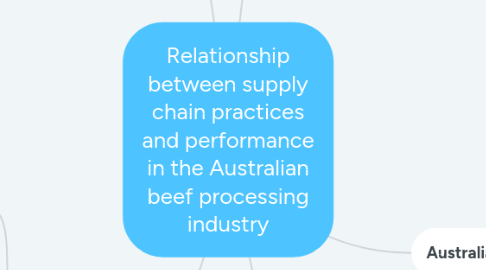
Relationship between supply chain practices and performance in the Australian beef processing ind...


1. Conceptual model
1.1. Framework elements
1.1.1. Explanatory variables
1.1.1.1. Strategic alliance
1.1.1.1.1. Co-operative and collaborative between buyers and suppliers
1.1.1.2. Customer focus
1.1.1.2.1. Process of identifying, establishing, maintaining, enhancing, terminating relationships with customers and other stakeholders
1.1.1.2.2. Aware of customers' need
1.1.1.2.3. Improved customer retention
1.1.1.3. Information sharing
1.1.1.3.1. High degree of cooperative behavior
1.1.1.3.2. Share operating information
1.1.1.3.3. Jointly plan strategies
1.1.1.4. Information quality
1.1.1.4.1. Accuracy
1.1.1.4.2. Timeless and proper formatting
1.1.1.5. Lean system
1.1.1.5.1. Driving out waste and unnecessary cost
1.1.2. Supply chain performance indicator
1.1.2.1. Food quality
1.1.3. Antecedent cooperative behavior
1.1.3.1. Trust and commitment
1.2. Hypothesis
1.2.1. H0 : No causal relationship exist between Supply chain performance and the explanatory variables
1.2.2. H1: A causal relationship exist between Supply chain performance and the explanatory variables
1.3. Data collection
1.3.1. Mail questionnaire survey
1.3.1.1. 140 completed and usable were returned
1.4. Analysis
1.4.1. Confirmatory factor analysis
1.4.2. Discriminant and convergent validity
1.5. stepwise multiple regression analysis was performed
2. Beef processing industry
2.1. Volatile profitability
2.1.1. Growing transport cost due to rising oil prices
2.1.2. High electricity cost
2.1.3. Low capacity utilization
2.2. Supply chains
2.2.1. Fully integrated
2.2.1.1. Cattle from feedlot/farm to processors and to end customers
2.2.2. Partially integrated
2.2.2.1. Slaughtering to end customers
2.2.2.2. Producing to slaughtering
3. Limitations
3.1. SCP only focus on food quality
3.2. Others SC practice not focused
3.2.1. Time
3.2.2. Cost
3.2.3. Flexibility
4. SC practices having positive effects on food quality
4.1. Strategic alliance
4.1.1. Forming strategic relationship between supplier chain partners
4.1.1.1. High level of buyer dependency
4.1.1.2. Maintaining cost
4.1.1.3. Operation effective
4.1.2. Industry is vertically integrated with large processors
4.1.2.1. Competitive advantages
4.1.2.1.1. Economies of scale
4.1.2.1.2. Processing innovation
4.2. Information quality
4.2.1. Highest positive effect
4.2.2. Provide facts for decision making
4.2.3. Can affect information sharing
4.2.4. Enhancing information quality
4.2.4.1. Important measures
4.2.4.1.1. Video Image Analysis Scan (VIAscan) Technology
4.2.4.1.2. AUS-MEAT Information System (AMIS) and web-based solutions
4.2.4.1.3. The VIAscan Chiller Assessment Systems
4.3. Trust and commitment
4.3.1. Increasing the value to customers
4.3.2. Long term cooperation between sellers and buyers
5. Australia plants
5.1. Competitive disadvantage
5.1.1. Plants lack of economies of scale and integration
5.1.2. Against USA and Brazil
5.2. Improve profitability
5.2.1. Consolidation and greater integration of meat production processing and retailing
5.3. Challenges
5.3.1. Carbon tax on agriculture section in 2012
5.3.2. Usage of electricity, particularly for refrigeration
5.3.3. Regulatory challenges and restraints
5.3.3.1. Food Safety
5.3.3.2. Product labelling