
Components and Subcomponents of your learning environment

Components and Subcomponents of a learning environment.

Components and Subcomponents of your learning environment
von JENNIFFER LISSETTE RIVERA ROSARIO
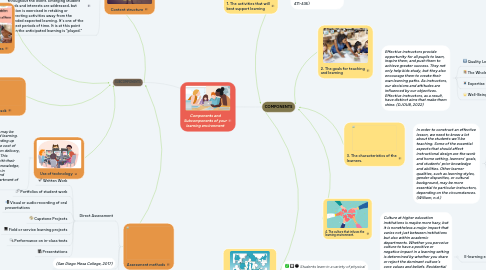
1. SUBCOMPONENTS
2. Content structure
2.1. Create a variety of personalised and socialized learning activities for the learner. The responsibility of the instructor is to maintain instructional intentionality throughout the event. Emerging student needs and interests are addressed, but caution is exercised in retaking or redirecting activities away from the intended expected learning. It's one of the longest periods of time. It is at this point when the anticipated learning is "played."
3. Practical activities
3.1. Hands-on learning aids pupils in remembering knowledge for longer periods of time and improves concept understanding more effectively than hearing. Students begin learning practically at a young age through numerous activities such as playing outdoor and indoor games, building models and buildings, and observing items in their environment, among others. (Embibe Beta, 2020)
4. Feedback
4.1. Feedback is an important part of the teaching and learning process since it informs the learner about what he or she has done well or poorly. It entails assisting the student in determining which objectives have been met and which have not, and in deciding where to focus his or her efforts. This assistance might be provided both during and after an activity. (Fernández, 2020)
5. Use of technology
5.1. In a number of ways, technology may be utilized to help both teaching and learning. It can boost productivity by speeding up the learning process, lowering the cost of educational materials and program delivery, and better using instructor time. This paradigm connects instructors with their students as well as professional knowledge, tools, and systems to assist them in improving their own education and personalizing learning. (U.S. Department of Education, n.d.)
6. Assessment methods
6.1. Direct Assessment
6.1.1. Written Work
6.1.2. Portfolios of student work
6.1.3. Visual or audio recording of oral presentations
6.1.4. Capstone Projects
6.1.5. Field or service learning projects
6.1.6. Performance on in-class tests
6.1.7. Presentations
6.2. (San Diego Mesa College, 2017)
6.3. Indirect Assessment
6.3.1. Surveys
6.3.2. Course Evaluations that you create to garner specific information from students
6.3.3. Curriculum and Syllabus Analysis
6.3.4. External Reviewers
7. COMPONENTS
8. 1. The activities that will best support learning
9. 2. The goals for teaching and learning
10. 3. The characteristics of the learners.
11. 4. The culture that infuses the learning environment.
12. 5. School policies, governance structures, and other features may also be considered elements of a “learning environment.”
13. The teacher's primary goal is to get pupils to participate in learning activities that are likely to lead to [the desired learning outcomes]. It's crucial to remember that the student's actions are more significant than the teacher's. (Shuell, 1986, 411-436)
13.1. Content Focus and Interaction
13.1.1. Live online or on-campus conferencing
13.1.2. Reading/assigned text
13.1.3. Multimedia Content
14. In order to construct an effective lesson, we need to know a lot about the students we'll be teaching. Some of the essential aspects that should affect instructional design are the work and home setting, learners' goals, and students' prior knowledge and abilities. Other learner qualities, such as learning styles, gender disparities, or cultural background, may be more essential to particular instructors, depending on the circumstances. (William, n.d.)
14.1. Increased diversity
14.2. The work and home context
14.3. Learners’ goals
14.4. Prior knowledge or skills
14.5. Digital natives
15. Effective instructors provide opportunity for all pupils to learn, inspire them, and push them to achieve greater success. They not only help kids study, but they also encourage them to create their own learning paths. As instructors, our decisions and attitudes are influenced by our objectives. Effective instructors, as a result, have distinct aims that make them shine. (DJOUB, 2022)
15.1. Quality Learning
15.2. The Whole Community
15.3. Expertise
15.4. Well-Being
16. Culture at higher education institutions is maybe more hazy, but it is nonetheless a major impact that varies not just between institutions but also within academic departments. Whether you perceive culture to have a positive or negative impact in a learning setting is determined by whether you share or reject the dominant culture's core values and beliefs. Residential schools, which were frequently forcibly put on aboriginal children in Canada, are an excellent illustration of how culture influences how schools run. (Teaching in a Digital Age, n.d.)
16.1. E-learning environment
16.1.1. mutual respect
16.1.2. evidence-based argument and reasoning
16.1.3. transparency in assessment
16.1.4. collaboration and mutual support