

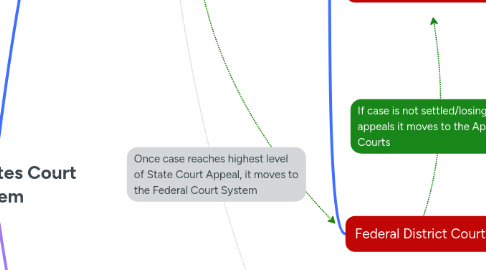
1. Federal Court System
1.1. Federal Supreme Court
1.1.1. Highest court
1.1.2. Nine Justices
1.1.2.1. One chief justice
1.1.2.2. Eight other justices
1.1.3. Both Appellate and Original Jurisdiction
1.1.3.1. Appellate jurisdiction if the federal judciary has jurisdiction
1.1.3.2. Original jurisdiction if:
1.1.3.2.1. the case is dealing with Ambassadors or public Ministers/Consuls
1.1.3.2.2. a U.S. State is a party
1.1.4. Supreme Court Process
1.1.4.1. If SCOTUS refuses to hear
1.1.4.1.1. Case dismissed
1.1.4.1.2. Lower court decision stays
1.1.4.2. Agree to hear
1.1.4.2.1. **Rule of Four** - four or more justices must agree to hear a case
1.2. Federal Appellate Courts
1.2.1. 13 Courts
1.2.1.1. 11 over regionally based circuits
1.2.1.2. 1 over Washington D.C
1.2.1.3. 1 dealing with international trade and patent law
1.2.2. Appellate Jurisdiction only
1.2.2.1. Case can be affirmed, confirming
1.2.2.2. Case can be reversed, overturning district court decision
1.2.2.3. Case can be remanded, sending the case back to the lower courts
1.3. Federal District Courts
1.3.1. Lowest federal court
1.3.2. Cases where Federal Gov. is party start here
1.3.3. 94 Courts
1.3.4. Original Jurisdiction Only
2. State Court System
2.1. State Supreme Courts
2.1.1. 51 State Supreme Courts
2.1.2. Highest State Court/Final Level of Appeal
2.2. Lower State Courts
2.2.1. Deal with state judicial issues
2.2.2. Most court cases start here
2.2.3. Some states have intermediate appellate courts
2.3. Special State Courts
2.3.1. Probate, juvenile, family, and other specialized state courts