


1. Opisthotonos- Prolonged arching of the back, with head and heels bent backwards. This indicates meningeal irritation, such as with meningitis.
2. Paralysis- decreased loss of motor power caused by a problem with motor nerve, or muscle fibers. Causes: trauma, stroke, etc. Patterns: hemiplegia: flaccid to one side. Paraplegia- symmetrical paralysis of both lower extremities. Quadriplegia- paralysis of all four extremities.
3. The Brain
3.1. Frontal: personality, behavior, emotions. Intellect
3.2. Broca: motor speech🡪 expressive aphasia
3.3. Parietal: center for sensation
3.4. Occipital: visual perception
3.5. Temporal: auditory perception (hearing, taste and smell)
3.6. Wernicke’s: language comprehension🡪 receptive aphasia, person hears sound, but does not understand the meaning.
3.7. Cerebellum: balance and coordination, located in occipital lobe.
3.8. Hypothalamus: respiratory center, VS control, ANS activity, stress response, pituitary regulator, sex, appetite, controls sleep.
3.9. Thalamus: sensory pathway station🡪 human emotions and creativity
3.10. Cerebellum- Under the occipital lobe, Motor coordination, voluntary movement, equilibrium, muscle tone.
3.11. Brain stem- is the central core of the brain consisting mostly of Nerve fibers. Cranial nerves 3 through 12 originate from nuclei in the brainstem. It has three areas.
3.12. Midbrain- the most anterior part of the brainstem. It merges into the thalamus and hypothalamus it contains many motor and neurons and tracks .
3.13. Pons-The enlarged area containing ascending sensory and descending motor tracts. It has two centers that coordinate the main respiratory Center in the medulla.
3.14. Medulla- the continuation of the spinal cord in the brain that contains all ascending and descending fiber tracts. it has vital autonomic centers, respiration, heart, GI function, a nuclei for cranial nerves 8 through 12.
4. Short leg- leg length discrepancy. Greater than 1 inch. Dislocated hip, congenital. Shortening from disease or trauma.
5. Memory loss- forgetting recently learned information. Most common early sign of dementia. A person begins to forget more often and is unable to recall information later.
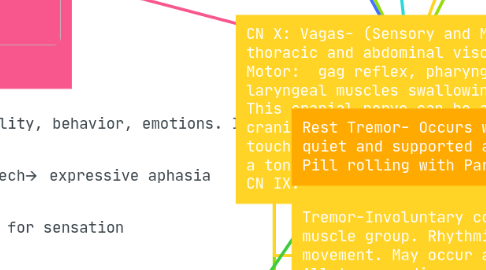
6. CN X: Vagas- (Sensory and Motor)- sensory: thoracic and abdominal viscera(organs). Motor: gag reflex, pharyngeal and laryngeal muscles swallowing and speech. This cranial nerve can be assessed with cranial nerve 1X. Test for gag reflex by touching the posterior pharyngeal wall with a tongue blade. Abnormal: same as with CN IX.
7. CN 1: Olfactory(Sensory)- Put a scent on a cotton ball as the client to smell it, see if they can identify it. Abnormal: Anosmia- decrease loss of smell. Can occur with head trauma or brain lesion.
8. Tic- involuntary, compulsive, repetitive twitching of a muscle group. (wink, grimace, head movement, shoulder shrug. Often do to a neurological cause. Tardive dyskinesias. Tourette syndrome.
9. Right Side and Left Side of the Brain Functions
10. The Aging Process
10.1. Atrophy with steady loss of neuron structure in the brain
10.2. Velocity of nerve conduction decreases, making reaction time slower
10.3. Increased delay at synapse results in diminished sensation of touch, pain, taste, and smell
10.4. Motor system may show general slowing down of movement; muscle strength and agility decrease
10.5. Progressive decrease in cerebral blood flow and oxygen consumption may cause dizziness and loss of balance
11. Glasgow Coma Scale
11.1. Glasgow Coma Scale is a standardized, objective, assessment that defines the level of Consciousness by giving it a numeric value. It assesses three criteria: Eye opening, best motor response, best verbal response.
11.1.1. Minimum score of 3
11.1.2. Max score of 15
11.1.3. Coma: 7 or less.
12. Abnormal Gaits
12.1. Spastic Hemiparesis: Arm immobile against body, with flexion of the shoulder, elbow, wrist, and fingers, adduction of the shoulder: does not swing freely. Leg is still and extended. Lesion of the corticospinal tract.
12.1.1. Scissors- Knees, cross or are in contact, like holding an orange between the thighs. The person uses short steps, and walking requires effort. Paraparesis of leg, MS.
12.2. Cerebral Ataxia- Staggering, wide, based gait. Difficulty with turns. Uncoordinated movements with positive Romberg test. Alcohol, Cerebellum, cerebellar tumor, MS
12.3. Parkinsonian- Posture is stooped, trunk is pinched forward, elbows, hips, and knees are flexed. Shuffling gait.
12.4. Steppage or foot drop- slapping quality. Looks as if walking up stairs, but there are no stairs. Lifts knee and foot high and slaps it down hard and flat to compensate for foot drop. Weakness of anterior tibial muscle, caused by lesion of spinal cord.
12.5. Waddling- Weak hip muscles, when the person takes a step, the opposite hip drops, which allows compensatory lateral movements of the pelvis. May occur with lumbar lordosis. MD, dislocation of the hips, pregnancy.
13. Deep Tendon Reflexes(DTR)
13.1. Reflex response graded on 4-point scale
13.1.1. Hyperreflexia vs hyporeflexia
13.1.2. Hyperreflexia and clonus may occur in hypertensive crisis.
13.1.3. Peripheral paralysis 🡪 Hypo
13.1.4. Brain lesions-> Hyper
13.2. Use smaller side of the hammer for smaller surfaces (upper extremities) and the larger side of the hammer for larger surfaces (lower extremities.
13.3. 4 = very brisk, hyperactive with clonus, indicative of disease
13.4. 3 = brisker than average, may indicate disease
13.5. 2 = Average, normal
13.6. 1 = diminished, low normal, or occurs with reinforcement
13.7. 0 = no response
13.7.1. Chorea- Sudden , rapid, jerky, purposeful movement involving limbs, trunk, and face. Common with Huntington disease.
14. Abnormalities of Muscle Movement
14.1. Myoclonus- Rapid, sudden jerk or short series of jerks at fairly regular intervals. Can Occur with Grand mal seizure.
14.2. Fasciculation: Rapid, continuous twitching of resting muscle or part of the muscle without movement of limbs. Presents with atrophy and weakness. Occurs from cold exposure or fatigue.
14.3. Intention Tremor- rate varies, worse with voluntary movement, as in reaching toward a visually guided target. Occurs with cerebellar disease and MS.
15. Rest Tremor- Occurs when muscles are quiet and supported against gravity, in lap. Pill rolling with Parkinson’s.
16. Tremor-Involuntary contraction of opposing muscle group. Rhythmic back and forth movement. May occur at rest or voluntary. All tremors disappear while sleeping. Parkinsons, stroke, MS.
17. Athetosis- Slow, twisting, writhing, continuous movement resembling a snake or worm. Occur with Cerebral palsy.
18. Warning Signs of Alzheimer Disease
18.1. Losing Track-Difficulty performing usual tasks. Loose track of steps. Example: meal preparation.
18.2. Forgetting words- Often forget simple words, and substitute unusual words.
18.3. Getting Lost: Disorientation to time and place. Often get lost in their own neighborhood.
18.4. Abstract Failing- Problem with abstract thinking. Example: being able to pay bills, balance a checkbook.
18.5. Poor Judgement- Such as wear inappropriate clothing, giving away large amounts of money, falling for scams.
18.6. Losing Things- Misplacing. Putting things in unusual places such as the iron in the freezer.
18.7. Mood Swings- Changes in behavior. Mood swings, anger, tears.
18.8. Personality Change- May become confused, suspicious, fearful even of family members.
18.9. Growing Passive: Loss of initiative in normal activities. Watch TV and sleep more.
19. Racial/Ethnic Disparity noted relative to strokes
19.1. 4% of African Americans have had a stroke
19.2. 2.5% of Hispanics have had a stroke
20. Flaccid quadriplegia(paralysis) - complete loss of muscle tone and paralysis of all four extremities indicating completely non-functional brain stem.
21. Decorticate-Upper extremities- Flexion of arms, wrists, and fingers. adduction of arms tight against the thorax. lower extremities- extension, internal rotation, plantar flexion. this indicates hemispheric lesion of cerebral cortex.
22. 6% of American Indians/Alaska Natives have had a stroke
23. Inability to discriminate🡪 lesions in sensory cortex
24. Decerebrate- Upper extremity stiffly extended. Adducted, internal rotation, Palms pronated. Lower extremities stiffly extended plantar flexion, teeth clenched, hyperextended back. Worse than decorticate. indicates lesion in brain stem at Mid brain or upper Pons.
25. Graphesthesia- Is the ability to read a number by having it traced on the skin. with the person's eyes closed use a blunt instrument to trace a single digit number or letter on the palm. Ask the person to tell you what it is. Inability to identify may be caused by a lesion in the sensory cortex.
25.1. Stereognosis- With the patient's eyes closed, place a familiar object such as a paperclip in the person's hand and asked them to identify it. Normally a person will explore it with the fingers and correctly named it. Test a different object in each hand, testing the left-hand assesses right parietal lobe function
26. CN 1X- Glossopharyngeal- (Sensory and Motor)- Taste posterior one third of tongue. Gag reflex. Have the Patient open their mouth and say “ahhh”, note that the palate rises symmetrically. Test for gag reflex by touching the posterior pharyngeal wall with a tongue blade. assess the sound of the patient's voice should be smooth and not strained. Assess swallowing. Abnormal: Absence of symmetry of soft palate movement of tonsillar pillar movement following a stroke, dysfunction in swallowing increases risk for aspiration. Hoarse or brassy voice occurs with vocal cord dysfunction. Same with CN X.
27. CN V111- Vestibulocochlear/Acoustic(sensory) Hearing and balance. Whisper test, Rinne test, Romberg test. Abnormal: inability to hear or problems with coordination and balance.
28. If they do it is noted as a positive Romberg
29. T6 through T12- sympathetic nervous system. Heart, blood vessels, temperature.
30. Coordination of Skilled Movement
31. Spinal Column
31.1. Brainstem- parasympathetic nervous system. Cranial nerves 111, V11, 1X, and X . Injury most severe, the higher up.
31.2. C1 through C5- phrenic nerve 2 diaphragm, respirations.
31.3. T1 through T5- the arm and respirations
31.4. S1-S5- parasympathetic nervous system, bowel, bladder
31.5. L1 through L5- legs
31.6. The peripheral nervous system, or PNS, consists of the nerves and ganglia outside of the brain and the spinal cord. The main function of the PNS is to connect the central nervous system (CNS) to the limbs and organs.
31.7. The peripheral nervous system or PNS contains the nerves, which leave the brain and the spinal cord and travel to certain areas of the body. The peripheral nervous system's main job is to send information gathered by the body's sensory receptors to the CNS as quickly as possible.
32. Genetics and Culture
32.1. Stroke belt: Mississippi, Tennessee, Louisiana, Kentucky, Georgia, North Carolina, Alabama, South Carolina, Arkansas, Indiana and Virginia. In Mississippi, With North Carolina, South Carolina, Georgia are the highest of the stroke belt. This disparity is due to partly and increased incidence of risk factors: high blood pressure, diabetes, atrial fibrillation, hyperlink lipidemia, smoking, and inactivity.
33. Assessment of Motor System
33.1. Assess muscles for size strength and tone. Abnormal findings include: atrophy, limited range of motion, pain with motion, Flaccidity, spasticity and rigidity,can occur with Central weakness. There should be no involuntary movements such as ticks or intentional tremors. Abnormal: dysmetria- lack of of coordination: slow, clumsy, sloppy, can occur with a cerebellar disease.
33.2. ask the person to pat the hands with both hands, lift up, turn hands over, and path with the backs of the hands. Then ask the person to do this faster normally this is done relatively quickly. Abnormal: lack of coordination, slow, clumsy, May indicate cerebellar disease.
33.3. Rapid alternating movements
33.3.1. Used to distinguish the subtypes of cerebellar disease.
33.4. Finger to finger test
33.5. ask the person to touch each finger to the thumb, and then in the reverse Direction. Normal finding: is it is done quick and accurate. Abnormal: lack of coordination. cerebellar disorders alcohol intoxication.
33.6. test lower extremity coordination by asking the person who was in a Supine position to place the heel of the opposite knee and run it down the shin from the knee to the ankle. A normal finding the person moves to heal in a straight line. Normal findings the same as the finger to finger and finger to nose test.
33.6.1. with a person's eyes open, ask them to use the index finger to touch their fingers and then to touch their nose. after a few minutes have then move the finger to a different spot normal findings should be smooth and accurate. abnormal findings the same as for the finger to finger test.
33.7. Nose to finger test
33.8. Heel to shin
33.8.1. Walking in a straight line with the front foot placed such that its heel touches the toe of the standing foot. Purpose:
33.9. Tandem Walking
33.9.1. Exacerbates all gait problems (especially those of vestibular in origin),
33.9.2. Ask the patient to close both eyes for 30 seconds
33.9.3. Used by law enforcement to test for intoxication.
33.10. Romberg
33.10.1. Patient should stand with feet together on level ground, arms at their sides, and eyes open
33.10.2. The examiner should stand facing the patient with their arms out, without touching them, to catch the patient if they fall
33.10.3. Observe the patient for about 20 seconds
33.10.4. Note any swaying or falling
33.10.4.1. Note the patient's ability to maintain an upright posture