


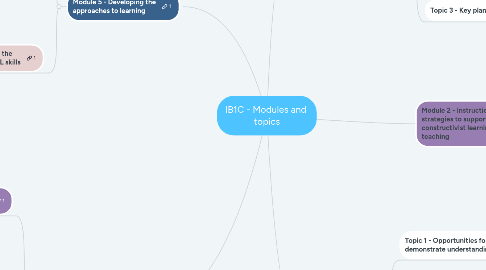
1. Module 5 - Developing the approaches to learning
1.1. Topic 1 - Strategies for the explicit teaching and implicit development of skills
1.1.1. Aims
1.1.1.1. Overview of the ATL skills
1.1.1.1.1. Strategies for the explicit teaching of ATL skills
1.1.1.1.2. Strategies for the implict development of ATL skills
1.1.2. Resources
1.1.2.1. Google slide presentation
1.1.2.2. Wakelet for the topic
1.2. Topic 2 - Strategies for the development of the ATL skills
1.2.1. Aims
1.2.1.1. The four other skill categories
1.2.1.1.1. Strategies to develop self-management skills
1.2.1.1.2. Strategies to develop social skills
1.2.1.1.3. Strategies to develop communication skills
1.2.1.1.4. Strategies to develop research skills
1.2.1.1.5. Strategies to develop thinking skills
1.2.2. Resources
1.2.2.1. Google slide presentation
1.2.2.2. Wakelet for the topic
2. Module 4 - Instructional strategies to support learner variability
2.1. Topic 1 -Strategies to foster agency
2.1.1. Aims
2.1.1.1. Agency in IB classrooms
2.1.1.1.1. Student voice
2.1.1.1.2. Student choice
2.1.2. Resources
2.1.2.1. Google Slide Presentation
2.1.2.2. Wakelet - Agency
2.2. Topic 2 - Differentiating teaching and learning
2.2.1. Aims
2.2.1.1. Differentiating context
2.2.1.2. Differentiation process
2.2.1.3. Differentiating product
2.2.2. Resources
2.2.2.1. Fliprid - Differentiation Strategies
2.2.2.2. Wakelet - Differentiated learning strategies
2.2.2.3. Google Slide Presentation
2.3. Topic 3 - Integrating technology
2.3.1. Aims
2.3.1.1. Principles of integrating technoloby
2.3.1.2. Technolgies to support collaborative learning
2.3.2. Resourcies
2.3.2.1. Wakelet - Integrating technology
2.3.2.2. Google Slide Presentation
3. Module 3 - Integrating assessment
3.1. Topic 1 - Opportunities for students to demonstrate understanding
3.1.1. Collecting information from a variety of contexts
3.1.2. Ongoing assessment
3.1.3. Formative vs summative assessment
3.2. Topic 2 - Starting with the end in mind - Designing assessment tasks
3.2.1. Assessing prior knowledge
3.2.2. Designing for assessment criteria
3.2.3. Communicating assessment expectations
3.2.3.1. Assessment policies
3.2.3.2. Task sheets
3.3. Topic 3 - Effective feedback
3.3.1. Descriptive feedback
3.3.2. Feeding back to feed forward
3.3.3. Strategies for providing feedback
4. Module 2 - Instructional strategies to support constructivist learning and teaching
4.1. Topic 1 - Making thinking visible
4.1.1. Provide an overview of visible thinking
4.1.2. Introduce strategies for making thinking visible (Graphic organizers, concept mapping...)
4.2. Topic 2 - Discussion strategies - Negotiating meaning
4.2.1. Discussion as a means of negotiating understanding
4.2.2. Types of discussion
4.2.3. Discussion strategies
4.3. Topic 3 - Strategies to contextualize learning
4.3.1. Problems, projects
4.3.2. The IB's contexts
4.3.3. Action, service as action, service
5. Module 1 - Collaborative learning environments
5.1. Topic 1 - Course overview
5.1.1. Course structure
5.1.2. Associated learning outcomes
5.1.3. Assessment details
5.2. Topic 2 - The planner and communities of practice
5.2.1. Introduction to the planner
5.2.2. Engaging with communities of practice
5.3. Topic 3 - Key planning considerations
5.3.1. Constructivism
5.3.2. Authenticity
5.3.3. Agency