


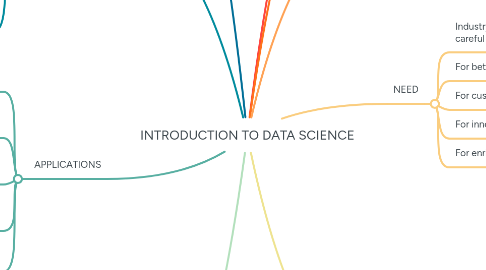
1. VENN DIAGRAM OF DATA SCIENCE
1.1. STATISTICS
1.1.1. Data Science involves statistical analysis to make sense of data, estimate probabilities, and identify patterns.
1.2. COMPUTER SCIENCE
1.2.1. Programming, data engineering, and machine learning are fundamental to handling and processing data efficiently.
1.3. DOMAIN KNOWLEDGE
1.3.1. Understanding the specific industry or domain you are working in is crucial for contextualizing data and deriving meaningful insights.
2. TERMINOLOGIES
2.1. DATA ANALYSIS
2.1.1. The process of inspecting, cleaning, transforming, and modeling data with the goal of discovering useful information, drawing conclusions, and supporting decision-making.
2.2. MACHINE LEARNING
2.2.1. A subfield of artificial intelligence (AI) that focuses on developing algorithms that enable computers to learn from and make predictions or decisions based on data.
2.3. DATA MINING
2.3.1. The practice of examining large databases to generate new information or discover hidden patterns
2.4. BIG DATA
2.4.1. Refers to extremely large and complex data sets that traditional data processing tools are insufficient to handle.
3. APPLICATIONS
3.1. BUSINESS
3.1.1. Forecasting sales, customer segmentation, and fraud detection.
3.2. HEALTHCARE
3.2.1. Disease prediction, patient outcome analysis, and drug discovery.
3.3. FINANCE
3.3.1. Risk assessment, algorithmic trading, and fraud prevention.
3.4. MARKETTING
3.4.1. Targeted advertising, sentiment analysis, and customer churn prediction.
3.5. TRANSPORTATIONS
3.5.1. Route optimization, traffic prediction, and autonomous vehicles.
4. STEPS
4.1. DATA COLLECTION
4.1.1. Involves gathering relevant data from various sources, which can be structured or unstructured.
4.2. DATA STORAGE
4.2.1. Collected data needs to be stored in a structured and secure manner. This may involve using databases, data lakes, or cloud storage solutions.
4.2.1.1. Proper data storage ensures data is easily accessible and can be managed efficiently throughout the data science project.
4.3. DATA CLEANING
4.3.1. Also known as data preprocessing, is the process of identifying errors, missing values, duplicates, and outliers. It involves data imputation, handling missing values, removing duplicates, and transforming data into a consistent format.
4.3.1.1. Clean data is crucial for accurate analysis.
4.4. DATA ANALYSIS
4.4.1. Heart of data science. In this stage, explore the data to uncover patterns, relationships, and insights
4.4.1.1. The goal is to gain a deeper understanding of the data and the problem you're trying to solve.
4.5. DATA VISUALISATION
4.5.1. An essential step to communicate your findings effectively. It involves creating charts, graphs, and visual representations of the data analysis results.
4.5.1.1. Tools like Matplotlib, Seaborn, and Tableau are commonly used for data visualization.
4.6. DECISION
4.6.1. The final step in the data science process is making informed decisions based on the insights gained from the analysis.
5. WHAT
5.1. Sudy of data
6. GOAL
6.1. To gain insight and knowledge from any type of data
7. TYPES OF DATA
7.1. STRUCTURED DATA
7.1.1. Quatitative data
7.1.1.1. Quantitative data represents information in a numerical form. It deals with measurable quantities and is often expressed as numbers.
7.1.2. Highly organized
7.1.3. eg:-age, name, address
7.2. UNSTRUCTURED DATA
7.2.1. Quanlitative data
7.2.1.1. It deals with qualities, attributes, or characteristics that can be observed but not measured in a numerical sense.
7.2.2. Difficult to deconstruct
8. NEED
8.1. Industry needs data to help make careful decisions
8.2. For better marketting
8.3. For customer acquisition
8.4. For innovation
8.5. For enriching lives
9. DATA SCIENTIST
9.1. Term coined in 2008 when companies realised the need for data professionals who are skilled in organizing and analysing massive amounts of data.
9.2. ROLE
9.2.1. Analytical experts who utilize their skills in both technology and social science to find trends and manage data.
9.2.2. Use industry knowledge, contextual understanding, skeptism of existing assumptions--to uncover solutions of business challenge.
9.3. GOAL
9.3.1. To make business grow better.
9.4. SKILLS
9.4.1. Statistics
9.4.2. Python / R
9.4.3. Excel / SQL
9.4.4. Communication skills
9.4.5. Creativity