
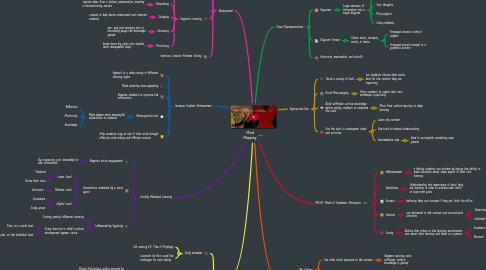
Mind Mapping

A mind map that covers the basics of what it is and its importance in education.

1. Visual Representations
1.1. Organizer
1.1.1. Large amounts of information into a single diagram
1.1.1.1. Brainstorm new ideas
1.1.1.2. Your thoughts
1.1.1.3. Plan projects
1.1.1.4. Solve problems
1.2. Diagram Format
1.2.1. Shows tasks, concepts, words, or items
1.2.1.1. Arranged around a central subject
1.2.1.2. Arranged around concept in a graphical pattern
1.3. Attractive, memorable, and colorful
2. Appropriate Use
2.1. Teach a variety of tools
2.1.1. Let students choose what works best for the content they are organizing
2.2. Avoid Photocopying
2.2.1. Allow students to create their own mindmaps organically
2.3. Build sufficient surface knowledge before asking students to complete the tools
2.3.1. Move from surface learning to deep learning
2.4. Use the tools in subsequent tasks and activities
2.4.1. Learn the content
2.4.2. Use tools to extend understanding
2.4.3. Intermediate step
2.4.3.1. Used to accomplish something even greater
3. MUSIC Model of Academic Motivation
3.1. eMpowerment
3.1.1. a feeling students can achieve by having the ability to make decisions about some aspect of their own learning
3.2. Usefulness
3.2.1. Understanding the importance of what they are learning in order to achieve their short- or long-term goals
3.3. Success
3.3.1. believing they can succeed if they put forth the effort
3.4. Interest
3.4.1. are interested in the content and instructional activities
3.4.1.1. Situational
3.4.1.2. Individual
3.5. Caring
3.5.1. Believe that others in the learning environment care about their learning and them as a person
3.5.1.1. Academic
3.5.1.2. Personal
4. Misuse
4.1. Timing
4.1.1. Use after initial exposure to the content
4.1.1.1. Deepens learning once sufficient surface knowledge is gained
4.1.2. Not used before or during the learning
4.1.2.1. Difficult to figure out relationshiops and create visuals of that information at this point
4.2. Function & Purpose
4.2.1. Tool to enhance learning
4.2.1.1. Not just a task or final step to complete
5. History
5.1. Early examples
5.1.1. 3rd century CE: Tree of Porphyry
5.1.2. Leonardo da Vinci used the technique for note-taking
5.2. Term was coined and developed in 1960s
5.2.1. Tony Buzan
5.2.1.1. British Psychology author inspired by Leonardo da Vinci, Albert Einstein, and Joseph Donald Novak
5.2.1.2. Claim - brain's natural way is to scan written details as a whole, in non-linear fashion
5.3. Increasingly popular among students and professionals
5.3.1. Computer-aided mind mapping tools
6. Increase Student Achievement
6.1. Appeals to a wide variety of different learning styles
6.2. Make planning more appealing
6.3. Requires students to organize the information
6.4. Metacognitive tool
6.4.1. Make deeper more meaningful connections to material
6.4.1.1. Reflection
6.4.1.2. Monitoring
6.4.1.3. Knowledge
6.5. Help students stay on top of their work through effective note-taking and efficient revision
7. Background
7.1. Connection of Key Concepts centered around a central concept
7.1.1. Using lines, images and linkages
7.2. Shows Relationship
7.2.1. Between different ideas and facts
7.3. Supports Learning
7.3.1. Brainstorming
7.3.1.1. focuses thinking, giving rise to other thoughts and showing how they relate to each other
7.3.2. Notetaking
7.3.2.1. capture ideas from a lecture, presentation, meeting or brainstorming session
7.3.3. Studying
7.3.3.1. created to help better understand and interpret material
7.3.4. Assessing
7.3.4.1. pre- and post-learning tool to accurately gauge the knowledge gained
7.3.5. Prioritizing
7.3.5.1. break down big tasks into smaller, more manageable steps
7.4. Improves Creative Problem Solving
8. Socially Mediated Learning
8.1. Requires active engagement
8.1.1. By connecting prior knowledge to new information
8.2. Interactions mediated by a social agent
8.2.1. Lower Level
8.2.1.1. Textbook
8.2.1.2. Notes from class
8.2.2. Medium Level
8.2.2.1. Instructor
8.2.3. Higher Level
8.2.3.1. Classmate
8.2.3.2. Study group
8.3. Influenced by Vygotsky
8.3.1. Society greatly influences learning
8.3.2. Every function in child's cultural development appears twice:
8.3.2.1. First, on a social level
8.3.2.2. Later, on the individual level