Cellular Respiration
von Ruth Binyam
1. Glycolysis Glucose Glucose to glucose-6-phosphate through phosphorylation (ATP to ADP) Glucose-6-phosphate to fructose-6-phosphate through isomerization Fructose-6-phosphate to fructose-1,6-phosphate through phosphorylation (ATP to ADP) Fructose-1,6-phosphate to dihydroxyacetone and glyceraldehyde-3-phosphate through cleavage Dihydroxyacetone to glyceraldehyde-3-phosphate through isomerization Glyceraldehyde-3-phosphate to 1,3-bisphosphoglycerate through redox of NAD+ to NADH and addition of Pi from cytosol 1,3-bisphosphate to 3-phosphoglycerate through substrate-level phosphorylation (ADP to ATP) 3-phosphoglycerate to 2-phosphoglycerate through isomerization 2-phosphoglycerate to phosphoenolpyruvate through dehydration/redox (removal of H2O) Phosphoenolpyruvate to pyruvate through substrate-level phosphorylation (ADP to ATP) Pyruvate
2. Pyruvate oxidation Pyruvate Decarboxylation, removal of CO2 Redox, NAD+ to NADH Reaction with coenzyme A to produce acetyl-CoA Acetyl-CoA
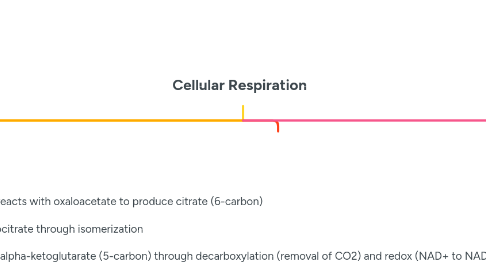
3. Krebs cycle acetyl-CoA acetyl-CoA reacts with oxaloacetate to produce citrate (6-carbon) Citrate to isocitrate through isomerization Isocitrate to alpha-ketoglutarate (5-carbon) through decarboxylation (removal of CO2) and redox (NAD+ to NADH) Alpha-ketoglutarate to succinyl-CoA (4-carbon) through decarboxylation (removal of CO2), redox (NAD+ to NADH), and reaction with CoA succinyl-CoA to succinate through substrate-level phosphorylation (GDP to GTP which in turn makes ADP to ATP) Succinate to fumarate through redox (FAD to FADH2) Fumarate to malate through hydration (addition of H2O) Malate to oxaloacetate through redox (NAD+ to NADH)
4. ETC NADH goes to complex I, NADH dehydrogenase, to be oxidized into NAD+ Electrons released by NADH excite the complex and move through it, the complex pumping H+ ions released by NADH from the matrix to the intermembrane space Electrons from NADH dehydrogenase move to ubiquinone (UQ) to be shuttled to the next complex, succinate dehydrogenase FADH2 goes to complex II, succinate dehydrogenase, to be oxidized to FAD Electrons released by FADH2 excite complex and move to ubiquinone to be shuttled to the next complex Electrons from ubiquinone excite complex III, cytochrome complex, and allow it to pump the H+ ions from the matrix to the intermembrane space Electrons from complex III move to cytochrome c (cyt c) to be shuttled to the next complex Electrons from cytochrome c excite complex IV (cytochrome oxidase) and allow it to pump H+ ions from matrix into intermembrane space Electrons from complex IV move to final electron acceptor, oxygen Oxygen reacts with H+ ions in matrix to produce H2O H+ ions in intermembrane space create a proton gradient and a charge gradient, creating a proton-motive force H+ ions move through ATP synthase and power it to produce ATP (oxidative phosphorylation)


