


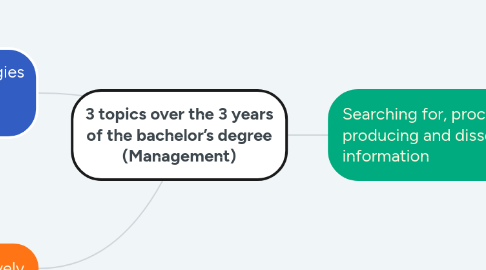
1. Learning strategies Reasoning Collaboration
1.1. Finding meaning in ones's studies
1.2. Acting ethically at university
1.3. Implementing effective learning strategies
1.4. Improving one’s work organisation
1.5. Maintaining motivation
1.6. Putting group work methods into practice
1.7. Reflecting on one’s learning through a reflective journal
2. Communicate effectively
2.1. Practising presenting one’s work orally
2.2. Communicating in a professional context
3. Searching for, processing, producing and disseminating information
3.1. Finding a document on a reading list
3.1.1. Understanding a reading list: books and journals
3.1.2. Finding a book using Archipel (printed and online versions)
3.1.3. Finding an article using Archipel
3.1.4. Photocopying, printing and scanning a document in the university library
3.2. Researching a subject (5W2H)
3.3. Databases in Capitole University
3.3.1. Doing extensive research on a subject
3.3.1.1. books
3.3.1.2. academic articles
3.3.1.3. newspaper articles
3.3.2. Refining search results in Archipel using filters
3.3.3. Researching news
3.3.3.1. Printed version in Capitole university library
3.3.3.2. Digital version: Europresse
3.3.4. Choosing the right database depending on the course and the subject
3.3.4.1. Navis
3.3.4.2. Xerfi
3.3.4.3. Cairn
3.3.4.4. Ebsco - Business source
3.3.4.5. Europresse
3.4. Presenting university assignments which respect copyright
3.4.1. Slideshows
3.4.1.1. Citing sources in a slideshow
3.4.1.2. Producing an attractive slideshow
3.4.2. Written assignments (dissertation, report, etc.)
3.4.2.1. Citing sources in written assignments
3.4.2.2. How to present a written document
3.4.3. Write a bibliography in accordance with the discipline's standards
3.4.4. Helping each other to do an oral presentation
3.5. The Web
3.5.1. Doing online research
3.5.2. Identifying fake news
3.5.3. Evaluating the quality and reliability of online information
3.5.4. Finding academic documents using Google Scholar
3.6. Monitoring news
3.6.1. Simple monitoring
3.6.1.1. alerts
3.6.1.2. subscribing to a newsletter
3.6.1.3. subscribing to a social media account
3.6.2. Dynamic monitoring of a subject
3.6.2.1. Feedly