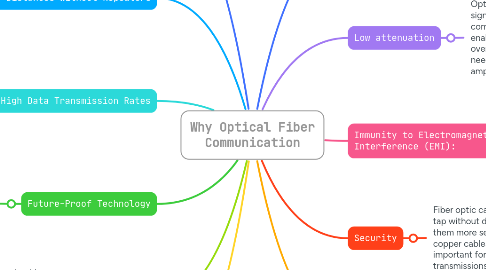
1.1. Optical fibers support high data transmission rates, including the ability to handle gigabit and terabit data rates. This makes them suitable for high-speed internet, multimedia applications, and data-intensive tasks.
2. Long Distances without Repeaters
2.1. Due to low signal attenuation, optical fibers can transmit signals over very long distances without the need for signal repeaters. This reduces the overall infrastructure cost and maintenance requirements.
3. High Data Transmission Rates
3.1. Optical fibers support high data transmission rates, including the ability to handle gigabit and terabit data rates. This makes them suitable for high-speed internet, multimedia applications, and data-intensive tasks.
4. Future-Proof Technology
4.1. Optical fiber technology has the potential for further advancements. As communication needs continue to grow, optical fibers can be upgraded to support higher data rates without changing the underlying infrastructure.
5. Durability:
5.1. Optical fibers are more durable than copper cables. They are resistant to environmental factors such as moisture, temperature variations, and chemicals, making them suitable for harsh conditions.
6. Fiber to the Home (FTTH):
6.1. Optical fibers play a crucial role in providing high-speed internet directly to homes (FTTH), enabling faster and more reliable internet connections for end-users.
7. High Bandwidth
7.1. Optical fibers have a much higher bandwidth compared to copper cables. This allows them to transmit a large amount of data over long distances without signal degradation
8. Low attenuation
8.1. Optical fibers experience lower signal loss, or attenuation, compared to copper cables. This enables signals to be transmitted over longer distances without the need for frequent signal amplification.
9. Immunity to Electromagnetic Interference (EMI):
9.1. Optical fibers are not susceptible to electromagnetic interference. This makes them ideal for environments with high levels of electrical noise, such as industrial settings or areas with many electronic devices.
10. Security
10.1. Fiber optic cables are difficult to tap without detection, making them more secure than traditional copper cables. This is particularly important for sensitive data transmissions.
11. light weight and small size
11.1. Fiber optic cables are difficult to tap without detection, making them more secure than traditional copper cables. This is particularly important for sensitive data transmissions.