


1. Age factors
1.1. (CPH) critical period hypothesis
1.2. Young learners faster
1.3. Older learners more effective (compensatory mechanism)
1.4. Teenagers get bored with long activities, slow-paced lesson
1.5. Adult 2 sides
1.5.1. Advantages
1.5.1.1. Engage with abstract thought
1.5.1.2. Have clear understanding of the lesson
1.5.2. Disadvantages
1.5.2.1. Be critical of teaching methods
1.5.2.2. Unfamiliar teaching patterns
1.5.3. Advantage:
1.5.4. • Engage with abstract thought
1.5.5. • Have clear understanding of the lesson
1.5.6. Disadvantage:
1.5.7. • Be critical of teaching methods
1.5.8. • Unfamiliar teaching patterns
2. Learner’s differences
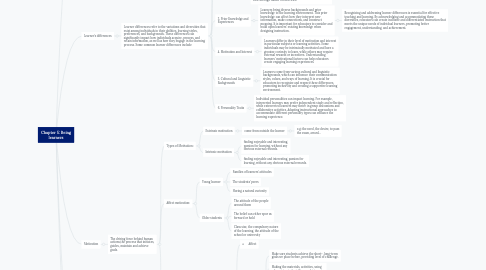
2.1. Learner differences refer to the variations and diversities that exist among individuals in their abilities, learning styles, preferences, and backgrounds. These differences can significantly impact how individuals acquire, process, and retain information, as well as how they engage in the learning process. Some common learner differences include
2.1.1. 1. Cognitive Abilities
2.1.1.1. Learners vary in their cognitive abilities, such as memory, attention span, problem-solving skills, and information processing speed. These differences can influence how learners understand and apply new concepts.
2.1.2. 2. Learning Styles
2.1.2.1. Different individuals have different learning styles, which are preferred ways of receiving and processing information. Visual learners, for example, prefer visual aids like diagrams and charts, while auditory learners may prefer listening to lectures or discussions. Other learners may have a kinesthetic preference, meaning they learn best through hands-on activities.
2.1.3. 3. Prior Knowledge and Experiences
2.1.3.1. Learners bring diverse backgrounds and prior knowledge to the learning environment. This prior knowledge can affect how they interpret new information, make connections, and construct meaning. It is important for educators to consider and build upon learners' existing knowledge when designing instruction.
2.1.3.1.1. Recognizing and addressing learner differences is essential for effective teaching and learning. By acknowledging and accommodating these diversities, educators can create inclusive and differentiated instruction that meets the unique needs of individual learners, promoting better engagement, understanding, and achievement.
2.1.4. 4. Motivation and Interest
2.1.4.1. Learners differ in their level of motivation and interest in particular subjects or learning activities. Some individuals may be intrinsically motivated and have a genuine curiosity to learn, while others may require external rewards or incentives. Understanding learners' motivational factors can help educators create engaging learning experiences.
2.1.5. 5. Cultural and Linguistic Backgrounds
2.1.5.1. Learners come from various cultural and linguistic backgrounds, which can influence their communication styles, values, and ways of learning. It is crucial for educators to recognize and respect these differences, promoting inclusivity and creating a supportive learning environment.
2.1.6. 6. Personality Traits
2.1.6.1. Individual personalities can impact learning. For example, introverted learners may prefer independent study and reflection, while extroverted learners may thrive in group discussions and collaborative activities. Adapting instructional approaches to accommodate different personality types can enhance the learning experience.
3. Motivation
3.1. The driving force behind human actions,the process that initiates, guides, maintain and achieve goals.
3.1.1. Types of Motivation:
3.1.1.1. Extrinsic motivation
3.1.1.1.1. come from outside the learner
3.1.1.2. Intrinsic motivation
3.1.1.2.1. finding enjoyable and interesting, passion for learning, without any obvious external rewards.
3.1.1.2.2. finding enjoyable and interesting, passion for learning, without any obvious external rewards.
3.1.2. Affect motivation:
3.1.2.1. Young learner
3.1.2.1.1. Families of learners’ attitudes
3.1.2.1.2. The students’ peers
3.1.2.1.3. Having a natural curiosity
3.1.2.2. Older students
3.1.2.2.1. The attitude of the people around them
3.1.2.2.2. The belief can either spur us forward or hold
3.1.2.2.3. Class size, the compulsory nature of the learning, the attitude of the school or university
3.1.3. What teachers can do about student motivation:
3.1.3.1. Affect
3.1.3.2. Achievement
3.1.3.2.1. Make sure students achieve the short-, long-term goals we place before, providing level of challenge.
3.1.3.2.2. Making the materials, activities, using relevant to students’ lives and interests.
3.1.3.2.3. Asking thinking of material, change information in a text
3.1.3.2.4. Varying activities with classes, balance students’ need for routine
3.1.3.3. Attitude
3.1.3.3.1. Showing confidence by appearance , where we stand ,we talk to the class, feel that we are prepared to teach this lesson in particular
3.1.3.4. Agency
3.1.3.4.1. Describes our ability to have control in lives, through thinking to effect change in the way we live.
3.1.3.5. Affect
3.1.3.5.1. Helping students create the ‘vision’ of ideal L2 self, and to remind them
3.1.3.5.2. Taking interest in students, personalising lessons, students'life are reflected in what happens in lessons
3.1.3.5.3. Sustaining through activities and encouragement, clear goal and task-setting,
4. Levels
4.1. From beginner to advanced
4.1.1. Real beginner or false beginner
4.1.1.1. elementary
4.1.1.1.1. lower-intermediate/pre-intermediate
4.2. The CEFR levels
4.2.1. organises language proficiency in six levels A1 to C2 ( A1, A2, B1, B2, C1, C2),
4.2.1.1. can be regrouped into three broad levels
4.2.1.1.1. - Basic User - Independent User - Proficient User
4.3. Other frameworks of language proficiency
4.3.1. The British Council/EAQUALS Core Inventory
4.3.2. The English Vocabulary Profile (EVP) from Cambridge University Press
4.3.3. The Cambridge English Scale
5. Learner Autonomy
5.1. The ultimate goal of language teaching
5.1.1. student should no longer need a teacher to improve and perfect their language ability
5.1.1.1. but instead should be able to do all of this on their own
5.2. 'True empowerment'
5.2.1. suggested John Field
5.2.1.1. 'consists of the freedom to learn outside the teaching context
5.2.1.2. the ability to continue learning after the instruction has finished'