
Release planning - Praneel M

Built this for an exploration of the topic of Release planning

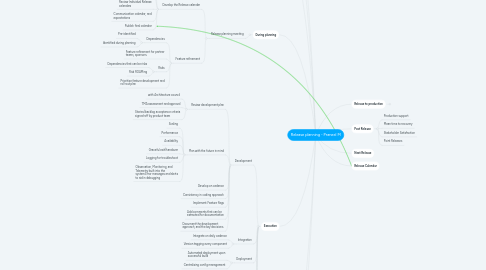
1. Release readiness
1.1. Change Management
1.1.1. Release build approval - Automated
1.1.2. Consistent performance of the code over a freeze period- 1/2 iterations.
1.1.3. Certify impact analysis
1.2. Release Engineering team
1.3. Release Notes
1.4. Knowledge articles
2. Pre-requisites for planning
2.1. List of stakeholders
2.1.1. Product teams
2.1.2. External clients
2.1.3. Internal sponsors
2.1.4. Release Engineering team
2.1.4.1. Platform and Product support teams / SRE team
2.1.4.1.1. Non-Functional requirements
2.1.4.2. Release Manager
2.1.4.2.1. Release management activities
2.1.5. Engineering teams
2.1.6. Compliance Teams
2.2. Engineering teams
2.2.1. Resource planning
2.2.2. Technical/Skill matrix
2.2.3. Capacity planning
2.3. Platform Team
2.3.1. Vision
2.3.2. Charter for the year
2.3.3. Milestones
2.3.4. Feature/Epic Backlog Refinement with the Engineering teams
2.3.4.1. NFR
2.4. Product teams (all products)
2.4.1. Vision
2.4.2. Feature/Epic Backlog Refinement with the Engineering teams
2.4.2.1. NFR
2.4.3. Milestones
2.5. Compliance Teams
2.5.1. Compliance requirements
2.5.1.1. Tenancy compliance
2.5.1.2. Geo-compliance
2.5.1.3. Security compliance
2.5.1.4. Data Privacy compliance
2.5.2. NFR
2.5.3. Threat Modeling
2.5.3.1. TMA assessment
2.5.3.2. TMA approval
2.6. Key events
2.6.1. Product alignment meeting
2.6.2. Feature freeze deadlines
2.6.3. Cross-team integration testing
2.6.4. Major compliance audits
2.6.4.1. TMA assesment and approvals
2.6.4.2. Architecture council approval
2.6.4.3. Change advisory board approval
2.6.5. Deployment events
3. Processes in place to support the plan for execution
3.1. Architecture council
3.1.1. Concurrent Development
3.1.2. Centralized Version control system
3.1.3. Standardized Build process
3.1.4. Shared component Library
3.2. Program/project management practices
3.2.1. Iteration Cadence
3.2.2. Iteration demos
3.2.3. System demos
3.2.4. Dependency management
3.3. Continuous Integration/ Continuous Deployment pipelines
4. During planning
4.1. Release planning meeting
4.1.1. Develop the Release calendar
4.1.1.1. Plan for points of integration
4.1.1.2. Identify milestones
4.1.1.3. Review Individual Release calendars
4.1.1.4. Communication calendar, and expectations
4.1.1.5. Publish final calendar
4.1.2. Feature refinement
4.1.2.1. Dependencies
4.1.2.1.1. Pre-identified
4.1.2.1.2. Identified during planning
4.1.2.2. Feature refinement for partner teams, sponsors.
4.1.2.3. Risks
4.1.2.3.1. Dependencies that can be risks
4.1.2.3.2. Risk ROAMing
4.1.2.4. Prioritize feature development and roll-out plan
5. Execution
5.1. Development
5.1.1. Review development plan
5.1.1.1. with Architecture council
5.1.1.2. TMA assessment and approval
5.1.1.3. Stories/backlog acceptance criteria signed-off by product team
5.1.2. Plan with the future in mind
5.1.2.1. Scaling
5.1.2.2. Performance
5.1.2.3. Availability
5.1.2.4. Graceful exit/handover
5.1.2.5. Logging for troubleshoot
5.1.2.6. Observation, Monitoring, and Telemetry built into the system.Error messages and alerts to aid in debugging
5.1.3. Develop on cadence
5.1.4. Consistency in coding approach
5.1.5. Implement Feature flags
5.1.6. Add comments that can be extracted for documentation
5.1.7. Document the development approach, and the key decisions.
5.2. Integration
5.2.1. Integrate on daily cadence
5.2.2. Version tagging every component
5.3. Deployment
5.3.1. Automated deployment upon successful build
5.3.2. Centralizing config management
5.4. Demonstration
5.4.1. Iteration Demo
5.4.2. System Demo
5.5. Built-in Quality
5.5.1. Automated tests
5.5.2. Build on integration, deploy on green
5.5.3. Integration tests
5.5.4. Build failure alerts
5.5.5. Performance/load testing
5.5.6. Testing for graceful exit/handover
5.6. Automation
5.7. Execution metrics
5.7.1. Deployment success on non-prod environment
6. Project/Program/Product Management
6.1. Establish Cadence for Iterative development
6.2. Share Engg best practices
6.2.1. CI/CD
6.2.2. Observability - logging, monitoring, alerting
6.2.3. Avoiding Technical debt
7. Communication - channels, people, frequency
7.1. Communicate Release plan
7.2. Set up regular connects for points of integration, and review by Product Owners.
7.3. Publish Reports on progress
7.4. Share updates with Stakeholders
8. Release to production
8.1. Deployment strategy
8.1.1. Blue/Green
8.1.2. Canary
8.2. Rollback strategy
8.3. Metrics
8.3.1. Production Observabillity and reports
8.3.2. Deployment frequency