


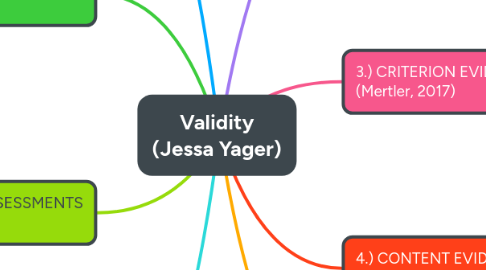
1. 1.) DEFINITION
1.1. "The connection between the purpose of the research and which data the researcher chooses to quantify that purpose (The Graide Networkd, 2018).
1.2. "Emphasizes not the results themselves but, rather, how you use the results. Validity is less about the quality of the assessment and its actual results but is more about the decisions that follow the interpretation of those results" (Mertler, 2017).
2. 6.) QUANTITATIVE ASSSESSMENTS (Mertler, 2017)
2.1. There is no formula or guidelines to follow to establish the validity of quantitative assessments.
2.2. Should consider guiding questions for content, criterion, and face evidence to enhance validity.
3. 7.) QUALITATIVE ASSESSMENTS (Mertler, 2017)
3.1. Mostly informal and unstructured, which provides a "snapshot" to what a student is learning in the moment.
3.2. Guiding questions to enhance qualitative assessments include observing student engagement, note-taking, and inferences.
4. 8.) SUMMARY POINTS (Mertler, 2017)
4.1. *Focus is on the decisions that are made by the interpretation of results.
4.2. Must continually gather and examine evidence to know the degree of validity.
4.3. Important for less formal and qalitative asssessments.
5. 2.) CONSTRUCT EVIDENCE (Mertler, 2017)
5.1. Relies on data analysis - The correlation between the hypothetical construct being measured and the nature of the responses from students.
5.1.1. Identifying performance based on skills and abilities for specific construct.
5.1.2. Connected to content and criterion evidence of validity.
6. 3.) CRITERION EVIDENCE (Mertler, 2017)
6.1. Relies on statistical analysis - A measure of the extent to which the scores resulting from an assessment are relaetd to the scores on another, well-established assesssment.
6.1.1. Predictive evidence of validity measures criterion such as an individual's potential to perform specific skills or tasks in the future.
6.1.2. Concurrent evidence of validity measures criterion at the same time or consists of some measure that is available at the same time.
7. 4.) CONTENT EVIDENCE (The Graide Network, 2019)
7.1. Relies on professional judgement - Content-related evidence is the most important source of evidence to determine.
7.1.1. "A test that is valid in content should adequately examine all aspects that define the objective." It contains the actual content taught by a teacher within the test.
8. 5.) FACE EVIDENCE (Mertler, 2017)
8.1. An informal measure of the extent to which the users/takers of a test believe that the tests are valid.
8.1.1. Relies heavily on content knowledge obtained for the test in order for the users/takers to assume they know what to expect - relevant for student motivation.