


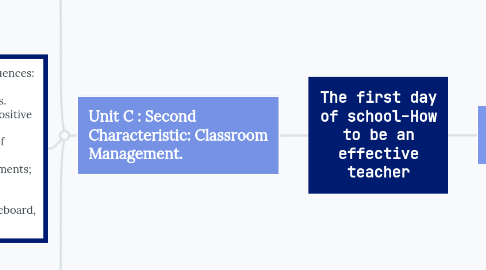
1. Unit C : Second Characteristic: Classroom Management.
1.1. What Is an Effective Teacher? THE KEY IDEA: The beginning teacher must become proficient in the three characteristies of an effective teacher.
1.1.1. The Three Characteristies of an Effective Teacher Has positive expeetations for student suceess Is an extremely good classroom manager Knows how to design lessons for student mastery
1.1.1.1. What works in a kindergarten classroom or a high school classroom also works with modification in any other classroom. The leacher with an ineffective classroom is constantly looking lor activities to grab the students' attention They are eager to present their lessons, do their exciting activities, and share their wonderful knowledge. But, none of these techniques will he successful until you hecome skilled in the charactenstics of an effective teacher. Teaching is not covering chapters or doing activities.
1.1.1.1.1. Foundations of Classroom Management: First-day preparation. Building student relationships. Setting positive expectations.
1.2. Discipline Plans Have Consequences: Rules must have consequences. Two kinds of consequences: positive and negative. Consequences are the result of chosen actions. Consequences are not punishments; they're simply what happens. Suggestions for implementing penalties include using a whiteboard, tickets, or patterns.
1.2.1. Discipline Plan Where Both the Student and Teacher Are in Charge: -Students should take responsibility for their actions. -"My Action Plan" involves problem-solving and responsibility. - Encouragement from home and school is crucial for students to achieve self-discipline.
1.2.1.1. Disciplinary Approach Empowering Both Students and Teachers: Students ought to assume accountability for their behavior. Implementing "My Action Plan" entails problem-solving and accountability. Support from both home and school plays a pivotal role in fostering students' self-discipline.
1.2.1.1.1. Guiding Students in Adhering to Classroom Protocols: A deficiency in protocols constitutes the foremost classroom issue. Proficient educators instruct students on adhering to protocols conscientiously. Classroom management encompasses methodologies and protocols, not solely disciplinary measures. Protocols guarantee a seamless learning atmosphere and optimize academic learning opportunities.
1.3. Chapter 20: How Procedures Improve the Opportunity to Learn
1.3.1. Importance of Procedures: -The significance of procedures lies in their ability to enhance classroom learning by providing structure and predictability. -Consistency is paramount in establishing an organized and predictable environment. -Procedures instigate enduring behavioral changes, reducing disciplinary issues and maximizing learning time. -Effective educators employ procedures to manage the classroom, whereas less effective ones resort to discipline through threats and punishments.
1.3.1.1. Benefits of Group Activities: Group activities foster hands-on learning and problem-solving skills. Students cultivate leadership, decision-making, and teamwork abilities through these activities.
1.3.1.1.1. Keys to Divide Groups: A clear explanation of the rationale behind forming groups facilitates swift and seamless division. The classroom layout and class atmosphere influence the efficacy of group division.
2. Unit B:First Characteristic, Positive Expectations.
2.1. Chapter 6:Creating a Positive Classroom Climate
2.1.1. Key Idea: A conducive classroom atmosphere is imperative for effective teaching and learning. Approaches: 1. Extend a warm greeting to students. 2. Employ positive language and reinforcement techniques. 3. Establish explicit expectations and guidelines. 4. Promote student engagement and active participation. 5. Nurture a sense of belonging and community spirit.
2.2. Chapter 7:Establishing Positive Relationships with Parents
2.2.1. Key Idea:Developing positive connections with parents contributes to student achievement. Strategies: 1. Maintain regular and effective communication channels. 2. Practice active and empathetic listening. 3. Collaborate with parents on student objectives and progress. 4. Respect cultural diversity and individual variations. 5. Address concerns and conflicts constructively.
2.3. Chapter 9:How to Invite Students to Learn
2.3.1. Key Idea:Invitational education fosters an environment conducive to learning and personal development. Practices: 1. Actively involve students and parents in the learning journey. 2. Cultivate positive relationships and connections. 3. Foster inclusivity and warmth in classroom interactions. 4. Acknowledge and appreciate each individual's potential. 5. Establish a welcoming and inclusive classroom ambiance.
2.4. Chapter 10:How to Increase Positive Student Behavior
2.4.1. Key idea:The essence of education lies in nurturing the heart. Five Fundamental Principles: 1. Address each student by name. 2. Incorporate "please" and "thank you" in interactions. 3. Smile genuinely and warmly. 4. Demonstrate care and affection towards students. 5. Foster a loving and supportive classroom environment.