


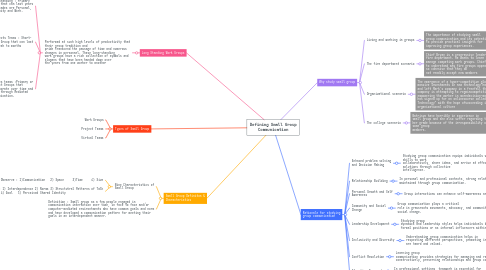
1. Rationale for studying group communication
1.1. Enhaced problem solving and Decision Making
1.1.1. Studying group communication equips individuals with the skills to work collaboratively, share ideas, and arrive at effective solutions through collective intelligence.
1.2. Relationship Building
1.2.1. In personal and professional contexts, strong relationships are often built and maintained through group communication.
1.3. Personal Growth and Self Awareness
1.3.1. Group interactions can enhance self-awareness and emotional intelligence.
1.4. Community and Social Change
1.4.1. Group communication plays a critical role in grassroots movements, advocacy, and community organizing, contributing to social change.
1.5. Leadership Development
1.5.1. Studying group dynamics and leadership styles helps individuals become better leaders, whether in formal positions or as informal influencers within a group.
1.6. Inclusivity and Diversity
1.6.1. Understanding group communication helps in respecting different perspectives, promoting inclusivity, and ensuring that all voices are heard and valued.
1.7. Conflict Resolution
1.7.1. Learning group communication provides strategies for managing and resolving conflicts constructively, preserving relationships and group cohesion.
1.8. Efeective Teamwork
1.8.1. In professional settings, teamwork is essential for achieving organizational goals
2. Small Group Definiton & Characteristics
2.1. Nine Characteristics of Small Group
2.1.1. Directly Obeserve : 1)Communication 2) Space 3)Time 4) Size
2.1.2. Indirectly Observable : 1) Interdependence 2) Norms 3) Structutral Patterns of Talk 4) Goal 5) Perceived Shared Identity
2.2. Definition : Small group as a few people engaged in communication interaction over time, in face to face and/or computer-mediated environtments who have common goals and norm and have developed a communication pattern for meeting their goals in an interdependent manner.
3. Why study small group
3.1. Living and working in groups
3.1.1. The importance of studying small group communication and its potential to provide practical insights for improving group experiences.
3.2. The fire department scenario
3.2.1. Chief Bryan is a progressive leader of a growing fire department. He wants to learn how to manage competing work groups. Chief Bryan needs to understand why fire groups appear to become so cohesive that they do not readily accept new members
3.3. Organizational scenario
3.3.1. The emergence of a hyper-competitive global economy and massive investments in new technology have eroded profits and left Mark's company in a freefall then the company The company is attempting to regaincompetitive advantage by empowering the worker in moredecision-making groups .Mark has signed up for an onlinecourse called "Teams and Technology" with the hope ofsucceeding in the new organizational culture
3.4. The college scenario
3.4.1. Batrisya have horrible in experience in small group and she also suffer regarding to her grade because of the irresponsibility of some group members.
4. Types of Small Group
4.1. Work Groups
4.2. Project Teams
4.3. Virtual Teams
5. Long Standing Work Groups
5.1. Performed at such high levels of productivity that their group tradition and pride transcend the passage of time and numerous changes in personnel. These long-standing work groups have a rich collection of symbols and slogans that have been handed down over the years from one worker to another
5.1.1. Long Standing : Primary Group that can last years to decades are Personal, Community and Work.
5.1.1.1. Personal : Family Group
5.1.1.2. Community : Religious Group
5.1.1.3. Work : Primary Work Group
5.1.2. Projects Teams : Short- Term Group that can last to week to months
5.1.2.1. Personal : Weddings, Graduation, Family Reunion
5.1.2.2. Community : Floods, Hurrricanes, Black outs, Tornadoes
5.1.2.3. Work : Stock holder meetings, Project teams/ Group
5.1.3. Virtues teams :Primary or Project Groups that collaborate over time and space through Mediated Communication.
5.1.3.1. Personal : Family Group Vacations, College
5.1.3.2. Community: Coomunity Group websites - Neighbourhood watch,prayer group school
5.1.3.3. Work : Virtual Primary Group -Virtual Universities Academic,publishing teams