Feminist Therapy
von Sandy Castillo
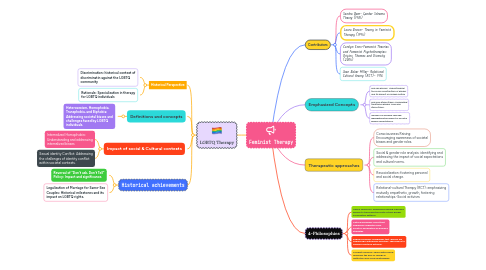
1. LGBTQ Therapy
1.1. Historical Perspective
1.1.1. Discrimination: historical context of discriminatin against the LGBTQ community
1.1.2. Rationale: Specialization in therapy for LGBTQ individuals
1.2. Definitions and concepts
1.2.1. Heterosexism, Homophobia, Transphobia, and Biphobia: Addressing societal biases and challenges faced by LGBTQ individuals.
1.3. Impact of social & Cultural contexts
1.3.1. Internalized Homophobia: Understanding and addressing internalized biases
1.3.2. Sexual identity Conflict: Addressing the challenges of identity conflict within societal contexts.
1.4. Historical achievements
1.4.1. Reversal of "Don't ask, Don't Tell" Policy: Impact and significance.
1.4.2. Legalization of Marriage for Same-Sex Couples: Historical milestones and its impact on LGBTQ rights.
2. Contributors
2.1. Sandra Bem- Gender Schema Theory (1981)
2.2. Laura Brown- Theory in Feminist Therapy (1994)
2.3. Carolyn Enns-Femenist Theories and Femenist Psychotherapies: Origins, Themes and Diversity (2004)
2.4. Jean Baker Miller- Relational Cultural theory (RCT)- 1976
3. Emphasized Concepts
3.1. Sex and gender: Understanding the social construction of gender and its impact on human nature
3.2. Sex Role Stereotypes: Challenging traditional gender roles and stereotypes.
3.3. Gender role schema Therapy: highlighting the impact of societal gender expectations.
4. Therapeutic approaches
4.1. Consciousness Raising: Encouraging awareness of societal biases and gender roles.
4.2. Social & gender role analysis: identifying and addressing the impact of social expectations and cultural norms.
4.3. Resocialization: fostering personal and social change.
4.4. Relational-cultural Therapy (RCT): emphasizing mutually empathetic, growth, fostering relationships.-Social activism.
5. 4-Philosophies
5.1. Liberal Femenism: emphasizes helping individual women to transcend the limits of their gender socialization patterns
5.2. Cultural Feminism: assert that oppression originates from society's devaluation of women's strengths.
5.3. Radical feminism: emphasizes that women are oppressed in patriarchal societies. Their goal is to change society by activism.
5.4. Socialist feminism: Shares with radical feminisim the goal of change in institutionl and social relationships.


