


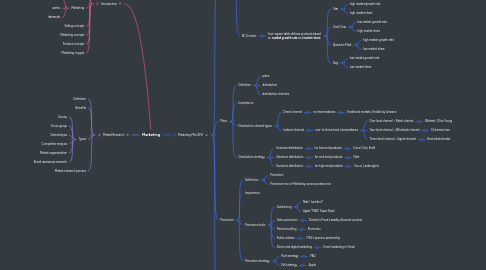
1. Introduction
1.1. Market
1.2. Marketplace
1.2.1. physical
1.2.2. digital
1.2.3. B2B
1.2.4. B2C
1.3. Marketing
1.3.1. needs
1.3.2. wants
1.3.3. demands
1.4. Selling concept
1.5. Marketing concept
1.6. Product concept
1.7. Marketing myopia
2. Market Research
2.1. Definition
2.2. Benefits
2.3. Types
2.3.1. Survey
2.3.2. Focus group
2.3.3. Data analysis
2.3.4. Competitor analysis
2.3.5. Market segmentation
2.3.6. Brand awareness research
2.4. Market research process
3. Marketing Mix (4Ps)
3.1. Product
3.1.1. Definition
3.1.2. Importance
3.1.3. Classification of product
3.1.3.1. Tangible
3.1.3.2. Intangible
3.1.3.3. Service
3.1.4. 6 questions asked before product launchment
3.1.5. Levels of product
3.1.5.1. Core product
3.1.5.1.1. the basic need that is satisfied by the product
3.1.5.2. Actual product
3.1.5.2.1. offers the best and easiest options for differentiation
3.1.5.3. Augmented product
3.1.5.3.1. adds further options to differentiate
3.1.6. Product life cycle
3.1.6.1. Introduction phase
3.1.6.2. Growth phase
3.1.6.3. Maturity phase
3.1.6.4. Decline phase
3.1.7. BCG matrix
3.1.7.1. four-square table defines products based on **market growth rate** and **market share**
3.1.7.1.1. Star
3.1.7.1.2. Cash Cow
3.1.7.1.3. Question Mark
3.1.7.1.4. Dog
3.2. Place
3.2.1. Definition
3.2.1.1. place
3.2.1.2. distribution
3.2.1.3. distribution channels
3.2.2. Importance
3.2.3. Distribution channel types
3.2.3.1. Direct channel
3.2.3.1.1. no intermediaries
3.2.3.2. Indirect channel
3.2.3.2.1. one- to three-level intermediaries
3.2.4. Distribution strategy
3.2.4.1. Intensive distribution
3.2.4.1.1. for low-end products
3.2.4.2. Selective distribution
3.2.4.2.1. for mid-end products
3.2.4.3. Exclusive distribution
3.2.4.3.1. for high-end products
3.3. Promotion
3.3.1. Defitnition
3.3.1.1. Promotion
3.3.1.2. Promotion mix or Marketing communication mix
3.3.2. Importance
3.3.3. Promotion tools
3.3.3.1. Advertising
3.3.3.1.1. Nike "Just do it"
3.3.3.1.2. Apple "1984" Super Bowl
3.3.3.2. Sales promotion
3.3.3.2.1. Domino's Pizza's weekly discount voucher
3.3.3.3. Personal selling
3.3.3.3.1. Electrolux
3.3.3.4. Public relation
3.3.3.4.1. FIFA's sponsor partnership
3.3.3.5. Direct and digital marketing
3.3.3.5.1. Email marketing in Gmail
3.3.4. Promotion strategy
3.3.4.1. Push strategy
3.3.4.1.1. P&G
3.3.4.2. Pull strategy
3.3.4.2.1. Apple
3.4. Price
3.4.1. Definition
3.4.2. Importance
3.4.3. Factors affecting price decisions
3.4.3.1. Internal
3.4.3.2. External
3.4.3.2.1. Market demand
3.4.3.2.2. Economy
3.4.3.2.3. Others
3.4.4. Pricing strategy
3.4.4.1. Customer value-based pricing
3.4.4.1.1. Good-value pricing
3.4.4.1.2. Value-added pricing
3.4.4.2. Cost-based pricing
3.4.4.2.1. Cost-plus pricing
3.4.4.2.2. Break-even pricing or Target profit pricing
3.4.4.3. Competition-based pricing
3.4.4.3.1. Caterpillar
3.4.4.4. New product pricing
3.4.4.4.1. Market skimming
3.4.4.4.2. Market penetration