

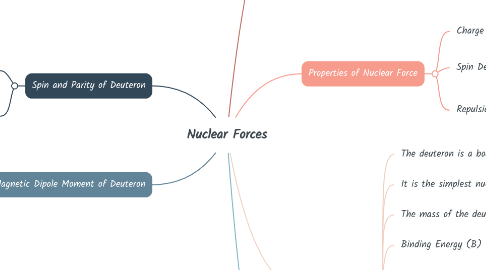
1. Spin and Parity of Deuteron
1.1. Experimental observations have determined the spin and parity states of the deuteron
1.1.1. The ground state of the deuteron has a spin of 1 and a positive parity (even parity)
1.1.2. Excited states can have various combinations of spin and parity
1.2. Acceptability based on nuclear spin and parity rules
1.2.1. Certain selection rules govern the allowed transitions between different spin and parity states
2. Magnetic Dipole Moment of Deuteron
2.1. The magnetic dipole moment represents the magnetic property of the deuteron
2.2. It can be calculated for the l = 0 state (S-state) by considering the contributions from the magnetic moments of the proton and neutron
2.3. The calculated values can be compared with experimental measurements, taking into account the nuclear spin contribution
2.3.1. Agreement between calculated and observed values indicates the validity of the model
3. Properties of Nucleons
3.1. Protons
3.1.1. Positively charged subatomic particles
3.1.2. Located in the nucleus of an atom
3.1.3. Have a mass of approximately 1 atomic mass unit (u)
3.2. Neutrons
3.2.1. Electrically neutral subatomic particles
3.2.2. Also located in the nucleus of an atom
3.2.3. Have a mass of approximately 1 atomic mass unit (u)
3.3. Nucleon Interactions at Short Distances
3.3.1. Nuclear force is stronger than the electromagnetic force
3.3.1.1. This overcomes the Coulomb repulsion between protons
3.3.1.2. Pion exchange between nucleons mediates the strong nuclear force
3.3.1.3. The strong force is attractive and binds nucleons together
4. Properties of Nuclear Force
4.1. Charge Independence
4.1.1. -The nuclear force acts in the same way on protons and neutrons. -It does not distinguish between the two particles
4.2. Spin Dependence
4.2.1. The nuclear force depends on the internal spin of nucleons
4.2.1.1. - When the spins of nucleons are aligned, the force is stronger - When the spins are anti-aligned, the force is weaker
4.3. Repulsion at Short Distances
4.3.1. - The nuclear force becomes repulsive for distances less than 5 femtometers (fm) - This is due to the overlapping of nucleon wave functions
5. The Deuteron
5.1. The deuteron is a bound state of a proton and a neutron
5.2. It is the simplest nucleus after the hydrogen nucleus (a single proton)
5.3. The mass of the deuteron is approximately 2.01418 atomic mass units (u)
5.4. Binding Energy (B)
5.5. The binding energy of the deuteron represents the energy required to separate the proton and neutron
5.5.1. It can be calculated in several ways, including:
5.5.1.1. 1. B = [m(p) + m(n) - m(d)] * 931.5 MeV - m(p): Mass of the proton - m(n): Mass of the neutron - m(d): Mass of the deuteron
5.5.1.2. 2. B = E(gamma) - K'(d) - E(gamma): Energy of the gamma ray emitted during the de-excitation of the deuteron - K'(d): Recoil kinetic energy of the deuteron
5.5.1.3. 3. B = E(gamma) - E(n) - E(p) - E(n): Binding energy of the neutron - E(p): Binding energy of the proton
6. Nuclear Potential for Deuteron
6.1. The nuclear potential describes the interaction between the proton and neutron in the deuteron
6.2. For the l = 0 state (S-state), the potential is central
6.2.1. It does not depend on the direction of the nucleon spins
6.3. For l > 0 states (P, D, F, etc.), the potential becomes non-central
6.3.1. It depends on the relative orientation of the nucleon spins