

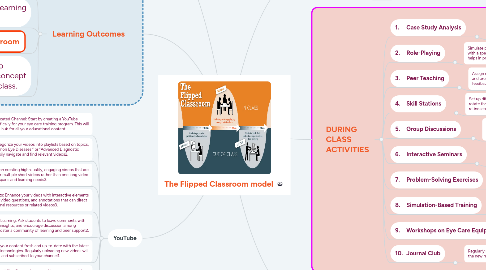
1. Course Challenge:
1.1. Take any one module from the course and design a flipped classroom for it
2. Learning Outcomes
2.1. Designing a Flipped classroom
2.2. 1. Building a library of self-paced e-learning content for your course.
2.3. Implementing a Flipped Classroom
2.4. 2. Designing activities for students to demonstrate, and / or teach back a concept or solve a real-world problem in the class.
3. YouTube
3.1. Create a Dedicated Channel: Start by creating a YouTube channel specifically for your eye care training program. This will be the central hub for all your educational content
3.2. Organize Content into Playlists: Categorize your videos into playlists based on topics, such as “Basic Eye Anatomy,” “Common Eye Diseases,” or “Advanced Diagnostic Techniques.” This helps students easily navigate and find relevant videos2.
3.3. Produce Quality Videos: Focus on creating high-quality, engaging videos that are concise and informative. Aim for multiple short videos rather than one long video to align with student attention spans and learning needs3.
3.4. Interactive Elements: Enhance your videos with interactive elements such as quizzes, in-video questions, and annotations that can direct students to additional resources or related videos3.
3.5. Encourage Active Learning: Ask students to leave comments with their questions or insights, and encourage discussion among viewers. This can foster a community of learning and peer support2.
3.6. Regular Updates: Keep your content fresh and up-to-date with the latest eye care practices and technologies. Regularly uploading new videos will keep students engaged and subscribed to your channel1.
3.7. Accessibility: Ensure that your videos are accessible to all students by including subtitles, clear visuals, and verbal descriptions of visual content1.
3.8. Promote Your Channel: Share your YouTube channel with your students via email, social media, and other platforms. Encourage them to subscribe and turn on notifications for new uploads1.
3.9. Feedback Loop: Use the analytics tools provided by YouTube to track which videos are most popular and engaging. Use this feedback to improve future content1.
3.10. Collaborate with Experts: Invite guest speakers or collaborate with other eye care professionals to create guest lectures or joint videos, adding variety and expertise to your channel
4. BEFORE
4.1. READ
4.1.1. Infographic, PPT/ PDF, Handout, MindMap, Flowchart, Article
4.1.1.1. Aurosiksha
4.1.1.1.1. Insight
4.2. WATCH
4.3. DO
5. DURING CLASS ACTIVITIES
5.1. 1. Case Study Analysis
5.1.1. Present a complex patient case study and have participants analyze the diagnosis, treatment plan, and follow-up care. This encourages critical thinking and application of theoretical knowledge.
5.2. 2. Role-Playing
5.2.1. Simulate patient interactions where one participant plays the role of the patient with a specific eye condition, and another plays the eye care professional. This helps in practicing communication skills and patient education.
5.3. 3. Peer Teaching
5.3.1. Assign each participant a topic related to eye care, which they must research and present to the group. This reinforces learning and allows for peer feedback.
5.4. 4. Skill Stations
5.4.1. Set up different stations equipped with eye care tools and instruments. Participants rotate through each station to practice specific skills, such as tonometry or retinoscopy, under supervision.
5.5. 5. Group Discussions
5.5.1. After watching pre-recorded lectures, hold group discussions on topics like the latest advancements in eye care or ethical dilemmas in the profession.
5.6. 6. Interactive Seminars
5.6.1. Invite a guest speaker to discuss a specialized area of eye care. After the seminar, participants can engage in a Q&A session to delve deeper into the subject.
5.7. 7. Problem-Solving Exercises
5.7.1. Provide scenarios of clinical challenges and have participants work in groups to come up with solutions, discussing different approaches and outcomes.
5.8. 8. Simulation-Based Training
5.8.1. Use virtual reality or other simulation tools to mimic real-life eye care procedures, allowing participants to gain hands-on experience in a controlled environment.
5.9. 9. Workshops on Eye Care Equipment
5.9.1. Conduct workshops focusing on the use and maintenance of eye care equipment, such as slit lamps or phoropters, with practical demonstrations and hands-on practice.
5.10. 10. Journal Club
5.10.1. Regularly review and discuss recent articles from eye care journals, focusing on how the new research can be applied to clinical practice.
6. After Class
6.1. Course Challenge:
6.1.1. Take any one module from the course and design a flipped classroom for it