


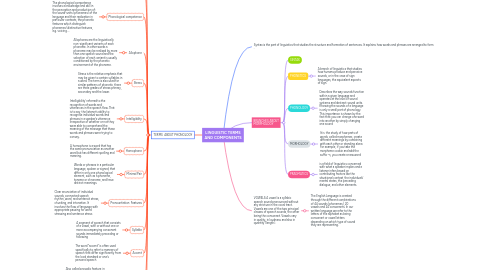
1. TERMS ABOUT PHONOLOGY
1.1. Pronountiation
1.1.1. Pronunciation is all about clear enunciation of individual sounds, connected speech, rhythm, word, and sentence stress, chunking, and intonation. It involves the flow of language with appropriate pausing for word stressing and sentence stress.
1.2. Phoneme
1.2.1. One of the smallest units of speech that make one word different from another word.
1.3. Phonological competence
1.3.1. The phonological competence involves a knowledge and skill in the perception and production of: the sound-units (phonemes) of the language and their realization in particular contexts, the phonetic features which distinguish phonemes (distinctive features, e.g. voicing ...
1.4. Allophone
1.4.1. Allophones are the linguistically non-significant variants of each phoneme. In other words a phoneme may be realised by more than one speech sound and the selection of each variant is usually conditioned by the phonetic environment of the phoneme.
1.5. Stress
1.5.1. Stress is the relative emphasis that may be given to certain syllables in a word. The term is also used for similar patterns of phonetic, there are three grades of stress:primary, secondary and the lower.
1.6. Intelligibility
1.6.1. Intelligibility’ referred to the recognition of words and utterances in the speech flow. That is to say, the listener’s ability to recognise individual words and phrases in a speaker’s utterance irrespective of whether or not they were able to comprehend the meaning of the message that these words and phrases were trying to convey.
1.7. Homophone
1.7.1. A homophone is a word that has the same pronunciation as another word but has different spelling and meaning.
1.8. Minimal Pair
1.8.1. Words or phrases in a particular language, spoken or signed, that differ in only one phonological element, such as a phoneme, toneme or chroneme, and have distinct meanings.
1.9. Pronountiation Features
1.9.1. Clear enunciation of individual sounds, connected speech, rhythm, word, and sentence stress, chunking, and intonation. It involves the flow of language with appropriate pausing for word stressing and sentence stress
1.10. Syllable
1.10.1. A segment of speech that consists of a vowel, with or without one or more accompanying consonant sounds immediately preceding or following
1.11. Accent
1.11.1. The word "accent" is often used specifically to refer to manners of speech that differ significantly from the local standard or one's personal speech
1.12. Supragsegmetal
1.12.1. Also called prosodic feature, in phonetics, a speech feature such as stress, tone, or word juncture that accompanies or is added over consonants and vowels; these features are not limited to single sounds but often extend over syllables, words, or phrases.
1.13. Segment
1.13.1. A minimal sound element that can be isolated in the chain of speech, corresponding to a letter in alphabetic representation of speech.
2. Syntax is the part of linguistics that studies the structure and formation of sentences. It explains how words and phrases are arranged to form .
3. BRANCHES ABOUT MORPHOLOGY
3.1. SINTAX
3.2. PHONETICS
3.2.1. A branch of linguistics that studies how humans produce and perceive sounds, or in the case of sign languages, the equivalent aspects of sign.
3.3. PHONOLOGY
3.3.1. Describes the way sounds function within a given language and operates at the level of sound systems and abstract sound units. Knowing the sounds of a language is only a small part of phonology. This importance is shown by the fact that you can change one word into another by simply changing one sound
3.4. MORHOLOGY
3.4.1. It is the study of how parts of words, called morphemes, create different meanings by combining with each other or standing alone. For example, if you take the morpheme cookie and add the suffix –s, you create a new word
3.5. PRAGMATICS
3.5.1. is a field of linguistics concerned with what a speaker implies and a listener infers based on contributing factors like the situational context, the individuals’ mental states, the preceding dialogue, and other elements.