
Hersey and Blanchards Situational Leadership Theory

This comprehensive mindmap provides an in-depth look at Hersey and Blanchards Situational Leadership Theory. The theory, which focuses on the readiness and capability level of a leaders followers, is broken down into easily understandable elements. Its core elements are explored, including the four main leadership styles telling, selling, participating, and delegating as well as the degrees of follower readiness. Also illustrated are the practical applications of the theory, its criticisms, a...

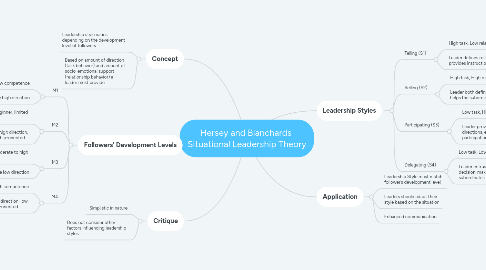
1. Concept
1.1. Leadership style varies depending on the development level of followers
1.2. Based on amount of direction (task behavior) and amount of socio-emotional support (relationship behavior) a leader must provide
2. Followers' Development Levels
2.1. M1
2.1.1. Novice, low competence
2.1.2. Require high direction
2.2. M2
2.2.1. Advanced beginner, limited competence
2.2.2. Require high direction, relationship-oriented
2.3. M3
2.3.1. Competent, moderate to high competence
2.3.2. Require low direction
2.4. M4
2.4.1. Dedicate, high competence
2.4.2. Require low direction, low relationship-oriented
3. Critique
3.1. Simplistic in nature
3.2. Does not consider other factors influencing leadership styles
4. Leadership Styles
4.1. Telling (S1)
4.1.1. High task, Low relationship
4.1.2. Leader defines roles and provides instruction
4.2. Selling (S2)
4.2.1. High task, High relationship
4.2.2. Leader both defines roles and helps the subordinates
4.3. Participating (S3)
4.3.1. Low task, High relationship
4.3.2. Leader provides few directions, encourage participation
4.4. Delegating (S4)
4.4.1. Low task, Low relationship
4.4.2. Leader entrusts decision-making power to subordinates