The Role of Literature in Teaching English as a Foreign Language
von Elvis Andrés Suárez Ovalles
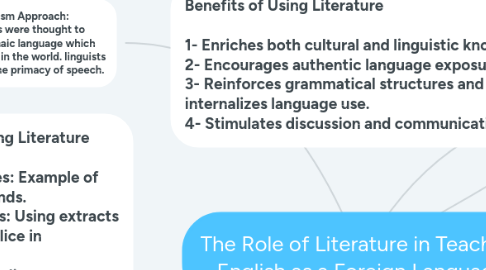
1. Audiolingualism Approach: Literary texts were thought to embody archaic language which had no place in the world. linguists believed in the primacy of speech.
2. Communicative Approach meant that literature could be used as a stimulus for discussion and genuine communication, rather than the learners being required to simply repeat set phrases.
3. Benefits of Using Literature 1- Enriches both cultural and linguistic knowledge. 2- Encourages authentic language exposure. 3- Reinforces grammatical structures and internalizes language use. 4- Stimulates discussion and communication.
4. Classroom Activities Using Literature 1- Pronunciation Exercises: Example of limericks to practice sounds. 2- Interactive Discussions: Using extracts from familiar texts (ex: Alice in Wonderland). 3- Group Work: Rewriting literary passages (ex: Jabberwocky) to encourage creativity. 4- Guessing Games: Guessing titles or rearranging poem lines in the correct order. 5- Listening Tasks: Jigsaw readings, filling in missing words, or transcribing poems.
5. Defining Literature: 1- Moody’s definition: Literature meets human communicative needs. 2- Brumfit's perspective: Literature reflects the time and place of its writing. 3- Literary texts as a form of authentic language.
6. Choosing Appropriate Texts 1- Consider linguistic and stylistic appropriacy. 2- Reflect learners' needs and abilities. 3- Balance between enjoyment and learning (Hill’s caution against over-analyzing literature). 4- Examples of suitable texts (simplified readers, light fiction, poetry).
7. Teacher’s Role 1- Importance of enthusiasm and innovative activities. 2- Adapting literary texts and activities for different levels. 3- Personal experiences (Jenny Elliott’s classroom examples).


