Enhancing Students' Oral Chunk Production through Listening
von David saldaña
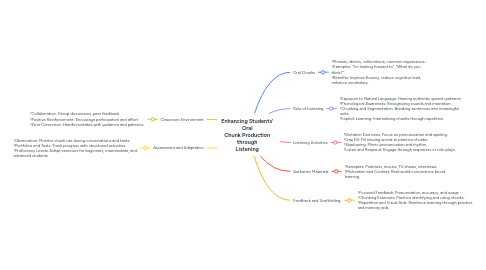
1. Classroom Environment
1.1. °Collaboration: Group discussions, peer feedback. °Positive Reinforcement: Encourage participation and effort. °Error Correction: Handle mistakes with guidance and patience.
2. Assessment and Adaptation
2.1. °Observation: Monitor chunk use during conversations and tasks. °Portfolios and Tests: Track progress with structured activities. °Proficiency Levels: Adapt exercises for beginners, intermediate, and advanced students.
3. Oral Chunks
3.1. °Phrases, idioms, collocations, common expressions. °Examples: "I'm looking forward to", "What do you think?". °Benefits: Improve fluency, reduce cognitive load, enhance vocabulary.
4. Role of Listening
4.1. °Exposure to Natural Language: Hearing authentic speech patterns. °Phonological Awareness: Recognizing sounds and intonation. °Chunking and Segmentation: Breaking sentences into meaningful units. °Implicit Learning: Internalizing chunks through repetition.
5. Listening Activities
5.1. °Dictation Exercises: Focus on pronunciation and spelling. °Gap Fill: Fill missing words to practice chunks. °Shadowing: Mimic pronunciation and rhythm. °Listen and Respond: Engage through responses or role-plays.
6. Authentic Materials
6.1. °Examples: Podcasts, movies, TV shows, interviews. °Motivation and Context: Real-world connections boost learning.
7. Feedback and Scaffolding:
7.1. °Focused Feedback: Pronunciation, accuracy, and usage. °Chunking Exercises: Practice identifying and using chunks. °Repetition and Visual Aids: Reinforce learning through practice and memory aids.


