Molecular Geometry and Bonding Theories
von Darren Perio
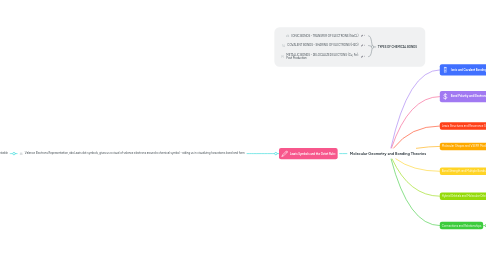
1. TYPES OF CHEMICAL BONDS
1.1. IONIC BONDS - TRANSFER OF ELECTRONS (NaCL)
1.2. COVALENT BONDS - SHARING OF ELECTRONS (H2O)
1.3. METALLIC BONDS - DELOCALIZED ELECTONS (Cu, Fe): Post Production
2. Lewis Symbols and the Octet Rule:
2.1. Valence Electrons Representation, aka Lewis dot symbols, gives us a visual of valence electrons around a chemical symbol - aiding us in visualizing how atoms bond and form
2.1.1. Octet RuleAtoms gain, lose, or share electrons to achieve 8 valence electrons.Exceptions to the Octet Rule - Helium and Hydrogen only need 2 electrons to be stable
3. Ionic and Covalent Bonding
3.1. Ionic: Electrostatic attraction between oppositely charged ions
3.1.1. Covalent: Sharing of electron pairs
4. Bond Polarity and Electronegativity
4.1. Electronegativity is the ability of an atom to attract shared electrons in a chemical bond. It is measured on the Pauiling scale.
4.2. Bond Polarity depends on the diference in electronegativy between two bonded atoms.
4.3. Nonpolar Covalent Bonds - Electrons are shared equally
4.4. Polar Covalent Bonds - Electrons are shared unequally
4.4.1. Ionic Bonds - Electrons are completely transferred from one atom to another
5. Lewis Structures and Resonance Structures
5.1. Lewis Structures are just a diagram that depict the bonding in a molecule using dots
5.2. Resonance Structures occur when mulitple valid Lewis Structures can be drawn for a molecule by shifting ONLY electrons
6. Molecular Shapes and VSEPR Model
6.1. The VSEPR model is used to predict the shape of molecules based on the idea that electron pairs around a central atom repel each other.
6.2. Common Molecular Shapes include Linear, Trigonal Planar, Tetrahedral, Trigonal Bipyramidal, Octahedral
7. Bond Strength and Multiple Bonds
7.1. Bond strength is how much energy is required to break a bond between two atoms, depending on the order, length, and the energy.
7.2. Shorter bonds are stronger because the atoms are closer together
7.3. Higher bond energy means more stability
8. Hybrid Orbitals and Molecular Orbitals
8.1. Hybridization is the micing of atomic orbitals to form new, equivalent hybrid orbitals.
8.2. Molecular Orbital theory describes the bonding using molecular orbitals to form a combination of atomic orbitals.
9. Connections and Relationships
9.1. Electronegativity determines bond polatiry, which then affects the molecular shape and intermolecular forces
9.2. Lewis Structues lead directly to VSEPR geometries, which directly influences molecular polarity
9.3. Hybrid Orbitals relate to molecular geometries
9.4. Bond Strenth correlates directly to bond order. Also the shorter the bonds - the stronger the molecule


