


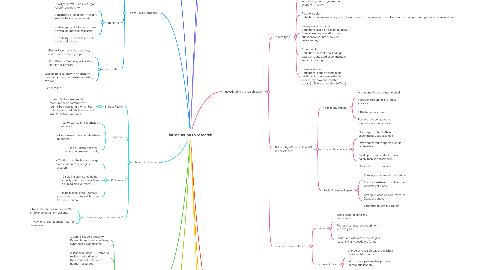
1. Key skills
1.1. Technical proficiency
1.2. Analytical skills
1.3. Experiment Design
1.4. Communication
1.5. Collaboration
2. Peer Review process
2.1. Mechanism
2.1.1. Researcher submits paper to journal/conference Editor assigns paper to anonymous expert reviewers
2.1.2. Reviewers evaluate: originality, methodology, clarity, impact Reviewers recommend: accept / reject / revisions
2.1.3. Authors revise and resubmit Editor or committee makes final publication decision
2.2. Benefits
2.2.1. Quality Control → Ensures rigor, validity, and novelty Constructive Feedback → Expert insights to strengthen work
2.2.2. Gatekeeping → Filters out weak, flawed, or unethical research Credibility → Increases trust in published science
2.3. Downsides
2.3.1. Bias → Favoring famous authors, institutions, or trendy topics Slow Pace → Can delay publication for months or years
2.3.2. Lack of Transparency → Anonymity may cause unaccountable/low-quality reviews Barrier to Inn
3. Scientific Journal
3.1. impact Factor
3.1.1. Impact Factors are used to measure the importance of a journal by calculating the number of times selected articles are cited within the last few years
3.2. Good for
3.2.1. • Quick way to rank journals by influence.
3.2.2. • Helps researchers decide where to publish.
3.2.3. • Used by institutions for evaluating research quality.
3.3. Problems
3.3.1. • Citation bias: Review articles get more citations than original research.
3.3.2. • Discipline bias: Some fields naturally cite more than others (e.g., medicine vs. math).
3.3.3. • Can be manipulated (journals push authors to cite articles from the same journal).
3.4. Does every journal have one?
3.4.1. • No. Only journals indexed in Web of Science get an official one.
3.4.2. • New or smaller journals may not have one.
4. Managing a research project
4.1. 1. Define Scope & Goals → Research question, objectives, hypotheses, significance
4.2. 2. Planning Phase → Literature review, methodology (tools/datasets), timeline, budget/resources
4.3. 3. Execution Phase → Data collection, experiments, analysis, documentation
4.4. 4. Monitoring & Iteration → Progress checks, reports, adjust methods if needed
4.5. 5. Finalization → Write paper/report, prepare presentations/posters, submit for review
4.6. 6. Dissemination → Publish results, present at conferences, share datasets/code for reproducibility
5. Researcher Career Paths
5.1. PhD student/researcher
5.2. Lecturer
5.3. Professor
5.4. Data Analyst
5.5. Lab manager
6. traits for good research
6.1. Curiosity
6.2. Perseverance
6.3. Open-mindness
6.4. Critical thinking
6.5. Integrity
7. How to approach ML, CS, & math from a researcher POV
7.1. Prioritize Concepts Over Tools
7.2. Embrace Mathematical Rigor
7.3. Engage in Hands-on Experimentation
7.4. Make Cross-Disciplinary Connections
7.5. Aim for Long-Term Depth
8. Investigating a research paper
8.1. Paper structure (Research and Review)
8.1.1. Abstract
8.1.2. Introduction
8.1.3. Literature Review
8.1.4. Methods
8.1.5. Results (not included in review paper)
8.1.6. Discussion
8.1.7. Conclusion
8.1.8. References
8.1.9. Appendices
8.2. Papers Type
8.2.1. Case Studies: Definition: An in-depth, detailed examination of a single subject (an individual, group, organization, event, or situation).
8.2.2. Review articles: Definition: Summarize, analyze, and synthesize existing research on a topic rather than presenting new experimental data.
8.2.3. Survey research paper: Definition: Based on collecting data from a sample population using questionnaires, interviews, or online surveys.
8.2.4. Experimental: Definition: Present new findings based on controlled experiments or empirical testing.
8.2.5. Cause and effect: Definition: Focus on examining relationships between variables, specifically how one variable (cause) influences another (effect).
8.3. Philosophy VS humanities VS social sciences
8.3.1. Philosophy Papers
8.3.1.1. Argumentative, not experimental Focus on reasoning and logical analysis
8.3.1.2. Little to no data used Few sources compared to humanities/social sciences
8.3.2. Humanities Papers
8.3.2.1. More argumentative than experimental, but balanced Often anchored to specific works or literature
8.3.2.2. Build upon prior works, but less rigidly than social sciences Moderate use of sources
8.3.3. Social Sciences Papers
8.3.3.1. Primarily experimental, data-driven Focus on real-world problems and possible solutions
8.3.3.2. Strong reliance on prior research (least estranged) Literature review is essential
8.4. Paper VS Science Article
8.4.1. paper
8.4.1.1. Broad term for scholarly documents Represents research, experiments, and analysis
8.4.1.2. Structured with references, logical reasoning, and academic format
8.4.2. Science Article
8.4.2.1. A type of research paper published in a scientific journal Must pass a peer-review process before publication
8.4.2.2. More informal in style compared to academic papers