

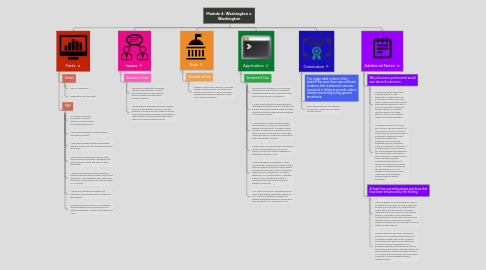
1. Facts
1.1. Parties
1.1.1. Alma D. Washington
1.1.2. Washington Hospital Center
1.2. 1987
1.2.1. Ms. Laverne Thompson underwent an elective abortion and tubal ligation under general anesthesia
1.2.2. o The nurse anesthetist, Elizabeth Adland, intubated the patient
1.2.3. o The plaintiff alleges that the endotracheal tube was inserted into the stomach rather than the trachea
1.2.4. o The surgeon noted dark blood and asked Nurse Adland to ensure her oxygenation was normal, and she replied that the vital signs were stable
1.2.5. o During the surgery the patient suffered a cardiac arrest and significant anoxic brain injury resulting in a near vegetative state, which she will remain in permanently, until her likely death in 10-20 years
1.2.6. o There was a settlement between the defendants Nurse Adland and Dr. Walker and the plaintiffs.
1.2.7. o The personal injury claim for Ms. Thompson and the husband’s loss of consortium claim against Washington Hospital Center went onto a jury.
2. Issues
2.1. Standard of Care
2.1.1. The Plaintiffs claim that the hospital deviated from standard of care for general anesthesia in the operating room by failing to provide carbon dioxide monitoring.
2.1.2. The Defendants appealed stating the plaintiffs failed to establish that standard of care was breached. This argument was based on the lack of sufficient evidence provided by the plaintiff's expert witness; that this witness was stating opinion more than evidence and fact.
3. Rule
3.1. Standard of Care
3.1.1. Standard of care means that any reasonably prudent anesthesiologist at a tertiary care hospital, similar to WHC, would use carbon dioxide monitoring for an elective surgery under general anesthesia
4. Application
4.1. Standard of Care
4.1.1. To demonstrate standard of care deviated, the plaintiff must prove that a reasonable anesthesiologist would have done the same actions under similar circumstances.
4.1.2. o In this case the plaintiff established that a reasonable anesthesiologist and a tertiary care hospital would have supplied a carbon dioxide monitor to a patient under general anesthesia for an elective surgery.
4.1.3. o The defendant argues that the plaintiff’s expert witness, Dr. Steen, did not provide evidence on the efficacy of carbon dioxide monitors, as this was not standard of care in 1987. They also contend that Dr. Steen was providing opinion on carbon dioxide monitors rather than written standards.
4.1.4. o At this time CO2 monitors were emerging as ‘strong recommendations’ from various experts, but had not yet been mandated or established standard of care.
4.1.5. o The judge argues that standard of care warrants what a ‘reasonably prudent’ hospital would do, which can include care exceeding the minimum required by law or professional regulation. Thus, regardless of Dr. Steen’s testimony, CO2 monitors were a reasonably prudent form of monitoring to have in operating rooms, and should have been present for this case.
4.1.6. o Dr. Murray the Chair of Anesthesiology for WHC stated that he submitted requests for CO2 monitors, but there is debate as to whether these were available or should have been available for Ms. Thompson’s case.
5. Conclusion
5.1. The Judge ruled in favor of the plaintiff because there was sufficient evidence that standard of care was breached, in failing to provide carbon dioxide monitoring during general anesthesia.
5.2. The apellate judge also ruled against the hospital in failing to claim liability for their actions.
6. Additional Notes
6.1. Why a business professional would care about the decision
6.1.1. This impacts technology within medicine greatly. As new technology is established to be efficacious in patient care, once there is medical literature or expert organizations endorsing its use, a jury can argue that a ‘reasonably prudent’ physician or hospital should integrate it into their practice, even if it is not legally required or hospital mandated.
6.1.2. An example of this in my current line of work is the intraosseous (IO) needle and IO drill. It is a fast and efficient way of obtaining access to a patient’s bloodstream to give medications, when an IV (intravenous) line cannot be established quickly. These have come out in the last 10-20 years. If a patient suffers from not having life-saving medications delivered to their blood stream due to lack of vascular access, a jury would argue that a reasonably prudent paramedic/physician/hospital should stock intraosseous needle and drill. Is it legally required as a life-saving device? No. Is it standard of care because other reasonably prudent medical providers should use this? Absolutely.
6.2. At least two current business practices that have been influenced by the holding
6.2.1. This case applies to the auto industry. There is constantly new technology, such as seat belts, air bags, anti-lock brakes, etc, that when the technology is first released it is not always required by law to be present in new vehicles. However, once there is proof that these measures are life-saving, they quickly become ‘standard of care’, where any reasonably prudent automaker SHOULD include life-saving features in their vehicles.
6.2.2. This also applies to the sport of football, at the level of the National Football League, to collegiate and high school levels. Gradually, new evidence has been revealed that head injury and concussion warrants formal evaluation, testing, and limitations on activity to promote brain recovery. While this sitting out after a head injury may not be legally required, it is a strong recommendation from the medical community, and has gradually become standard of care.