


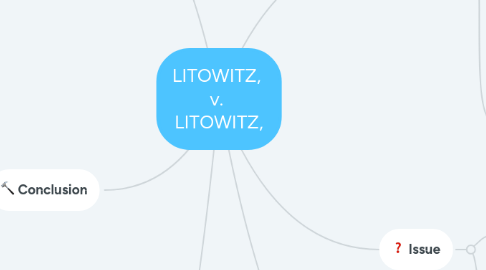
1. Conclusion
1.1. Reversed
1.1.1. Regarding issue 1- there was no contract for the court of appeals and superior court to enforce, because no express contract was made.
1.1.1.1. In order for contract regarding decision of preembryos to be made, the Respondent and Petitioner must petition a court first
1.1.2. Regarding issue 2- the court will not consider additional evidence, as it did not meet criteria to be considered-
1.1.2.1. (1) If necessary to resolve issue (2) if it will change the decision being reviewed (3) it is equitable to excuse the failure to produce evidence in trial court (4) the remedy available to is inadequate or unnecessarily expensive (5) appellate court remedy of granting new trial is inadequate or unnecessarily expensive (6) it would be inequitable to decide the case given only the current evidence
1.2. Given the contract with Loma Linda Center, it is also unclear whether there are any preembryos still in existence, as they were contractually allowed to let them thaw out after five years- which have already passed
2. Analysis / Application
2.1. Petitioner (Beck Litowitz) claims that she has a contractual right to the preembryos because the egg donor contract gives both her and the Respondent equal rights to the preembryos
2.1.1. Argues that biological relationship should not matter
2.1.1.1. Supreme court agrees that the contract gives equal right to both intended parents (Respondent and Petitioner)
2.2. Respondent (David J. Litowitz) argues that the donor contract does not expressly state that the preembryos can be given to the petitioner in the event of divorce
2.2.1. No provision within the contract relation to disposition of eggs
2.2.1.1. The written agreement does state that if the two parties cannot come to a conclusion of what to do regarding disposition of the preembryos, they must petition a court of competent jurisdiction for instruction
2.2.1.1.1. The court determines that it is obvious that the two parties have not reached a mutual decision
2.3. Petitioner (Beck Litowitz) also claims that when the Court of Appeals granted the Respondent the embryos to be put up for adoption, it extinguished the egg donor's rights without consent.
2.3.1. Using this claim to show that court of appeals is internally inconsistent
2.3.1.1. Egg donor contract is not of concern in this case- as there is only a necessity to review the preembryo cropreservation contract
2.4. Respondent's additional evidence motion is to be used to determine Becky Litowitz's suitability as a parent.
3. 3 I's
3.1. Impact
3.1.1. STATE v. WILKINS, Court of Appeals of Washington, Division Three.
3.1.1.1. Referenced when reviewing contract language and overall contract validity
3.1.2. SZAFRANSKI v. DUNSTON, Appellate Court of Illinois, First District, Second Division.
3.1.2.1. Referenced when applying the contractual approach to the case at hand
3.2. Importance
3.2.1. An HCP would care about this decision because it focuses on the contract behind the relationship. Despite the other factors at play, and the potential to delve into the definition of life and potential future of the embryos, the court made a conscious decision to focus on the language used within the contract to determine the disposition of the embryos.
3.2.2. HCP should also care about the decision because of the information required to be given to the persons involved prior to engaging in any of these procedures. Additionally, it may be in the institutions or doctor's best interest to inform patients that due to the nature of this relationship, contingencies and other details should be specifically stated in their contracts.
3.3. Influence
3.3.1. Legal teams in institutions performing ART to conduct strict contractual reviews
3.3.2. Ensuring that each stage of the in vitro process is covered by contractual language and agreed to by all parties with informed consent
4. Facts
4.1. Parties
4.1.1. Huband, Respondent, David J. Litowitz
4.1.2. Wife, Petitioner, Becky M. Litowitz
4.2. What Happened?
4.2.1. Respondent and Petitioner were married
4.2.1.1. Petitioner had 2 children prior to marriage. Together, they had 1 child naturally together, and 1 child via in vitro fertilization. Through the in virto fertilization process, the medical group created five preembryos, with egg donor eggs and the respondent's sperm
4.2.1.1.1. Respondent and Petitioner both signed a contract to enter into this relationship, defining them both as "Intended Parents", and stating that all eggs produced by this process were property of the "Intended Parents".
4.2.1.1.2. Three preembryos were used, two were cryopreserved and stored
4.2.1.2. Before their last child was born, the couple had separated.
4.2.1.2.1. During the dissolution proceeding, the petitioner stated she wanted to bring the embryos to full term, and the respondent wanted to put them up for adoption.
4.3. Procedural History
4.3.1. Superior Court, Pierce County awarded husband David Litowitz cryopreserved preembryos
4.3.1.1. Becky Litowitz appealed
4.3.2. The Court of Appeals affirmed
4.3.2.1. Becky Litowitz appealed
5. Issue
5.1. (1) Was Court of Appeals correct when it affirmed the Superior Court's decision
5.1.1. Contractually, is there obligation to continue with the family plan?
5.2. (2) Court also reviewed whether a motion by Respondent David J. Litowitz to submit additional evidence should be granted.
5.2.1. Respondent has evidence of petitioner's drug use after dissolution resulting in modified parent plan, and attempted murder.
6. Rule of Law
6.1. Uniform Parentage Act- Article 7
6.1.1. Assisted conception - If a man and a woman consent to any sort of assisted conception, and the woman gives birth to the resultant child, they are the legal parents. Sperm or egg donors may not be a legal parent under any circumstances.
6.2. Precedent set in Davis v. Davis
6.2.1. Question of disposition of embryos after a divorce.
6.2.1.1. Court set aside person v. property discussion and determined that the disappointment of Mrs. Davis not having a child with those embryos was less than the burden of a child being born with them given the responsibilities of both persons involved.