Entdecken Sie das volle Potential Ihrer Projekte.
Testen Sie MeisterTask kostenlos.
Haben Sie kein Benutzerkonto?
Kostenlos registrieren
Browse
Empfohlene Maps
Kategorien
Projektmanagement
Geschäft & Ziele
Personalwesen
Brainstorming & Analyse
Marketing & Content
Bildung & Notizen
Unterhaltung
Leben
Technologie
Design
Zusammenfassungen
Andere
Sprachen
English
Deutsch
Français
Español
Português
Nederlands
Dansk
Русский
日本語
Italiano
简体中文
한국어
Andere
Vollbild-Modus
Map bearbeiten
Kopieren
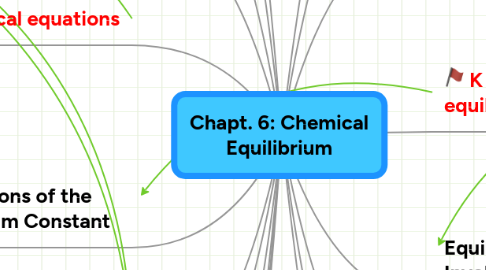
Chapt. 6: Chemical Equilibrium
Andere
AD
Aadarshi dave
Folgen
Concept map of textbook material (in black) and Key Concepts discussed in lecture (in red)
Jetzt loslegen.
Gratis!
Mit Google registrieren
oder
registrieren
mit Ihrer E-Mail-Adresse
Ähnliche Mindmaps
Mindmap-Gliederung
Chapt. 6: Chemical Equilibrium
von
Aadarshi dave
1. Equilibria Involving Real Gases
1.1. Non-ideality
1.2. How to correct Kp for non-ideality
2. "Stress" on an equilibrium shifts reaction in direction that minimizes change
2.1. Add reactant (R) or product (P): rxn shifts to consume it Remove R or P: rxn shifts to replace it
2.2. Decrease the volume: rxn shifts to the side with the smallest n
2.3. Treat energy as R or P to predict effect of T on K
3. Le Châtelier's Principle
3.1. Effect of a change in conditions on equilibria
3.2. Effect of a change in concentration
3.3. Effect of a change in pressure
4. Solving Equilibrium Problems
5. You can do "math" with chemical equations
5.1. Adding c.e. means multiplying K
5.2. Multiplying c.e. by n means taking K^n
5.3. Reversing c.e. means taking 1/K
6. Applications of the Equilibrium Constant
6.1. Predictions based on the equilibrium constant
6.2. Extent of reaction
6.3. Reaction quotient (Q)
6.4. Calculating equilibrium pressures and concentrations
7. Try to make x in the ICE table small. This simplifies the math!
8. ICE tables help organize equilibrium problems
9. Heterogeneous Equilibria
9.1. Phases: gas, solid, liquid
9.2. Heterogeneous Equilibria: between multiple phases
9.3. Equilibrium constant for heterogeneous equilibria
9.4. Activity of pure phases (solids or liquids)
10. Q describes the position of a rxn not necessarily at equilibrium
11. Acitivity of pure solid or liquid = 1
12. Activity coefficients correct for interactions between species
13. The Equilibrium Condition
13.1. How a reaction reaches equilibrium
13.2. Characteristics of chemical equilibrium
13.3. Equilibria are dynamic
14. Equilibria are dynamic but may be so slow that []s appear not to change
15. The Equilibrium Constant
15.1. Law of mass action
15.2. Characteristics of the equilibrium expression
15.3. Equilibria in ammonia synthesis
15.4. Equilibrium position
16. K is meaningful only at equilibrium
16.1. Can't be = 0 or 1/0
16.2. Large K (>>1) means products favored
16.3. Small K (<<1) means reactants favored
17. Equilibrium Expressions Involving Pressures
17.1. Ideal gas law
17.2. Equilibrium partial pressures
17.3. Kp vs. K
18. Partial pressures sum to total pressure
19. Activity is a way to compare the amount of a reactant or product to their standard state and make K unit-less
20. The Concept of Activity
20.1. The reference state
20.2. For a gas, 1 atm
20.3. Definition of activity
Gratis anmelden!
Mit Google verbinden
oder
Registrieren