


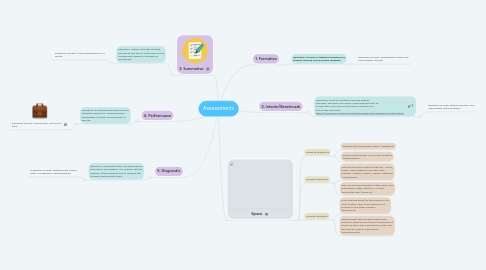
1. 3. Summative
1.1. Definition: used to evaluate student learning at the end of a learning unit by comparing it against a standard or benchmark.
1.1.1. Examples include: a final presentation or a recital
2. 4. Performance
2.1. Definition: An assessment that provides students freedom to showcase their knowledge of a topic by applying it in real life.
2.1.1. Examples include: science labs, and mock trials
3. 5. Diagnostic
3.1. Definition: Diagnostic tests are given before instruction even begins, it is used to see the abilities of the students and to identify the student achievement gaps.
3.1.1. Examples Include: Textbook pre course tests or diagnostic questionnaires
4. 1. Formative
4.1. Definition: Process of gathering evidence of student learning and providing feedback
4.1.1. Examples include: Observations (informal) and Quizzes (formal)
5. 2. Interim/Benchmark
5.1. Definition: measures student learning against standard. Teachers use results of benchmarks test to modify their instruction and prepare students for end of the year tests. https://classroom.synonym.com/benchmark-test-education-6038119.html
5.1.1. Examples include: writing samples, and open ended math problems
6. Space
6.1. Opening Questions
6.1.1. What do we know about space? (definition)
6.1.2. What are the planets in our Solar System? (identification)
6.2. Guiding Questions
6.2.1. How are the inner planets (Mercury, Venus, Earth, Mars) different from the outer planets? (Jupiter, Saturn, Uranus, Neptune) (contrasting)
6.2.2. Why do you think planets further away from Earth have longer rotations, or years, around the sun? (analysis)
6.3. Closing Questions
6.3.1. From learning about all the planets in our Solar System, why could humans not survive on any other planets? (application)
6.3.2. Imagine there was another planet past Neptune, what do you think its temperature would be like? How long would its year be? Would it be solid or a gas giant? (hypothesizing)