


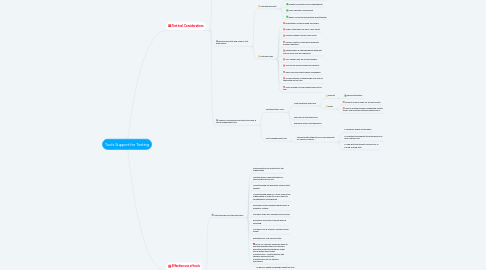
1. Test tool Considerations
1.1. Classify test tools according to their purpose and the test activities they support
1.1.1. Tool support for management of testing and testware
1.1.1.1. Test management tools & application lifecycle managment tools (ALM)
1.1.1.2. Requirement management tools
1.1.1.3. Defect management tools
1.1.1.4. Configuration management tools
1.1.1.5. Continues Integration tools (D)
1.1.2. Tool support for static testing
1.1.2.1. Static analysis tools (D)
1.1.3. Tool support for test design & implementation
1.1.3.1. Model-Based testing tools
1.1.3.2. Test data preparation tools
1.1.4. Tool support for test execution & logging
1.1.4.1. Test execution tools
1.1.4.2. Coverage tools (D)
1.1.4.3. Test harnesses (D)
1.1.5. Tool support for performance testing & dynamic analysis
1.1.5.1. Performance testing tools
1.1.5.2. Dynamic testing tools
1.1.6. Tool support for specialized testing needs
1.2. Identify benefits and risks of test automation
1.2.1. Potential benefits
1.2.1.1. Reduction in repetitive manual work thus saving time
1.2.1.2. Greater consistency and repeatability
1.2.1.3. More objective assessment
1.2.1.4. Easier access to information about testing
1.2.2. Potential risks
1.2.2.1. Expectation of tool maybe unrealistic
1.2.2.2. Under-estimation for time, cost, effort
1.2.2.3. The tool maybe relied on too much
1.2.2.4. Version control of test work products maybe neglected
1.2.2.5. Relationships & interoperability between critical tools may be neglected
1.2.2.6. Tool vendor may go out of business
1.2.2.7. The vendor may provide poor support
1.2.2.8. Open source project maybe suspended
1.2.2.9. A new platform or technology may not be supported by the tool
1.2.2.10. There maybe no clear owner ship for the tool
1.3. Special consideration for test execution & test management tools
1.3.1. Test Execution Tools
1.3.1.1. Capturing test approach
1.3.1.1.1. Benefit
1.3.1.1.2. Risks
1.3.1.2. Data-driven test approach
1.3.1.3. Keyword-driven test approach
1.3.2. Test Management Tools
1.3.2.1. Interface with other tools or spreadsheets for various reasons...
1.3.2.1.1. To produce useful information
1.3.2.1.2. To maintain traceability to requirements in requ. manag. tool
1.3.2.1.3. To link with test object version info. in config. manag. tool
2. Effective use of tools
2.1. Main principles for tool selection
2.1.1. Assessment of the maturity of the organization
2.1.2. Identification of opportunities for improving test process
2.1.3. Understanding technologies used by test objects
2.1.4. Understanding build & CI tools used in the organization in order to ensure the tool compatibility & integration
2.1.5. Evaluation of tool against requirement & objective criteria
2.1.6. Consider if the tool available for free trial
2.1.7. Evaluation of vendor, training need & coaching
2.1.8. Consider pros & cons for various license model
2.1.9. Estimation of cost-benefit ratio
2.1.10. Proof-of-concept should be done to evaluate whether the tool performs effectively with the software under test & within the current infrastructure - also to identify the changes needed to that infrastructure to use the tool effectively
2.2. Pilot project for introducing the tool
2.2.1. To gain in-depth knowledge about the tool
2.2.2. Evaluate how the tool fits with existing process & what would need to change
2.2.3. Deciding on standard ways of using, managing, storing & maintaining the tool and test work products
2.2.4. Assessing whether the benefits will be achieved with reasonable price
2.2.5. Understanding the metrics that you wish the tool to collect & report
2.3. Success factors for tools
2.3.1. Rolling out the tool to the rest of the organization incrementally
2.3.2. Adapting & improving the process to fit with the use of the tool
2.3.3. Providing training, coaching & mentoring for tool users
2.3.4. Defining guidelines for the use of the tool
2.3.5. Implementing a way to gather usage info. from actual use of the tool
2.3.6. Monitoring tool use & benefits
2.3.7. Providing support to the users of the tool
2.3.8. Gathering lessons learned from all users