

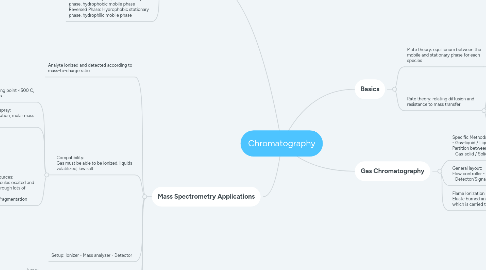
1. HPLC
1.1. High Performance Liquid Chromatography
1.2. Specific Methods/Stationary Phase/Type of Equilibrium: - Liquid-liquid / Liquid adsorbed or bonded to a solid surface / Interaction with or partitioning between immiscible liquids - Liquid-solid or adsorption / Solid / Adsorption - Ion exchange / Ion exchange resin / Ion exchange - Size exclusion / Liquid in interstices of a polymeric solid / Partition or sieving - Affinity / Group-specified liquid bonded to a solid surface / Partition between surgace liquid and mobile liquid
1.3. Normal Phase: Hydrophilic stationary phase, hydrophobic mobile phase Reversed Phase: Hydrophobic stationary phase, hydrophilic mobile phase
2. Mass Spectrometry Applications
2.1. Analyte ionized and detected according to mass-to-charge ratio
2.2. Compatibility: Gas must be able to be ionized, liquids volatilized, low salt
2.2.1. Gases: Thermally stable. boiling point <500 C, molar mass < 1000 Da
2.2.2. Desorption and electrospray: Doesn't require volatilization, molar mass up to 10^5 Da
2.2.3. General ionization sources: Hard sources - molecules excited and energy dissipated through lots of fragmentation Soft sources - little fragmentation
2.2.3.1. Types of Ion Sources: - Electron ionization - Chemical Ionization - Electrospray Ionization - Atmospheric pressure chemical ionization - Matrix-assisted laser desorption/ioniation
2.2.3.2. Hard source: Sample vaporized at high temp, bombarded with beam of electrons Usually coupled with gas chromatography Many fragment ions creased Mass range <1000 Da
2.2.3.3. Soft source: High energy electrons ionize reagent gas to collide with analyte, transferring protons Most commonly electrospray and matrix-assisted laser desorption ionization
2.3. Setup: Ionizer - Mass analyzer - Detector
2.4. Mass analyzers
2.4.1. Types: Magnetic sector Quadrupole Ion Trap Time-of-Flight FT-ion cyclotron resonance Orbitrap
2.5. Detectors
2.5.1. Types: Faraday collector Electron multiplier
3. Basics
3.1. Plate theory: equilibrium between the mobile and stationary phase for each species
3.1.1. Column efficiency: Height equivalent of a theoretical plate (H=L/N)
3.2. Rate theory: relating diffusion and resistance to mass transfer
3.2.1. Eddy diffusion
3.2.2. Longitudinal diffusion
3.2.3. Resistance to mass transfer in mobile phase
3.2.4. Resistance to mass transfer in stationary phase