


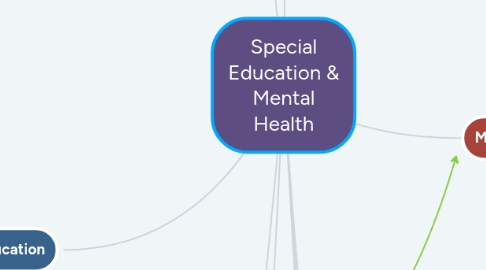
1. Special Education
1.1. diagnosed
1.1.1. exceptionalities could be hereditary, some developed over time, or some acquired (ie: an accident)
1.1.1.1. It can be difficult and problematic to identify and classify disability
1.1.1.1.1. teach based on child's learning need and not based on how their exceptionality is classified
1.1.1.2. Exceptionalities include intellectual disabilities, autism spectrum disorder, speech and language disorders, hard of hearing, visual impairments, physical disabilities and chronic health conditions (cerebral palsy, spina bifida, epilepsy, tourette syndrome, brain injury, fetal alcohol spectrum disorders, muscular dystrophy, juvenile arthritis, diabetes, allergies, asthma, cystic fibrosis,crohn's disease, ulcerative colitis, cancer, etc.
1.2. require special support
1.2.1. medical support
1.2.2. physical support (ie: wheel chairs)
1.2.3. emotional support
1.2.4. accomodation
1.2.4.1. Changes HOW student is taught
1.2.5. Modification
1.2.5.1. Changes WHAT student is taught
1.2.6. Effective Teaching Strategies and use evidence based teaching-strategies
1.2.6.1. Grouping, explicit instruction, systematic instruction, response to opportunities, immediate corrective feedback, progress monitoring, varied assessment
1.2.6.1.1. Effectiveness of professional, learning communities
1.2.7. Teachers need to have a problem solving hat to address student needs: identify a strategy, obstacle, and solution
1.2.8. Bill 82 in Ontario - students have the right to access special education support
1.3. huge variation of impact to student learning
1.3.1. students may be in a regular classroom or in a special needs class/school depending on their needs
1.3.1.1. gifted students are also part of spec ed
1.3.1.1.1. discrimination, there are more white students than coloured students who are identified for the gifted program
1.3.2. physical vs emotional vs cognitive support
1.4. Individualized Education Plans
1.4.1. Importance for students to understand themselves as learners
1.5. inclusion is key
1.5.1. Special needs students could experience more bullying, impacting their mental health
1.5.2. how well does curriculum meet the needs of Special Education Students?
1.5.2.1. Universal Design for Learning
1.5.2.2. Differentiated Instruction
1.5.2.2.1. Can differentiate content, process, activities, product, learning environment, assessment. Consider students readiness, passions, affect and learning profile per the Dimensions of Differentiation chart
1.5.2.3. Response to Intervention (classroom, small group, individual)
1.5.2.4. ADAPT Strategy
1.5.3. negative association exists with Special Education
1.5.3.1. Need to remove the stigma associated with being different. All students are different and embrace diversity. Make students aware we are all different and must be inclusive
1.5.4. Teaching practices that are inclusive of all student ability
1.5.4.1. Use thinking routines to help students to organize, analyze, and discuss information
1.5.5. Mindset of knowledge, experience, and creativity
1.5.6. With student: set learning goals, success criteria, provide feedback and peer self-assessment. It is important to monitor progress.
1.6. Research gaps exist wiith regards to effective teaching methods for special education students at the secondary level
2. What supports are there for parents to help them accept and support their child if they require Mental Health or Special Education support?
2.1. Special education support and psychologist available
2.2. There is however a problematic lack of resources in schools to support Special Education and Mental Health. There are lots of students on the waitlist waiting to be evaluated to access these programs.
3. Addressing all students' needs through differentiated instruction
4. How does the perception of mental health vary amongst cultures? What strategies exist for Cultural Relevant Mental Health Education and Special Education?
4.1. importance to work with student, parents, and school as there could be conflicting perspectives
4.2. Always do what is best for the child
4.3. get to know the students, their family and their culture and use culturally relevant pedagogy
5. Trauma: event experienced by a student which has lasting adverse effects
6. Mental Health
6.1. self-care
6.1.1. good diet
6.1.2. exercise
6.1.3. time for rest and relaxation
6.2. support
6.2.1. family
6.2.2. friends
6.2.3. medical
6.2.4. educators
6.2.4.1. Classroom resources
6.2.4.1.1. R.A.I.N - Recognize, Accept, Identify, non-identification. Exercise to help us stay in the present
6.2.4.1.2. Facial relaxation
6.2.4.1.3. Mindfulness
6.2.4.1.4. 30-sec de-stress routine
6.2.4.1.5. Mind your mind interactive games
6.2.4.1.6. Gratitude moments
6.2.4.1.7. thinking routines
6.2.4.1.8. Wishing well for the classroom
6.2.4.2. multiple modes of assessment - help with text anxiety
6.2.4.3. Create a safe environment of collaboration over competition
6.2.4.4. Provide students with toolbox (school organized external guest speaker) to help students identify abuse and know how to report it
6.2.4.5. Do not single out students or judge them. Instead, try to understand why may be happening in their life that has resulted in certain behaviour
6.2.4.6. Prepare students for self-advocacy, to know their ability and advocate for their needs
6.2.4.7. collaborate with other educators to brainstorm solutions for supporting students
6.2.4.8. Aligned and Integration model for School mental health and well-being: Start with a foundation of inclusion, welcoming, understanding, partnership. Then Identify: support, bolster, prevent. Lastly bridge: intervene and mobilize resources to support the individual
6.3. not always visible
6.3.1. lack of self-esteem
6.3.2. feeling of loneliness
6.3.3. depression
6.3.4. fatigue