Distance Education in Nursing
par Jessica Gommel
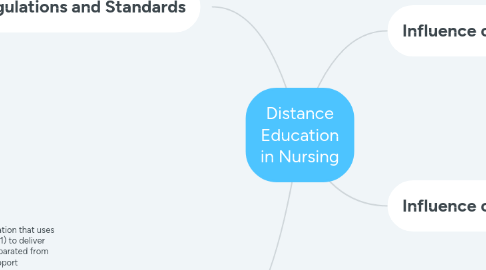
1. Regulations and Standards
1.1. Commission on Collegiate Nursing Education (CCNE), an autonomous accreditation agency of baccalaureate and graduate nursing programs.
1.1.1. Four standards of expected institutional performance, to include distance education programs.
1.1.1.1. Program Quality: Mission and Governance
1.1.1.2. Program Quality: Institutional Commitment and Resources
1.1.1.3. Program Quality: Curriculum and Teaching-Learning Practices
1.1.1.4. Program Effectiveness: Assessment and Achievement of Program Outcomes
1.2. National League for Nursing Commission for Nursing Education Accreditation (NLN CNEA), an autonomous accreditation agency of baccalaureate and graduate nursing programs.
1.2.1. Five standards essential to ensuring quality academic programs, applying to all types of nursing education, including distance education.
1.2.1.1. Culture of Excellence – Program Outcomes
1.2.1.2. Culture of Excellence and Caring – Faculty
1.2.1.3. Culture of Integrity and Accountability – Mission, Governance, and Resources
1.2.1.4. Culture of Excellence and Caring – Students
1.2.1.5. Culture of Learning and Diversity – Curriculum and Evaluation Processes
1.3. Southern Association of Colleges and Schools Commission on Colleges (SACSCOCC) is the regional body for the accreditation of degree-granting higher education institutions in the Southern States.
2. Definitions
2.1. Distance education: education that uses one or more technologies 1) to deliver instruction to students separated from the educator and 2) to support interactions synchronously or asynchronously (Higher Education Opportunity Act of 2008).
2.2. Online education: generally taught by instructors incrementally with interaction between teacher and student. Uses one or more technologies to support regular and substantive interaction.
2.3. Correspondence education: predates online education and differs in delivery. Correspondence course materials are delivered up front and progress is generally self-paced. Interaction between learner and instructor is limited.
3. Influence on Nursing Education
3.1. Pros: available everywhere, works with students' work and family obligations, and digital textbooks can reduce traditional high classroom material costs.
3.2. Cons: online access is not readily available or sufficient for all students, technological tools are not always affordable, readily available or updated, and still as expensive as in-person classes (the "Digital Divide").
4. Influence on Staff Development
4.1. Pros: asynchronous use increases, educators are utilizing the medium more commonly, better use of multimedia content, experimenting with class structure is easier, and aligning content, activities, and assignments with objectives can be more fluid.
4.2. Cons: Concern about yielding same learning outcomes as face-to-face- instruction, quality of instruction is not comparable to face-to-face, costs are just as high as with traditional instruction, too much corporate influence can be found online, and there is a faculty loss of control over the content and outcomes.


