


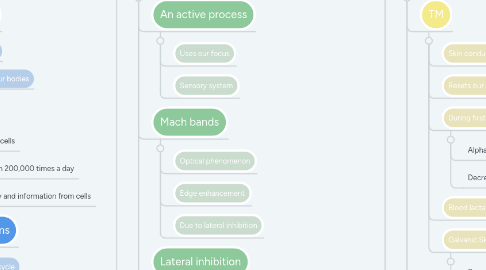
1. Paradigms
1.1. Paradigms
1.1.1. We use paradigms to judge
1.1.1.1. Affected by our emotional response
1.1.2. Information processing
1.1.2.1. Low road response
1.1.2.1.1. Emotional response
1.1.2.1.2. Brain stem and the limbic system
1.1.2.1.3. Fast and automatic
1.1.2.2. High road Response
1.1.2.2.1. Cerebral cortex
1.1.2.2.2. Reflects
1.1.2.2.3. Slower
1.1.3. Emotional response
1.1.3.1. Affects our Action
1.1.3.2. Affects thinking
1.1.3.3. Affects our meaning making
1.1.3.4. Affects our experience
1.2. Brain and Consciousness models
1.2.1. The Maharishi Vedic Science model
1.2.1.1. Consciousness is a biological phenomenon
1.2.1.2. neuronal processes
1.2.1.3. Individual experience is effected
1.2.2. Brain and Consciousness model
1.2.2.1. Consciousness is a never-changing phenomenon
1.2.2.2. function causally
1.2.2.3. rocess going on in the brain
1.2.3. Consciousness
1.2.3.1. Pure Being
1.2.3.2. Brain
1.2.3.3. All there is
1.3. Paradigms and Racism
1.3.1. Unconscious behavior
1.3.1.1. Act on prejudice and stereotypes
1.3.1.2. neutral and open
1.3.1.3. Perception is colored by emotional response
1.3.1.3.1. Low road
1.3.1.3.2. old experiences
1.3.2. Government
1.3.2.1. Workshops
1.3.2.1.1. Not enough
1.3.3. Improving racism
1.3.3.1. Rewire brain's structure
1.3.3.2. Long process
1.3.3.3. TM
1.3.3.3.1. Clears our mind
1.3.3.3.2. Aware of our behavior
2. Evolving Brain
2.1. Brain’s Details
2.1.1. Brain
2.1.1.1. Starts developing in the womb
2.1.1.2. 25 years to develop maturity
2.1.1.3. Neurons
2.1.1.3.1. 100 billion
2.1.1.3.2. Axons
2.1.2. Grey matter
2.1.2.1. Outer layer
2.1.2.2. Process information
2.1.2.3. Dendrites
2.1.2.3.1. Input fiber
2.1.2.3.2. Synaptic integration
2.1.3. White matter
2.1.3.1. Fatty-inner layer
2.1.3.2. Myelin & astrocytes
2.1.3.2.1. Nourishes cells
2.1.3.2.2. Output information
2.1.3.3. Communicates with body
2.2. Waves of Maturation
2.2.1. Brain evolution
2.2.1.1. Womb
2.2.1.1.1. Unassembled
2.2.1.1.2. Not auditory stimulation
2.2.1.2. From three to seven
2.2.1.2.1. Explosion of synaptic connections
2.2.1.2.2. Gains Myelin
2.2.1.2.3. Explore the world
2.2.1.3. From five to ten
2.2.1.3.1. World of Wisdom
2.2.1.3.2. Thinking develops
2.2.1.4. From twelve to twenty five
2.2.1.4.1. Individuality emerges
2.2.1.4.2. TM-shidhis
2.2.1.4.3. Higher levels of consciousness
2.2.2. Worldview
2.2.2.1. Alter by changes is grey and white matter
2.2.2.1.1. Synapses
2.2.2.1.2. myelination
2.2.3. Consciousness
2.2.3.1. level of physiology
2.2.3.2. Changes by information
2.3. Experience Changes the Brain
2.3.1. Physiology
2.3.1.1. Its nature is to grow
2.3.1.2. Designed for change
2.3.2. Experiences
2.3.2.1. Change our worldview
2.3.2.2. Change our brains plasticity
2.3.2.3. Change our reality
2.3.3. Habits
2.3.3.1. We become our habits
2.3.3.2. Be can change
2.3.3.3. Takes time and Effort
3. Sleeping and Dreaming
3.1. Two processes Guide Sleep
3.1.1. Sleep pressure
3.1.1.1. Slows down body
3.1.1.2. Utilize energy in our bodies
3.1.1.3. Adenosine
3.1.1.3.1. Molecule in cells
3.1.1.3.2. Brakes down 200,000 times a day
3.1.1.3.3. Uses energy and information from cells
3.1.2. Circadian rhythms
3.1.2.1. Nature's 24-hour cycle
3.1.2.2. Influenced by the sun
3.1.2.3. Brain synchrony
3.1.3. Sleep state
3.1.3.1. We sleep 1/3 of our lives
3.1.3.2. Semi-starvation mode
3.1.3.3. Essential physiological cycle
3.2. Brain during Sleep and Dreaming
3.2.1. Sleep and dreaming
3.2.1.1. Activity and intelligently regenerates
3.2.1.2. Neural plasticity
3.2.1.2.1. Strengthen connections
3.2.1.2.2. Clean up unused connections
3.2.1.3. Synaptic housekeeping
3.2.1.4. Active process
3.2.2. Stages and cycles
3.2.2.1. Stage one
3.2.2.1.1. Less linear thoughts
3.2.2.1.2. Raphe and locus
3.2.2.1.3. Blood flow decrease in the frontal lobe
3.2.2.2. Stage two
3.2.2.2.1. Thalamus is turnoff
3.2.2.2.2. Delta waves are not yet stronger
3.2.2.2.3. Tend to wake up
3.2.2.3. Stage three (20%) and four (50%)
3.2.2.3.1. Delta (1 Hz) begins operating
3.2.2.3.2. Raphe and locus ceruleus at slowest
3.2.2.3.3. Environment is ignored
3.2.2.4. Paradoxical sleep
3.2.2.4.1. REM
3.2.2.4.2. Hard to wake up
3.2.2.4.3. Blood flow decreases in CEO AND IPC
3.3. Sleep Prepares the brain
3.3.1. Waking state
3.3.1.1. Affected by the quality of functioning of our brain
3.3.1.2. Brain's functionality is affected by our sleep habits
3.3.1.3. Mental clarity is affected by poor sleep patterns
3.3.2. Sleep
3.3.2.1. Process new information
3.3.2.2. We need more than six hours of sleep
3.3.2.3. Brain merges new information with stored memories
3.3.2.4. Help us make better decisions
3.3.2.5. Gets rid of toxins in the brain
3.3.2.6. Washes away sleep dirt
3.3.3. Sleep deprivation
3.3.3.1. Impacts cognitive function
3.3.3.2. More prominent psychiatric cases
3.3.3.2.1. Anxiety
3.3.3.2.2. Insomnia
3.3.3.3. Physiology
4. Perception
4.1. Perception
4.1.1. An active process
4.1.1.1. Uses our focus
4.1.1.2. Sensory system
4.1.2. Mach bands
4.1.2.1. Optical phenomenon
4.1.2.2. Edge enhancement
4.1.2.3. Due to lateral inhibition
4.1.3. Lateral inhibition
4.1.3.1. Helps reduce firing of all the rods and cons
4.1.3.2. Light enters the retina
4.1.3.3. Input bounces off the back of the eye
4.1.3.4. Fire perpendicular
4.1.4. Binocular convergence
4.1.4.1. bounce off the retina
4.1.4.2. Travels to opposite hemispheres of the brain
4.1.4.3. Create the supposed reality
4.1.5. Two (rods and cone) sensitive receptors
4.1.5.1. Rods
4.1.5.1.1. 23/share output
4.1.5.1.2. Sensitive to black and white
4.1.5.1.3. Energy intensity
4.1.5.2. Cons
4.1.5.2.1. Three different types of cons
4.1.5.2.2. Three different types of wavelength
4.1.5.2.3. Sensitive to color
4.2. Attention
4.2.1. Attention
4.2.1.1. Determines what we see
4.2.1.1.1. We see 2,000 bits
4.2.1.1.2. Eyes receive 4 billion bits of information
4.2.1.2. Reality is what we focus on
4.2.1.3. Determines what we experience
4.2.1.3.1. Cognitive orientation
4.2.1.4. We don't see the world as it is
4.2.2. Mind exists in layers
4.2.2.1. Senses
4.2.2.1.1. Connect the mind
4.2.2.1.2. Uses outer world of objects
4.2.2.1.3. Affects our reality
4.2.2.2. Mind
4.2.2.3. Intellect
4.2.2.4. Feelings
4.2.2.5. Ego
5. Brain Wave Patterns
5.1. Transcending
5.1.1. TM
5.1.1.1. Skin conductance increases
5.1.1.2. Resets our stress response system
5.1.1.3. During first minute of TM
5.1.1.3.1. Alpha1 band shows (EEG)
5.1.1.3.2. Decreased beta and gamma power
5.1.1.4. Blood lactate decreases
5.1.1.5. Galvanic Skin Responses
5.1.1.5.1. Sweat gland activity
5.1.2. Transcending in meditation
5.1.2.1. Transition from one state to another
5.1.2.2. Lower the content coming in
5.1.2.3. Resets autonomic functioning
5.1.3. The fourth
5.1.3.1. Pure Consciousness
5.1.3.2. We experience it during sleep
5.1.3.3. We experience while transcending in meditation
5.1.3.4. Burst in central nervous system
5.1.3.4.1. Alpha1 power and coherence are high
5.1.3.5. Mind is completely silent
5.1.3.5.1. Matrix nuclei (very active)
5.2. Meditation Practices
5.2.1. Gamma wave
5.2.1.1. Restriction of the mind
5.2.1.2. Involves focused attention
5.2.1.3. Meditation styles
5.2.1.3.1. Tibetan Buddhists (love and kindness)
5.2.2. Theta wave
5.2.2.1. Involves an open-monitoring
5.2.2.2. Nonreactive monitoring/no rumination
5.2.2.3. Meditation styles
5.2.2.3.1. Mindfulness
5.2.3. Alpha1
5.2.3.1. Doesn't involve individual manipulation
5.2.3.2. Transcend into pure consciousness
5.2.3.3. Sharpens the mind
5.2.3.4. Meditation styles
5.2.3.4.1. Automatic self-transcending
5.3. Mind Wandering
5.3.1. Positive mind-wandering
5.3.1.1. Higher connectivity (DMN and FPN)
5.3.1.2. Higher creativity
5.3.1.3. Positive-constructive daydreaming
5.3.1.3.1. Curiosity
5.3.2. Negative mind-wandering
5.3.2.1. Unpleasant emotions
5.3.2.2. Rumination
5.3.2.2.1. Guilty-dysphoric
5.3.2.3. Poorer performance
5.3.2.4. Reduced working memory capacity
5.3.3. Meditations traditions
5.3.3.1. Buddhist
5.3.3.1.1. Controls all mind-wandering
5.3.3.1.2. Blocking negative/positive mind-wandering
5.3.3.1.3. Blocking positive mind-wandering
5.3.3.2. Automatic Self-Transcending
5.3.3.2.1. Allows the experience of pure awareness
5.3.3.2.2. Mind is not under cognitive control
6. Enlightenment
6.1. The Four
6.1.1. TM
6.1.1.1. A tool for enlightenment
6.1.1.2. Transcending state
6.1.1.3. Pure self-awareness
6.1.2. Theoretical evidence
6.1.2.1. Subjectively distinct from
6.1.2.1.1. Waking (sense of self/content)
6.1.2.1.2. Sleeping (no sense of self/no content)
6.1.2.1.3. Dreaming (no sense of self/content)
6.1.2.2. The four state of Consciousness
6.1.2.2.1. Sense of self/no content
6.1.2.2.2. Body functions differently
6.1.2.2.3. Brain and body functionality transforms
6.1.3. Empirical evidence
6.1.3.1. Using content analysis
6.1.3.2. Absence of time, space, sense
6.1.3.3. Apneustic breathing
6.1.3.4. EGG high coherence
6.1.3.5. Skin conductance response
6.2. Cosmic Consciousness
6.2.1. Experience of Pure Consciousness
6.2.1.1. Can occur exponentially
6.2.1.2. Can occur while meditating
6.2.2. During sleep
6.2.2.1. Inner wakefulness
6.2.2.2. Continuum process
6.2.2.3. Witnessing (noun) sleep is non-active
6.2.2.4. Alpha and Delta waves
6.2.2.4.1. Remained synchronously active
6.2.3. During waking state
6.2.3.1. Broad-band coherence increased
6.2.3.2. More Alpha EEG
6.2.3.3. Brains start to work at the right time
6.2.3.4. Brain uses less energy
6.3. The mind
6.3.1. The mind
6.3.1.1. Likes expansion
6.3.1.2. Naturally driven to Pure Consciousness
6.3.1.3. Craves boundlessness
6.3.2. Transcendental Consciousness
6.3.2.1. Transcends cognitive
6.3.2.2. Non-dual state of pure Consciousness
6.3.2.3. Experienced while meditating
6.3.2.4. Automatic self-transcending category
6.3.2.5. TM
6.3.3. Cosmic Consciousness permanently
6.3.3.1. Regular practice TM
6.3.3.1.1. TC gets integrated
7. Why We Do What We Do
7.1. Behavior
7.1.1. Automatic emotional response
7.1.2. Governed by the brain's limbic system
7.1.2.1. Hypothalamus
7.1.2.2. Amygdala
7.1.2.3. Insula
7.1.2.4. Cingulate gyrus
7.1.2.5. Nucleus accumbens
7.1.2.5.1. Represent Dharma in the brain
7.1.3. Classical condition
7.1.3.1. Two simultaneous stimuli are needed
7.1.4. Operant conditioning
7.1.4.1. Voluntary behavior
7.1.4.2. Pleasure circuit
7.1.4.2.1. Nucleus accumbens
7.1.4.2.2. Shapes our future behavior
7.2. Desire
7.2.1. Desires
7.2.1.1. Drive our expansion
7.2.1.2. Coexist in a fixed orbit
7.2.1.2.1. Action, impression, desire
7.2.1.3. Can be positively transformed
7.2.1.3.1. by transcending regularly (TM)
7.2.2. Desire cycle
7.2.2.1. Starts at Chit
7.2.2.2. Any action leads to experience
7.2.2.3. Past impression resonates with present
7.2.2.4. Experiences giving rise to new thoughts
7.2.2.5. Though gains sympathy of the senses
7.2.3. Growth
7.2.3.1. Money doesn’t always motivate us
7.2.3.1.1. algorithmic tasks
7.2.3.2. Creative thinking tasks
7.2.3.2.1. Make us grow
7.2.3.3. Three factors
7.2.3.3.1. Autonomy, mastery, Purpose
7.3. We are What We Eat
7.3.1. Brain
7.3.1.1. Mediator between inner and outer
7.3.1.2. Helps us make sense of our reality
7.3.1.3. Frontal lobe
7.3.1.3.1. Bigger picture
7.3.2. Drugs
7.3.2.1. Distort our perception
7.3.2.2. Disturbs dynamic balance of synapses
7.3.2.3. In the stomach
7.3.2.3.1. Digestion, intestines, blood, brain, interacts with synapses
7.3.2.4. Recreational marihuana (THC)
7.3.2.4.1. Creates cognitive deficits
7.3.2.5. Medical marihuana
7.3.2.5.1. Help individuals
7.3.2.6. Psilocybin
7.3.2.6.1. Decreases blood flow
7.3.2.6.2. Use in healing ceremonies
7.3.3. TM
7.3.3.1. Natural process of transcending
7.3.3.2. Stimulates alpha brain waves