


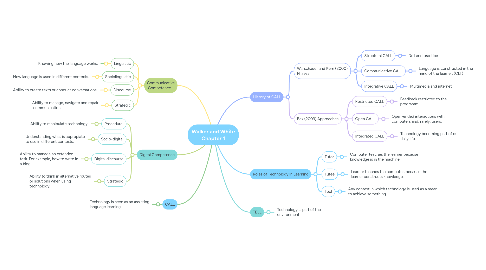
1. Communicative Competence
1.1. Linguistic
1.1.1. Knowing how the language works.
1.2. Sociolinguistic
1.2.1. How language is used in different contexts.
1.3. Discourse
1.3.1. Ability to create texts or conduct conversations.
1.4. Strategic
1.4.1. Ability to manage, navigate and repair communication.
2. Digital Competence
2.1. Procedural
2.1.1. Ability to manipulate technology.
2.2. Socio-digital
2.2.1. Understanding what is appropiate to use in different contexts.
2.3. Digital discourse
2.3.1. Ability to manage an extended task. For example, how to write in a blog.
2.4. Strategic
2.4.1. Ability to think in alternative routes or solutions when using technology.
3. CALL
3.1. Technology is seen as an assisting language learning
4. History of CALL
4.1. Warschauer and Kern (2000) Phases
4.1.1. Structural CALL
4.1.1.1. Drill and practice
4.1.2. Communicative CALL
4.1.2.1. Language is constructed in the mind of the learner. (CLT)
4.1.3. Integrative CALL
4.1.3.1. Multimedia and internet
4.2. Bax (2003) Approaches
4.2.1. Restricted CALL
4.2.1.1. Feedback restricted to the programm.
4.2.2. Open CALL
4.2.2.1. Open-ended interactions with computers and, rarely, users.
4.2.3. Integrated CALL
4.2.3.1. Technology becoming part of our daily life.
5. Roles of Technology in Learning
5.1. Tutor
5.1.1. Computer teaches the learner because knowledge is in the machine.
5.2. Tutee
5.2.1. Learner teaches the computer, because the learner constructs knowledge.
5.3. Tool
5.3.1. Any context in which technology is used as a mean to achieve something.