

1. Female Reproductive system
1.1. Primary sex organs
1.1.1. Ovary
1.1.1.1. Produces ovum / egg
1.1.1.2. Steroid hormones - ovarian hormones - estrogen & progesterone
1.1.1.3. Covered by thin cuboidal epithelium
1.1.1.3.1. Encloses stroma
1.2. Secondary sex organs
1.2.1. Accessory ducts
1.2.1.1. Oviducts / fallopian tube
1.2.1.1.1. Infundibulum
1.2.1.1.2. Ampulla
1.2.1.1.3. Isthmus
1.2.1.1.4. Ampullary - isthmus junction - fertilization takes place
1.2.1.2. Uterus/Womb
1.2.1.2.1. Narrow cervix
1.2.1.2.2. Walls - 3 layers of tissues
1.2.1.3. Vagina
1.2.2. External genitalia
1.2.2.1. Mons pubis
1.2.2.1.1. Cushion of fatty tissue
1.2.2.2. Labia majora
1.2.2.2.1. Fleshy folds of tissue
1.2.2.3. Labia minora
1.2.2.3.1. Paired folds of tissue under labia majora
1.2.2.4. Hymen
1.2.2.4.1. Often covers opening of vagina
1.2.2.5. Clitoris
1.2.2.5.1. Finger like structure at upper junction of two labia minora above urethral opening
1.2.3. Mammary gland
1.2.3.1. Fats
1.2.3.2. Glandular tissues
1.2.3.2.1. 15-20 mammary lobules
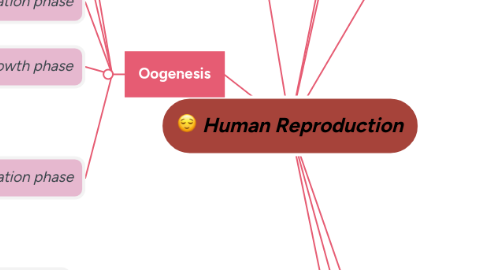
2. Oogenesis
2.1. Formation of mature female gamete
2.2. Embryonic stage
2.3. Multiplication phase
2.3.1. Oogonia
2.3.1.1. Meiosis 1 but arrested at prophase 1
2.3.1.1.1. Primary oocytes
2.4. Growth phase
2.4.1. Primary oocytes surrounded by layer of granulosa cells
2.4.1.1. Primary follicle
2.4.1.1.1. Puberty
2.5. Maturation phase
2.5.1. Secondary follicles
2.5.1.1. Teritary follicle
2.5.1.1.1. Fluid filled cavity - antrum
2.5.1.2. Mature follicle /Graffian follicle
2.5.1.2.1. Ruptures and releases secondary oocyte ( ovum )
2.5.2. Secondary oocyte
2.5.2.1. New membrane - zona pellucida
3. Fertilization
3.1. Coitus - semen released by penis into vagina ( insemination )
3.1.1. Motile sperms - pass thru cervix - into uterus - isthmus ampullary region
3.1.1.1. Ovum released by ovary - ampullary region
3.1.1.1.1. Fertilization
4. Pregnancy & Embryonic development
5. Male Reproductive system
5.1. Primary sex organs
5.1.1. Testis
5.1.1.1. Produces sperms and hormones
5.1.1.2. Outside abdominal cavity in scrotum ( helps to maintain temp for spermatogenesis
5.1.1.3. Requires temp below normal BP for spermatogenesis ( 2 - 2.5° less )
5.1.1.4. Covered by dense covering called Tunica albuginea
5.1.1.5. 250 compartments - testicular lobules
5.1.1.5.1. 1 to 3 highly coiled seminiferous tubules
5.2. Secondary sex organs
5.2.1. Accessory ducts
5.2.1.1. Rete testis
5.2.1.1.1. Vasa efferentia
5.2.1.2. Transport and storage of sperms
5.2.2. Accessory glands
5.2.2.1. Seminal vesicles
5.2.2.1.1. 60% fructose
5.2.2.2. Prostrate gland
5.2.2.2.1. Milky secretion - part of semen
5.2.2.3. Bulbourethral gland / Cowper's gland
5.2.2.3.1. Mucus for lubrication of penis
5.2.3. External genitalia
5.2.3.1. Penis
5.2.3.1.1. Special tissue - erection of penis - insemination
5.2.3.1.2. Enlarged end - glans penis
5.2.3.2. Discharge of semen
5.3. Structure of sperm
5.3.1. Head
5.3.1.1. Haploid nucleus + acrosome ( cap like structure )
5.3.1.1.1. Hydrolytic enzymes
5.3.2. Neck
5.3.2.1. Proximal centriole - first cleavage of zygote
5.3.2.2. Distal centriole - tail filament
5.3.3. Middle piece
5.3.3.1. Mitochondria
5.3.3.1.1. Energy for movt of tail
5.3.4. Tail
5.3.4.1. Axial filaments
5.3.4.1.1. Movt of sperm in fluid medium
6. Gametogenesis
6.1. Spermatogenesis
6.1.1. Production of sperms from spermatogonia ( immature male germ cells )
6.1.2. At puberty
6.1.2.1. Due to increase in GnRH
6.1.2.1.1. Pituitary gland
6.1.3. Primary spermatocytes
6.1.3.1. Meiosis 1 ( reduction division )
6.1.3.1.1. 2 equal haploid secondary spermatocytes
6.1.4. Semen
6.1.4.1. Seminal plasma + sperms
7. Menstruation cycle
7.1. First menstruation - puberty - menarche ( 12-13 yrs )
7.2. Menstrual phase
7.2.1. Ovulation during middle of cycle
7.2.1.1. Only occurs if ovum is not fertilized
7.2.1.1.1. menstrual flow results in breaking down of endometrium layer
7.3. Follicular phase
7.3.1. Primary follicles
7.3.1.1. Fully mature graffian follicle
7.3.1.1.1. Endometrium layer regenerates
7.4. Ovulation phase
7.4.1. LH and FSH at peak level
7.4.1.1. Abt 14th day
7.4.1.1.1. LH surge induces rupture of graffian follicle
7.5. Luteal phase
7.5.1. Remaining parts of graffian follicle
7.5.1.1. Corpus luteum
7.5.1.1.1. Large amt of progesterone
7.5.1.1.2. No fertilization
7.6. Stop of menstruation - menopause ( 40-50 yrs )
7.7. Extends from menarche to menopause
8. Implantation
8.1. Mitosis starts when zygote moves through isthmus - cleavage
8.1.1. 2,4,8,16 daughter cells - blastomeres
8.1.2. Embryo with 8 to 16 blastomeres = morula
8.1.2.1. Blastocyst
8.1.2.1.1. Blastomeres arranged into outer layer = trophoblast